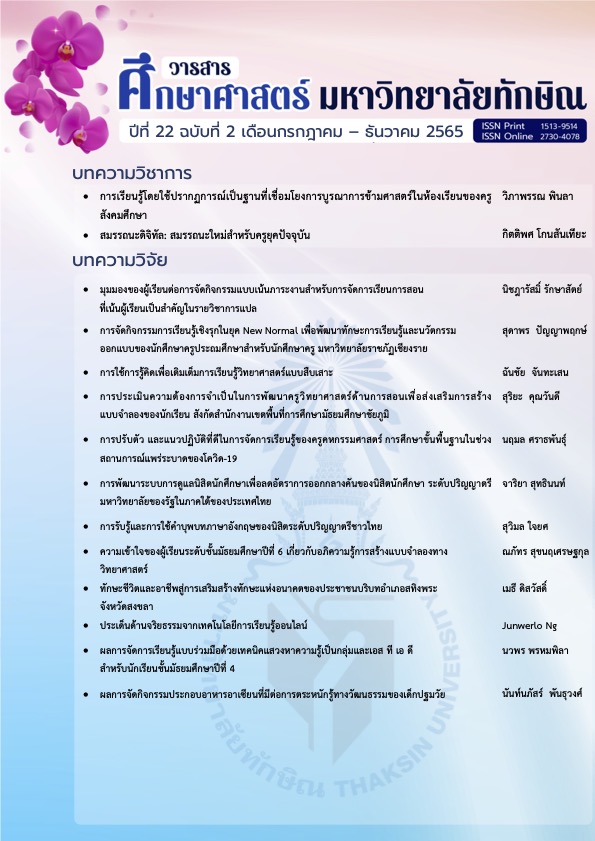
The Needs Assessment for Science Teachers Development in Teaching to Enhance Student’s Modelling under The Office of Chaiyaphum Secondary Educational Service Area
Article Sidebar
Main Article Content
Abstract
The purpose of this research was to investigate the current state, desirable state and compare the need assessment of science teachers at middle school and high school levels under The Office of Chaiyaphum Secondary Educational Service Area — science teachers' pedagogical development to enhance students' modelling. There were 90 sciences teachers for research participants. The research instrument was a rating scale questionnaire of 10 items, and the validity was checked by science education experts. Statistics were mean, standard deviation, and Modified Priority Needs Index; PNI.
The research findings were 1) the current state was at more levels and the desirable state was the most levels under the science teacher’s pedagogical development to enhance student's modelling, and 2) the middle school science teachers needed more than the high school science teachers in the pedagogical development to enhance students' modelling. The most need for science teachers’ pedagogical development is the actions that favor the expression and discussion of students' previous ideas.
Article Details

This work is licensed under a Creative Commons Attribution-NonCommercial-NoDerivatives 4.0 International License.
ในกรณีที่กองบรรณาธิการ หรือผู้เชี่ยวชาญ ซึ่งได้รับเชิญให้เป็นผู้ตรวจบทความวิจัย หรือ บทความทางวิชาการมีความเห็นว่าควรแก้ไขความบกพร่อง ทางกองบรรณาธิการจะส่งต้นฉบับให้ ผู้เขียนพิจารณาจัดการแก้ไขให้เหมาะสมก่อนที่จะลงพิมพ์ ทั้งนี้ กองบรรณาธิการจะยึดถือความคิด เห็นของผู้เชี่ยวชาญเป็นเกณฑ์
References
กระทรวงศึกษาธิการ. (2560). ตัวชี้วัดและสาระการเรียนรู้แกนกลาง กลุ่มสาระการเรียนรู้วิทยาศาสตร์ (ฉบับปรับปรุง พ.ศ. 2560) ตามหลักสูตรแกนกลางการศึกษาขั้นพื้นฐาน พุทธศักราช 2551. กรุงเทพฯ: โรงพิมพ์ชุมนุมสหกรณ์การเกษตรแห่งประเทศไทย จำกัด.
จันทร์ประภา แก้วสีขาว และ กาญจน์ เรืองมนตรี. (2563). การพัฒนาโปรแกรมเสริมสร้าง สมรรถนะการจัดการเรียนรู้ของครูโดยใช้กระบวนการสืบเสาะทางวิทยาศาสตร์ สังกัดสำนักงาน เขตพื้นที่การศึกษามัธยมศึกษา เขต 26. วารสารมหาจุฬานาครทรรศน์, 7(6),192-206.
ไฉไลศรี เพชรใต้ และ พชรวิทย์ จันทร์ศิริสิร. (2564). ความต้องการจำเป็นและแนวทางการส่งเสริมสมรรถนะการจัดการเรียนรู้ของครูประถมศึกษา สังกัดสำนักงานคณะกรรมการการศึกษาขั้นพื้นฐาน. วารสารชุมชนวิจัย, 15(4), 222-234.
นันทิยา ไชยมัชฌิม, อรนุช ศรีสะอาด และทัศน์ศิรินทร์ สว่างบุญ. (2557). การประเมินความต้องการจำเป็นในการพัฒนาสมรรถนะครูวิทยาศาสตร์ด้านการวัดและประเมินผลการคิดวิเคราะห์ ในโรงเรียนมัธยมศึกษาจังหวัดกาฬสินธุ์. วารสารการวัดผลการศึกษา มหาวิทยาลัยมหาสารคาม, 20(1),118-133.
น้ำฝน คูเจริญไพศาล. (2552). มาตรฐานสำหรับการเตรียมครูวิทยาศาสตร์ของประเทศสหรัฐอเมริกา. วารสารศรีนครินทรวิโรฒวิจัยและพัฒนา (สาขามนุษยศาสตร์และสังคมศาสตร์), 1(2), 24-30.
พัชราภร พูลบุญ และ ธีรพงษ์ แสงประดิษฐ์. (2564). การพัฒนารูปแบบการพัฒนาวิชาชีพครูเพื่อส่งเสริมความสามารถ ในการจัดการเรียนรู้วิทยาศาสตร์โดยใช้การโต้แย้งเชิงวิทยาศาสตร์ ของนักศึกษาครูวิทยาศาสตร์. วารสารสังคมศาสตร์และมานุษยวิทยาเชิงพุทธ, 6(3), 387-403.
ภรทิพย์ สุภัทรชัยวงศ์, ชาตรี ฝ่ายคำตา และพจนารถ สุวรรณรุจิ. (2558). การจัดการเรียนรู้โดยใช้แบบจำลองเป็นฐานเพื่อพัฒนาแบบจำลองทางความคิดเรื่อง โครงสร้างอะตอม และความเข้าใจธรรมชาติของแบบจำลองของนักเรียนชั้นมัธยมศึกษาปีที่ 4. วารสารนวัตกรรมการเรียนรู้ มหาวิทยาลัยวลัยลักษณ์, 1(1), 97-124.
ลฎาภา ลดาชาติและลือชา ลดาชาติ. (2560). มุมมองและความเข้าใจเกี่ยวกับแบบจำลองทางวิทยาศาสตร์ของครูวิทยาศาสตร์. วารสารการวิจัยเพื่อพัฒนาชุมชน (มนุษยศาสตร์และสังคมศาสตร์), 10(3), 149-162.
ลฎาภา ลดาชาติ. (2561). แบบจำลองกับการศึกษาวิทยาศาสตร์. วารสารมหาวิทยาลัยศิลปากร, 38 (4), 133-159.
ลฎาภา ลดาชาติ. (2562). การส่งเสริมความเข้าใจและการใช้แบบจำลองในการสอนวิทยาศาสตร์:กรณีศึกษากับครูวิทยาศาสตร์ประจำการ. วารสารศึกษาศาสตร์ มหาวิทยาลัยนเรศวร, 21(2), 271-284.
สถาบันทดสอบทางการศึกษาแห่งชาติ. (2564). สถิติ O-Net ย้อนหลัง. สืบค้นเมื่อ ธันวาคม 2564 จาก https://www.niets.or.th/th/catalog/view/3865.
สำนักงานเขตพื้นที่การศึกษามัธยมศึกษาชัยภูมิ. (2564). ผลการสอบ O-Net. สืบค้นเมื่อ ธันวาคม 2564 จาก https://www.sesao30.go.th/document.php?type=document&action=onet.
สุริยะ คุณวันดี และร่มเกล้า อาจเดช. (2560). Modelling-based Teaching: A Strategy to Enhance Students’ Understanding of Model in Science. Proceeding of The National and International Graduate Research Conference 2017. 1662-1669.
สุวิมล ว่องวานิช. (2562). การวิจัยประเมินความต้องการจำเป็น. กรุงเทพฯ :สำนักพิมพ์จุฬาลงกรณ์มหาวิทยาลัย.
Bamberger, Y.M., & Davis, E.A. (2013). Middle-school science students’ scientific modelling performances across content areas and within a learning progression. International Journal of Science Education, 35(2), 213-238.
Chittleborough, G.D., & Treagust, D.F. (2009). Why models are advantageous to learning science. Educación química, 20(1), 12-17.
Justi, R.S., & Gilbert, J.K. (2002). Modelling, teachers' views on the nature of modelling, and implications for the education of modellers. International Journal of Science Education, 24(4), 369-387.
Justi, R., Costa, P. P., & Mozzer, N. B. (2011). Key teacher’s roles in supporting the co-construction of students’ knowledge in modeling-based teaching contexts. In ESERA 2011 Conference Proceedings: Nature of science, History, Philosophy, Sociology of Science. (pp. 57-63).
Krell, M., & Krüger, D. (2017). University students’ meta-modelling knowledge. Research in Science & Technological Education, 35(3), 261-273.
Next generation science standard [NGSS]. (2013). Read the Standards. Retrieved Nov 2021 from https://www.nextgenscience.org/search-standards.
Podungge, R., Rahayu, M., Setiawan, M., & Sudiro, A. (2020, June). Teacher Competence and Student Academic Achievement. In 23rd Asian Forum of Business Education (AFBE 2019) (pp. 69-74). Atlantis Press.
Praisri, A., & Faikhamta, C. (2020). Enhancing Students’ Mental Models of Chemical Equilibrium Through Argumentation within Model-based Learning. International Journal of Learning, Teaching and Educational Research, 19(7), 121-142.
Schwarz, C.V., Reiser, B.J., Davis, E.A., Kenyon, L., Achér, A., Fortus, D., & Krajcik, J. (2009). Developing a learning progression for scientific modeling: Making scientific modeling accessible and meaningful for learners. Journal of Research in Science Teaching, 46(6), 632-654.
