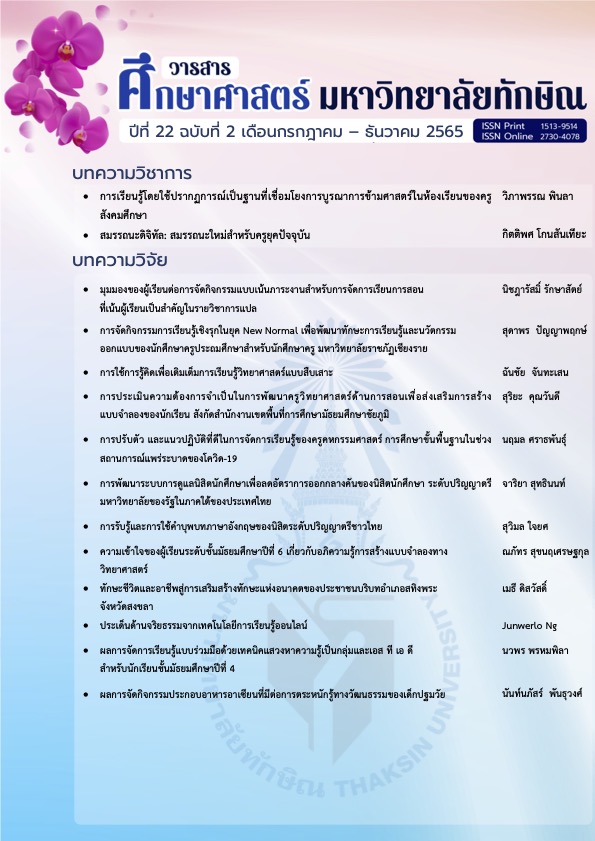
การใช้การรู้คิดเพื่อเติมเต็มการเรียนรู้วิทยาศาสตร์แบบสืบเสาะ
Article Sidebar
Main Article Content
บทคัดย่อ
การเรียนรู้แบบสืบเสาะ เป็นยุทธวิธีในการจัดการเรียนการรู้ที่เน้นผู้เรียนเป็นสำคัญ ให้ผู้เรียนได้สร้างความรู้ด้วยตนเอง เป็นวิธีการจัดการเรียนรู้ที่ครูวิทยาศาสตร์นิยมใช้ แต่ปัญหาในการจัดการเรียนรู้วิทยาศาสตร์ เกิดจากการที่นักเรียนมีแนวความคิดเดิมอยู่ก่อนแล้ว และส่วนมากแตกต่างไปจากแนวความคิดของนักวิทยาศาสตร์ เป็นสิ่งขัดขวางการเรียนรู้อย่างมีความหมาย และยากที่จะแก้ไขเปลี่ยนแปลง นอกไปจากนั้นในระหว่างทำการทดลอง นักเรียนทำการทดลองอย่างไม่มีเป้าหมาย ไม่รู้ว่าทำการทดลองไปเพื่ออะไร ซึ่งทำให้นักเรียนไม่ได้รับประสบการณ์เช่นเดียวกับที่นักวิทยาศาสตร์ได้รับ การรู้คิดน่าจะเป็นเทคนิคหนึ่งที่ช่วยในการจัดการเรียนรู้วิทยาศาสตร์ให้บรรลุเป้าหมาย การรู้คิด เป็นความสามารถในการตรวจสอบการคิดของตนเอง รู้และเข้าใจว่าตัวเองรู้อะไร และไม่รู้อะไร ดังนั้นหากบุคคลใดมีการรับรู้และเข้าใจอย่างชัดเจนในการรู้คิดของตนเองหรือการมีความตระหนักรู้ในการรู้คิดอยู่ในตนเอง ก็จะสามารถกำกับตนเองให้ไปสู่เป้าหมายได้ ในบทความนี้ จะแสดงให้เห็นถึงความสำคัญของการรู้คิดที่จะช่วยเติมเต็มในการจัดการเรียนรู้วิทยาศาสตร์ด้วยรูปแบบการจัดการเรียนรู้แบบสืบเสาะ ซึ่งการรู้คิดช่วยในการพัฒนาการเรียนวิทยาศาสตร์ และเป็นประโยชน์ในเรื่องประสิทธิภาพในการรับรู้และการเข้าใจ การรู้คิดยังสามารถประยุกต์และขยายแนวความคิดและเพิ่มทักษะความคิดที่ยาก ๆ ได้
Article Details

อนุญาตภายใต้เงื่อนไข Creative Commons Attribution-NonCommercial-NoDerivatives 4.0 International License.
ในกรณีที่กองบรรณาธิการ หรือผู้เชี่ยวชาญ ซึ่งได้รับเชิญให้เป็นผู้ตรวจบทความวิจัย หรือ บทความทางวิชาการมีความเห็นว่าควรแก้ไขความบกพร่อง ทางกองบรรณาธิการจะส่งต้นฉบับให้ ผู้เขียนพิจารณาจัดการแก้ไขให้เหมาะสมก่อนที่จะลงพิมพ์ ทั้งนี้ กองบรรณาธิการจะยึดถือความคิด เห็นของผู้เชี่ยวชาญเป็นเกณฑ์
เอกสารอ้างอิง
กรมวิชาการ. (2545). หลักสูตรการศึกษาขั้นพื้นฐานพุทธศักราช. พิมพ์ครั้งที่ 2. กรุงเทพฯ: กระทรวงศึกษาธิการ.
ไพฑูรย์ สุขศรีงาม. (2545). ความเข้าใจเกี่ยวกับการสอนแบบสืบเสาะ. มหาสารคาม: มหาวิทยาลัยมหาสารคาม.
ไพฑูรย์ สุขศรีงาม. (2540). ทักษะกระบวนการทางวิทยาศาสตร์ขั้นพื้นฐานและเจตคติเชิงวิทยาศาสตร์ของนักเรียนระดับมัธยมศึกษาตอนต้นสังกัดสำนักงานคณะกรรมการการประถมศึกษาแห่งชาติในภาคตะวันออกเฉียงเหนือ. (รายงานการวิจัย). มหาสารคาม: คณะวิทยาศาสตร์ มหาวิทยาลัยมหาสารคาม.
ไพฑูรย์ สุขศรีงาม. (2531). ความรู้เกี่ยวกับการสอนแบบสืบเสาะ (Inquiry). มหาวิทยาลัยศรีนครินทรวิโรฒมหาสารคาม, 7(1), 58-78.
ภพ เลาหไพบูลย์. (2534). แนวการสอนวิทยาศาสตร์. กรุงเทพฯ: ไทยวัฒนาพานิช.
ลือชา ลดาชาติ และกาญจนา มหาลี. (2559). ความเข้าใจเกี่ยวกับธรรมชาติของการสืบเสาะทางวิทยาศาสตร์ของนักเรียน ชั้นมัธยมศึกษาตอนต้น. วารสารหน่วยวิจัยวิทยาศาสตร์เทคโนโลยี และสิ่งแวดล้อมเพื่อการเรียนรู้, 7(2), 298-324.
Barman, C. (1997). The Learning Cycle Revised: A Modification an Effective Teaching Model Monograph 6. Washington D.C.: Council for Elementary Science International.
Beeth, M.E. (1998). Teaching for Conceptual Change: Using Status as a Metacognitive Tool. Science Education, 82(3), 343-350.
Blank, L.M. (2000). A Metacognitive Learning Cycle: A Better Warranty for Student Understanding?. Science Education, 84(4), 486-516.
Bybee, R.W. (1997). Achieving Scientific Literacy: From Purpose to Practices. Portsmouth, New Hampshire: Heinemann.
Bybee, R.W. and others. (1991). Integrating the History and Nature of Science and Technology in Science and Social Studies Curriculum. Science Education, 75(1), 143-155.
Council, N. (2000). Inquiry and the National Science Education Standards: A Guide for Teaching and Learning. Washington D.C.: National Academy Press.
Flavell, J.H. (1979). Metacognition and Cognitive Monitoring: A New Area of Cognitive Developmental Inquiry. American Psychologies, 34(10), 906-911.
Gordon, J. (1996). Tracks for Learning: Metacognition and Learning Technologies. Australian Journal of Educational Technology, 12(1), 65-85.
Magoon, A.J. (1977). Constructivist Approaches in Educational Research. Reviews of Educational Research, 47(4), 651-693.
Mittlefehldt, S., and Grotzer, T. (2003). Using metacognition to facilitate the transfer of causal models in learning density and pressure. Paper presented at the National Association of Research in Science Teaching Conference.
Nickerson, R., Perkins, D. N., and Smith, E. E. (1985). The Teaching of Thinking. Hillsdale, New Jersey: Lawrence Erlbaum Associates.
Osborne, R. J., and Wittrock, M. C. (1983). Learning Science: A Generative Process. Science Education, 67(4), 489-508.
Paris, S. G., & Winograd, P. (1990). How metacognition can promote academic learning and instruction. In Dimensions of thinking and cognitive instruction., eds. B. F. Jones and L. Idol, (pp. 15–51). Hillsdale, NJ: Erlbaum.
Posner, B., and others. (1982). Accommodation of a Scientific Conception, Toward a Theory of Conceptual Change. Science Education, 66(2), 211-227.
Renner, J. W., and Phillips, D. G. (1980). Piagetian Development Model: A Basic for research in Science Education. School Science and Mathematics, 80(1), 193-199.
Tafoya, E., Sunal, D. W., and Knecht, P. (1980). Assessing Inquiry Potential: A Tool for Curriculum Decision Making. School Science and Mathematics, 80(1), 43-48.
