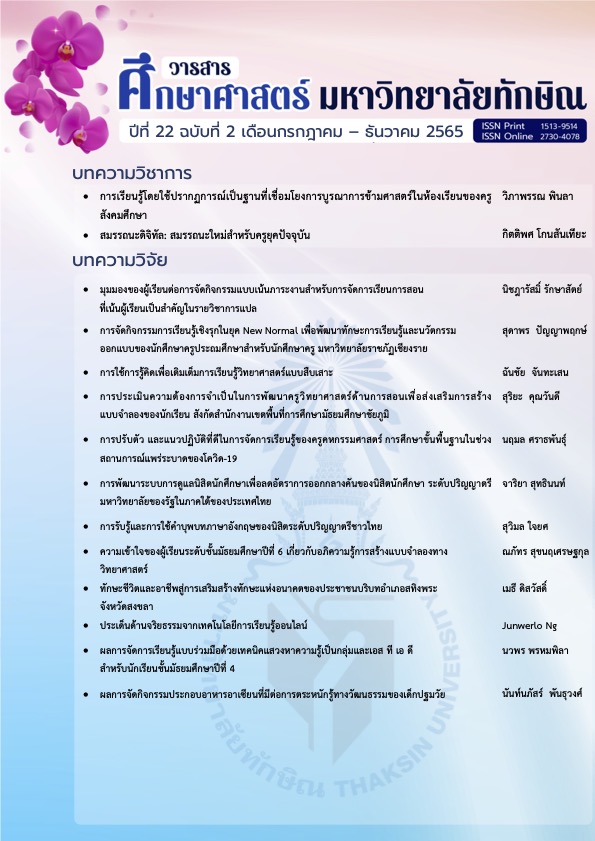
Active Learning Activities in the New Normal Era to Develop Learning and Innovation Skills for Student Teachers of Chiang Rai Rajabhat University
Article Sidebar
Main Article Content
Abstract
This research aimed to develop active learning activities in the new normal era and to develop learning and innovation skills of Chiang Rai Rajabhat University students by using active learning activities in the new normal era. The sample group was 25 Social Studies major students in the fourth year who studied in ESS 4801 Social Studies learning management in the primary level course. The sample group was from the simple random sampling. The research instruments were 1) A course syllabus of ESS 4801 Social Studies learning management in the primary level course taught by active learning, 2) An observation form of learning and innovation skills with 4 skills. The data were analyzed by using mean (), standard deviation (S.D.) and content analysis. The findings appeared that four steps of the active learning activities to develop learning and innovation skills of Chiang Rai Rajabhat students in the new normal era consisted of 1) Readiness survey 2) Thinking encouragement 3) Knowledge construction 4) Knowledge sharing 5) Reflection and application. The active learning activities was also integrated with other learning activities systems such as Google classroom, other applications and digital tools. After using active learning activities in the new normal era, the students’ learning and innovation skills were at a high level (=4.28). When considered in each skill, it was found that every skill was at a high level. The mean of collaboration skill was the highest (=4.38), the communication skill (=4.20), and critical thinking and problem solving skills ( =4.14) were ranked respectively, while the mean of creativity and innovation skills were the lowest (=4.13).
Article Details

This work is licensed under a Creative Commons Attribution-NonCommercial-NoDerivatives 4.0 International License.
ในกรณีที่กองบรรณาธิการ หรือผู้เชี่ยวชาญ ซึ่งได้รับเชิญให้เป็นผู้ตรวจบทความวิจัย หรือ บทความทางวิชาการมีความเห็นว่าควรแก้ไขความบกพร่อง ทางกองบรรณาธิการจะส่งต้นฉบับให้ ผู้เขียนพิจารณาจัดการแก้ไขให้เหมาะสมก่อนที่จะลงพิมพ์ ทั้งนี้ กองบรรณาธิการจะยึดถือความคิด เห็นของผู้เชี่ยวชาญเป็นเกณฑ์
References
กองทุนเพื่อความเสมอภาคทางการศึกษา. (2563). บทความ“ผศ.อรรถพล” เปิดโมเดล “Remote Learning” ปรับการเรียนการสอนรับ COVID-19. ออนไลน์จาก https://www.eef.or.th/93-2/. สืบค้นเมื่อวันที่ 20 พฤษภาคม 2564.
บัณฑิกา จารุมา และพะยอม ก้อนในเมือง. (2563). วิธีพัฒนาทักษะการสื่อสารที่มีประสิทธิภาพ. วารสาร มจร. มนุษยศาสตร์ปริทรรศน์, 8(1), 433-428.
บุปผชาติ ทัฬหิกรณ์. (2551). การประยุกต์ใช้เทคโนโลยีสารสนเทศในการเรียนการสอน. กรุงเทพฯ: โครงการเทคโนโลยีสารสนเทศตามพระราชดำริ สมเด็จพระเทพรัตนราชสุดาฯ สยามบรมราช กุมารี ศูนย์เทคโนโลยีอิเล็กทรอนิกส์และคอมพิวเตอร์แห่งชาติ.
พรทิพย์ วงศ์ไพบูลย์. (2560). การเรียนรู้เชิงรุกและการมีส่วนร่วมของผู้เรียน (Active learning). วารสารสถาบันวิจัยญาณสังวร มหาวิทยาลัยมหามกุฏราชวิทยาลัย, 8(2), 327-336.
พิมพันธ์ เดชะคุปต์. (2561). ทักษะ 7C ของครู 4.0. (พิมพ์ครั้งที่ 4). กรุงเทพฯ: โรงพิมพ์แห่งจุฬาลงกรณ์มหาวิทยาลัย.
นพพร ธนะชัยขันธ์. (2552). สถิติการวิจัยฉบับเสริมการวิเคราะห์ข้อมูลด้วย Microsoft Excel. เชียงราย : คณะวิทยาศาสตร์และเทคโนโลยี มหาวิทยาลัยราชภัฏเชียงราย.
นภมณฑล สิบหมื่นเปี่ยม. (2550). สังคมแห่งการเรียนรู้. วารสารการศึกษาไทย, 4(35), 31-37.
ราชบัณฑิตยสถาน. (2555). พจนานุกรมศัพท์ศึกษาศาสตร์ ฉบับราชบัณฑิตยสถาน. กรุงเทพฯ : ราชบัณฑิตยสถาน.
เยาวเรศ ภักดีจิตร. (2557). เอกสารประกอบการเสวนาทางวิชาการ “วันส่งเสริมวิชาการสู่คุณภาพการเรียนการสอน” วันที่ 30 กรกฎาคม 2557 ณ หอประชุมมหาวิทยาลัยราชภัฏนครสวรรค์.
วิชัย วงษ์ใหญ่ และมารุต พัฒผล. (2562). การพัฒนาทักษะสร้างสรรค์นวัตกรรม. กรุงเทพฯ : ศูนย์ผู้นำนวัตกรรม หลักสูตรและการเรียนรู้.
วัชรา เล่าเรียนดี ปรณัฐ กิจรุ่งเรือง และอรพิณ ศิริสัมพันธ์. (2560). กลยุทธ์การจัดการเรียนรู้เชิงรุกเพื่อพัฒนาการคิด และยกระดับคุณภาพการศึกษาสำหรับศตวรรษที่ 21. นครปฐม : เพชรเกษมพริ้นติ้ง กรุ๊ป จำกัด.
สาวิตรี โรจนะสมิต อาร์โนลด์. (2555). รายงานการวิจัยเพื่อพัฒนาการเรียนการสอน เรื่อง การจัดการเรียนรู้ด้วยวิธีการ เรียนเชิงรุกเพื่อพัฒนาพฤติกรรมการเรียนรู้และแนวคิดเกี่ยวกับการจัดการเรียนรู้ของนักศึกษา มหาวิทยาลัยราช ภัฏพระนคร. วิทยาลัยการฝึกหัดครู มหาวิทยาลัยราชภัฏพระนคร.
สำนักงานคณะกรรมการการอุดมศึกษา. (2561). แผนอุดมศึกษาระยะยาว 20 ปี พ.ศ. 2561 – 2580. กรุงเทพฯ : บริษัท พริกหวานกราฟฟิค จำกัด.
สุคนธ์ สินธพานนท์. (2560). ครูยุคใหม่กับการจัดการเรียนรู้ สู่การศึกษา 4.0. กรุงเทพฯ : ศูนย์หนังสือจุฬาลงกรณ์ มหาวิทยาลัย.
สุคนธ์ สินธพานนท์, วรรัตน์ วรรณเลิศลักษณ์ และพรรณี สินธพานนท์. (2552). พัฒนาทักษะการคิด? พิชิตการสอน. พิมพ์ครั้งที่ 4. กรุงเทพฯ : ศูนย์หนังสือจุฬาลงกรณ์มหาวิทยาลัย.
Bill, P. (2010). Three Principles of Effective Online Pedagogy. J Asynchronous Learn Networks, 14(1), 103-116.
Mckinney, S. E. (2008). Developing Teachers for High-Poverty Schools : The Role of the Internship Experience. Urban Education. 43(1), 68-82. Online from http://www.eric.ed.gor. Retrieved on May 2, 2021.
Partnership for 21st Century Skills. (2019). Framework for 21st Century Learning Definitions. Online from http://static.battelleforkids.org/documents/p21/P21_Framework_DefinitionsBFK.pdf. Retrieved on May 10, 2021.
World Health Organization. (2021). Timeline: WHO's COVID-19 response. Online from https://www.who.int/emergencies/diseases/novel-coronavirus-2019/interactive-timeline#event- 72 Retrieved on May 20, 2021.
