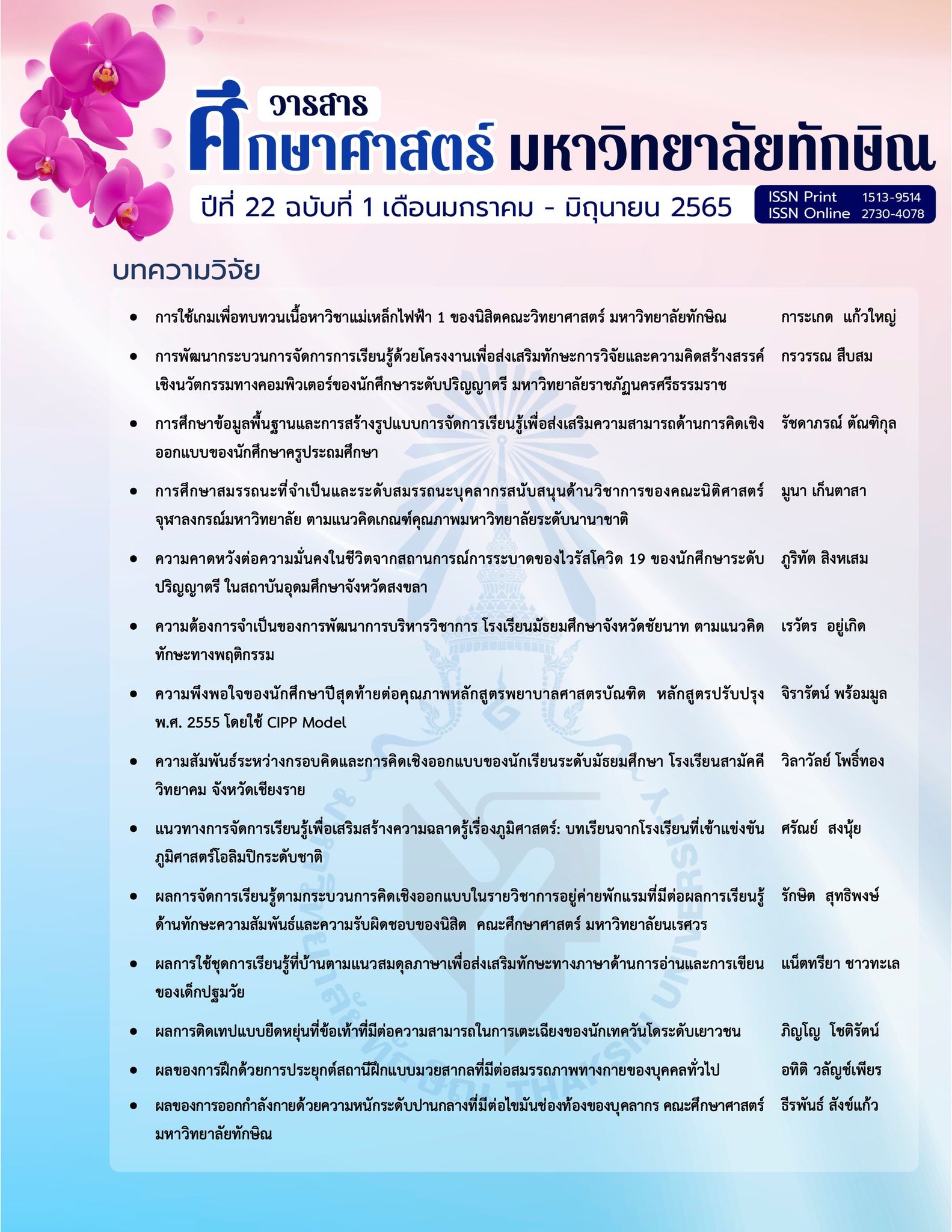
ความสัมพันธ์ระหว่างกรอบคิดและการคิดเชิงออกแบบของนักเรียนระดับมัธยมศึกษา โรงเรียนสามัคคีวิทยาคม จังหวัดเชียงราย
Article Sidebar
Main Article Content
บทคัดย่อ
การคิดเชิงออกแบบเป็นกระบวนการที่ใช้ในการออกแบบและแก้ปัญหาของผู้อื่น ซึ่งเป็นกระบวนการที่ต้องทำซ้ำอย่างต่อเนื่อง นักคิดเชิงออกแบบจึงต้องมีความอดทนต่อความคลุมเครือ และความเสี่ยงกับผลลัพธ์ที่อาจไม่เป็นไปตามที่คาดหวังไว้ คุณลักษณะนี้สอดคล้องกับชุดความคิดเติบโตที่เชื่อว่าทุกคนสามารถเปลี่ยนแปลงและเติบโตได้ด้วยความพยายามและประสบการณ์ งานวิจัยนี้จึงมีวัตถุประสงค์เพื่อศึกษากรอบคิด การคิดเชิงออกแบบ และความสัมพันธ์ระหว่างกรอบคิดและการคิดเชิงออกแบบของนักเรียนระดับมัธยมศึกษา โรงเรียนสามัคคีวิทยาคม กลุ่มเป้าหมายคือนักเรียนระดับมัธยมศึกษาที่ตอบแบบสอบถามกลับคืนทั้งสิ้น 475 ฉบับ ผลการวิจัยพบว่า ไม่มีนักเรียนที่มีชุดความคิดจำกัด ด้านการคิดเชิงออกแบบ พบว่า นักเรียนส่วนใหญ่เห็นว่าตนเองมีการคิดเชิงออกแบบ โดยเฉพาะอย่างยิ่งด้านการทำงานร่วมกันเป็นทีมกับสมาชิกที่มีความแตกต่างกันในด้านต่าง ๆ สิ่งที่นักเรียนมีน้อยที่สุดคือ การแก้ปัญหาที่ให้ผลลัพธ์ไม่เป็นไปตามที่คาดหวัง ด้านความสัมพันธ์ระหว่างกรอบคิดและการคิดเชิงออกแบบ พบว่า การคิดเชิงออกแบบทุกด้านมีความสัมพันธ์กันกับกรอบคิด ยกเว้นด้านความสบายใจกับความไม่แน่นอนและความเสี่ยง ภาพรวมมีความสัมพันธ์กันอยู่ในระดับน้อย โดยมีนัยสำคัญทางสถิติที่ระดับ .01 และ .05 และพบว่า ข้อคำถามที่เป็นชุดความคิดเติบโตมีความสัมพันธ์กับการคิดเชิงออกแบบทุกด้าน ส่วนข้อคำถามที่เป็นชุดความคิดจำกัด พบว่า ไม่มีความสัมพันธ์กับการคิดเชิงออกแบบ และมีความสัมพันธ์ทางลบกับการคิดเชิงออกแบบในบางด้าน
Article Details

อนุญาตภายใต้เงื่อนไข Creative Commons Attribution-NonCommercial-NoDerivatives 4.0 International License.
ในกรณีที่กองบรรณาธิการ หรือผู้เชี่ยวชาญ ซึ่งได้รับเชิญให้เป็นผู้ตรวจบทความวิจัย หรือ บทความทางวิชาการมีความเห็นว่าควรแก้ไขความบกพร่อง ทางกองบรรณาธิการจะส่งต้นฉบับให้ ผู้เขียนพิจารณาจัดการแก้ไขให้เหมาะสมก่อนที่จะลงพิมพ์ ทั้งนี้ กองบรรณาธิการจะยึดถือความคิด เห็นของผู้เชี่ยวชาญเป็นเกณฑ์
เอกสารอ้างอิง
แครอล เอส ดเว็ค. (2561). Mindset ใช้กรอบความคิดเอาชนะโชคชะตา [Mindset] (พรรณี ชูจิรวงศ์, ผู้แปล). กรุงเทพฯ: วีเลิร์น.
จารุวัจน์ สองเมือง และอภิรักษ์ โต๊ะตาหยง. (2564). แนวทางประยุกต์การคิดเชิงออกแบบเพื่อสร้างการเปลี่ยนแปลงในสถานศึกษา. Journal of Information and Learning [JIL], 32(1). 52-57.
มิลินทรา กวินกมลโรจน์. (2557). การวิจัยและพัฒนากระบวนการชี้แนะที่อิงทฤษฎีการเรียนรู้สู่การเปลี่ยนแปลงเพื่อปรับชุดความคิดด้านการจัดการเรียนการสอนของครูประถมศึกษา. ปริญญาครุศาสตรดุษฎีบัณฑิต, สาขาวิชาหลักสูตรและการสอน, คณะครุศาสตร์ จุฬาลงกรณ์มหาวิทยาลัย. กรุงเทพฯ.
บุญศรี พรหมมาพันธุ์. (2561). เทคนิคการแปลผลการวิเคราะห์ข้อมูลสำหรับการใช้สหสัมพันธ์และการถดถอยในการวิจัย. วารสารศึกษาศาสตร์ มสธ., 11(1). 32-45.
พฤทธิ์ ศิริบรรณพิทักษ์. (2564). แบบสอบถามกรอบความคิด. สืบค้น 28 มิถุนายน 2564, จากhttps://online.pubhtml5.com/rzma/vifz/#p=1
ราชกิจจานุเบกษา. (2561). ประกาศเรื่อง ยุทธศาสตร์ชาติ (พ.ศ.2561-2580). สืบค้น 16 กรกฎาคม 2564, จาก http://www.ratchakitcha.soc.go.th/DATA/PDF/2561/A/082/T_0001.PDF
ลฎาภา ลดาชาติ และลือชา ลดาชาติ. (2563). โปรดใช้ความระมัดระวังขณะสอนวิทยาศาสตร์โดยการออกแบบ. วารสารเทคโนโลยีสุรนารี Suranaree Journal of Social Science, 14(2). 118-132.
สิทธิชัย ทองวร. (2562). ความสัมพันธ์ระหว่างชุดความคิดกับความเชื่อเชิงชดเชยในการควบคุมน้ำหนัก. วารสารสมาคมจิตแพทย์แห่งประเทศไทย, 64(3), 271-282.
Apedoe, X. S., Reynolds, B., Ellefson, M. R., & Schunn, C. D. (2008). Bringing engineering design into high school science classrooms: The heating/cooling unit. Journal of Science Education and Technology, 17(5), 454-465.
Ellefson, M. R., Brinker, R. A., Vernacchio, V. J., & Schunn, C. D. (2008). Design-based learning for biology: Genetic engineering experience improves understanding of gene expression. Biochemistry and Molecular Biology Education, 36(4), 292-298.
Dym, C. L., Agogino, A. M., Eris, O., Frey, D. D., & Leifer, L. J. (2005). Engineering design thinking, teaching, and learning. Journal of Engineering Education, 94(1), 103-120.
Fortus, D., Dershimer, R. C., Krajcik, J., Marx, R. W., & Mamlok-Naaman, R. (2004). Design-based science and student learning. Journal of Research in Science Teaching, 41(10), 1018-1110.
Hinkle, D.E, William ,W. and Stephen G. J. (1998). Applied Statistics for the Behavior Sciences. 4th ed. New York: Houghton Mifflin.
Huiping Wu & Shing-On Leung. (2017). Can Likert Scales be Treated as Interval Scales?—A Simulation Study, Journal of Social Service Research, 43:4, 527-532, DOI: 10.1080/01488376.2017.1329775
Kenneth J. Reid and Daniel M. Ferguson. (2014). Do design experiences in engineering build a “growth mindset” in students?. Retrieved 12 July 2021, form https://ieeexplore.ieee.org/stamp/stamp.jsp?arnumber=6891046
Kolodner, J. L., Camp, P. J., Crismond, C. D., Fasse, B., Gray, J., Holbrook, J., Puntambekar, S., & Ryan, M. (2003). Problem-based learning meets case-based reasoning in the middle-school science classroom: Putting learning by designTM into practice. The Journal of the Learning Sciences, 12(4), 495-547.
Krejcie, R. V., & Morgan, D. W. (1970). Determining sample size for research activities. Educational and Psychological Measurement, 30(03), 608.
Ladachart, L., Cholsin, J., Kwanpet, S., Teerapanpong, R., Dessi, A., Phuangsuwan, L., and Phothong, W. (2021). Ninth-grade students’ perceptions on the design-thinking mindset in the context of reverse engineering. International Journal of Technology and Design Education. https://doi.org/10.1007/s10798-021-09701-6
Leigh Thompson & David Schonthal. (2020). The Social psychology of design thinking. California Management Review, 62(2), 84–99. https://doi.org/10.1177/0008125619897636
Pleasants, J. & Olson, J. K. (2019). What is engineering? Elaborating the nature of engineering for K-12 education. Science Education, 103(1), 145-166.
Quinn, C. M., Reid, J. W., & Gardner, G. E. (2020). S + T + M = E as a convergent model for the nature of STEM. Science and Education, 29(4), 881-898.
Schweitzer, J., Groeger, L., & Sobel, L. (2016). The design thinking mindset: An assessment of what we know and what we see in practice. Journal of Design, Business and Society, 2(2), 71-94.
Sung, E. & Kelly, T. R. (2019). Identifying design process patterns: A sequential analysis study of design thinking. International Journal of Technology and Design Education, 29(2), 283-302.
Susannah Bedford. (2017). Growth mindset and motivation: a study into secondary school science learning, Research Papers in Education, 32:4, 424-443, DOI: 10.1080/02671522.2017.1318809
Vongkulluksn, V. W., Matewos, A. M., & Sinatra, G. M. (2021). Growth mindset development in design-based makerspace: a longitudinal study. The Journal of Educational Research, 114(2), 139–154. doi:10.1080/00220671.2021.1872473
Yeager, D. S., Romero, C., Paunesku, D., Hulleman, C. S., Schneider, B., Hinojosa, C., Lee, H. Y., O'Brien, J., Flint, K., Roberts, A., Trott, J., Greene, D., Walton, G. M., & Dweck, C. S. (2016). Using design thinking to improve psychological interventions: The case of the growth mindset during the transition to high school. Journal of Educational Psychology, 108(3), 374–391. https://doi.org/10.1037/edu0000098
