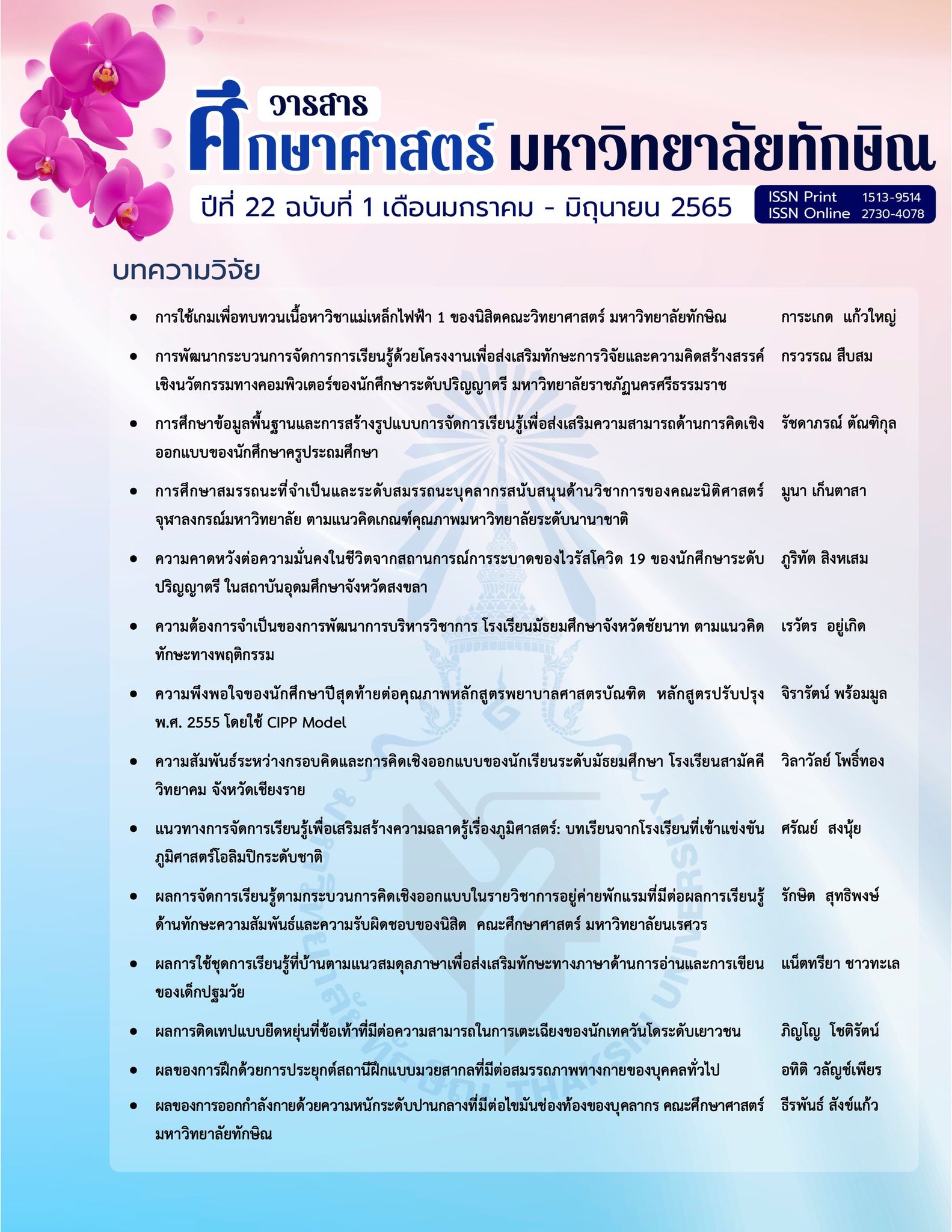
The Needs Assessment for Developing Academic Management of Secondary Schools in Chainat Province Based on The Concept of Non-Cognitive Skills
Article Sidebar
Main Article Content
Abstract
The purpose of this research were to study the level of current states, desirable states and needs assessment for developing academic management of secondary schools in Chainat province based on the concept of non-cognitive skills. The population is 13 secondary schools in Chainat province under the secondary educational service area office Uthaithani Chainat. The total research informants was 226 informants including 11 school directors, 10 deputy directors and 205 teachers. The research instrument was 5-rating-scale questionnaire. The data were analyzed by mean and Modified Priority Needs Index (PNImodified).
The research found that: Current states and desirable states for developing academic management of secondary schools in Chainat province based on the concept of non-cognitive skills were at the medium level (Mean = 3.413) and the highest level (Mean = 4.688). The first priority needed for academic management was developing a school curriculum (PNImodified = 0.383). Also, the highest needed component of non-cognitive skills is emotional stability (PNImodified = 0.408). The second priority needed for academic management was developing students’ learning process (PNImodified = 0.379). Also, the highest needed component of non-cognitive skills is emotional stability (PNImodified = 0.409). The third priority needed of academic management was measurement and evaluation (PNImodified = 0.363). Also, the highest needed component of non-cognitive skills is emotional stability (PNImodified = 0.391). The school can use findings to gear up the academic management for developing school curriculum, students’ learning process, measurement and evaluation to support non-cognitive skills to suit with students’ learning.
Article Details

This work is licensed under a Creative Commons Attribution-NonCommercial-NoDerivatives 4.0 International License.
ในกรณีที่กองบรรณาธิการ หรือผู้เชี่ยวชาญ ซึ่งได้รับเชิญให้เป็นผู้ตรวจบทความวิจัย หรือ บทความทางวิชาการมีความเห็นว่าควรแก้ไขความบกพร่อง ทางกองบรรณาธิการจะส่งต้นฉบับให้ ผู้เขียนพิจารณาจัดการแก้ไขให้เหมาะสมก่อนที่จะลงพิมพ์ ทั้งนี้ กองบรรณาธิการจะยึดถือความคิด เห็นของผู้เชี่ยวชาญเป็นเกณฑ์
References
กานต์ธีรา ภูริวิกรัย. (2563). การศึกษาโลกในศตวรรษที่ 21 : ระบบยังเหลื่อมล้ำ การเรียนรู้ยังวิกฤต. ค้นจาก https://www.the101.world/global-education/
เครือข่ายส่งเสริมประสิทธิภาพการจัดการมัธยมศึกษา จังหวัดชัยนาท. (2560). ผลการประเมินมาตรฐานการ ปฏิบัติงาน 2560. ค้นจาก https://sites.google.com/a/chainatpit.ac.th
จงรักษ์ หงส์งาม. (2555). ผลกระทบของทักษะทางปัญญาและทักษะทางบุคลิกลักษณะต่อรายได้ กรณีศึกษา จังหวัดขอนแก่น ประเทศไทย. วารสารเศรษฐศาสตร์ปริทรรศน์ สถาบันพัฒนาศาสตร์. 6(2). 1-22.
จักรกฤษณ์ สิริริน. (2563). Non-Cognitive Skills แนวคิดใหม่ในการบริหารการศึกษา. ค้นจาก https://www.salika.co/2020/03/03/non-cognitive-skills-part-2/
ประอร สุนทรวิภาต. (2546). การวัดและประเมินผลการศึกษา: หนึ่งในดัชนีชี้วัดคุณภาพการศึกษาโรงเรียนนาย เรือ. วารสารโรงเรียนนายเรือ. 3(2). 49 - 55.
ปรียาพร วงศ์อนุตรโรจน์. (2543). การบริหารงานวิชาการ. กรุงเทพมหานคร : ศูนย์สื่อเสริมกรุงเทพ.
พระราชบัญญัติการศึกษาแห่งชาติ. (2542/19/8). ราชกิจจานุเบกษา. เล่มที่ 116 ตอนที่74ก. 1 – 23.
พิมพันธ์ เดชะคุปต์ และ พเยาว์ ยินดีสุข. (2560). ทักษะ 7C ของครู 4.0. กรุงเทพมหานคร: โรงพิมพ์แห่งจุฬาลงกรณ์มหาวิทยาลัย.
พิริยะ ผลพิรุฬห์ และปังปอนด์ รักอำนวยกิจ. (2558). ทุนมนุษย์กับผลิตภาพแรงงานในภาคอุตสาหกรรมไทย. กรุงเทพมหานคร : สำนักงานกองทุนสนับสนุนการวิจัย.
ยงยุทธ วงศ์ภิรมย์ศานติ และคณะ. (2553). การอบรมสร้างทีมวิทยากรการสอนเจตคติและทักษะเพื่อป้องกันโรค เอดส์ในกลุ่มวัยรุ่น. นนทบุรี: กรมสุขภาพจิต กระทรวงสาธารณสุข.
รุ่งชัชดาพร เวหะชาติ. (2550). การบริหารงานวิชาการสถานศึกษาขั้นพื้นฐาน. สงขลา: มหาวิทยาลัยทักษิณ.
วรรณี แกมเกตุ. (2555). วิธีวิทยาการวิจัยทางพฤติกรรมศาสตร์ (พิมพ์ครั้งที่ 3). กรุงเทพมหานคร: โรงพิมพ์แห่งจุฬาลงกรณ์มหาวิทยาลัย.
วิจารณ์ พาณิช. (2556). การสร้างการเรียนรู้สู่ศตวรรษที่ 21 (พิมพ์ครั้งที่ 1). กรุงเทพมหานคร: ส.เจริญการพิมพ์.
ศศิธร เห็นงาม. (2557). ปัจจัยด้านทักษะของแรงงานที่ส่งผลต่อรายได้ของแรงงานในสถานประกอบการขนาด กลางและขนาดย่อมในเขตอำเภอเมือง จังหวัดขอนแก่น. วารสารเศรษฐศาสตร์และกลยุทธ์การจัดการ. 1(2). 52-62.
สารินทร์ เอี่ยมครอง. (2561). แนวทางการบริหารวิชาการของสถานศึกษาในจังหวัดชัยนาท สังกัดสำนักงานเขต พื้นที่การศึกษามัธยมศึกษา เขต 5. วิทยานิพนธ์ครุศาสตรมหาบัณฑิต สาขาวิชาบริหารการศึกษา คณะครุศาสตร์ มหาวิทยาลัยราชภัฏนครสวรรค์, นครสวรรค์.
สิทธิพร นิยมศรีสมศักดิ์. (2555). การพัฒนาโรงเรียนให้เป็นองค์กรแห่งการเรียนรู้:แนวปฏิบัติที่เป็นรูปธรรม. สืบค้นจาก https://journal.oas.psu.ac.th/index.php/asj/article
สำนักบริหารงานการมัธยมศึกษาตอนปลาย สำนักงานคณะกรรมการการศึกษาขั้นพื้นฐาน. (2558). แนวทางการ จัดทักษะการเรียนรู้ในศตวรรษที่ 21 ที่เน้นสมรรถนะทางสาขาวิชาชีพ. กรุงเทพมหานคร : สำนักบริหารงานฯ.
สำนักงานเขตพื้นที่การศึกษามัธยมศึกษา เขต 5. (2562). สารสนเทศทางการศึกษา. สิงห์บุรี : สำนักงานเขตพื้นที่.
Brunello, G., and Schlotter, M. (2011). Non Cognitive Skills and Personality Traits: Labour Market Relevance and their Development in Education & Training Systems. Discuss paper presented at The European Commission, Brussel, Belgium.
Chamorro-Premuzic, T., & Furnham, A. (2003). Personality predicts academic performance: Evidence from two longitudinal university samples. Journal of Research in Personality, 37(4), 319–338.
Chamorro-Premuzic, T., & Furnham, A. (2003). Personality traits and academic examination performance. European Journal of Personality, 17(3), 237–250.
Duckworth, A. L., & Yeager, D. S. (2015). Measurement matters: Assessing personal qualities other than cognitive ability for educational purposes. Educational Researcher, 44(4), 237–251.
Gray, G., McGuinness, C., and Owende, P. (2016). Non-cognitive Factors of Learning as Early Indicators of Students At-Risk of Failing in Tertiary Education. In Myint Swe Khine and Shaljan Areepattamannil (Eds.), Non – cognitive Skills and Factors in Educational Attainment. (pp. 199 – 238). Netherland: Sense Publishers.
Heckman, J.J., Stixrud, J. and Urzua, S. (2006) "The Effects of Cognitive and Noncognitive Abilities on Labor Market Outcomes and Social Behavior," Journal of Labor Economics, 24(3): 411-482.
Khine S. M. and Areepattamannil S. (2016). Non – cognitive Skills and Factors in Educational Attainment. Natherland: Sense Publishers.
Richard D. Robert, Jonathan E. Martin and Gabriel Olaru. (2015). A Rosetta Stone for Noncognitive Skills Understanding, Assessing, and Enhancing Noncognitive Skills in Primary and Secondary Education. United state of America; Asia Society Organization.
Sanchez-Ruiz, M. J., Khoury, E. J., Saadé, G., and Salkhanian M. (2016). Non-Cognitive Variables and Academic Achievement: The Role Of General and Academic Self-Efficacy and Trait Emotional Intelligence. In Myint Swe Khine and Shaljan Areepattamannil (Eds.), Non – cognitive Skills and Factors in Educational Attainment. (pp. 65 – 86). Netherland: Sense Publishers.
World Health Organization. (1994). Life skills education for children and adolescences in school. London: Education Department of Health.
