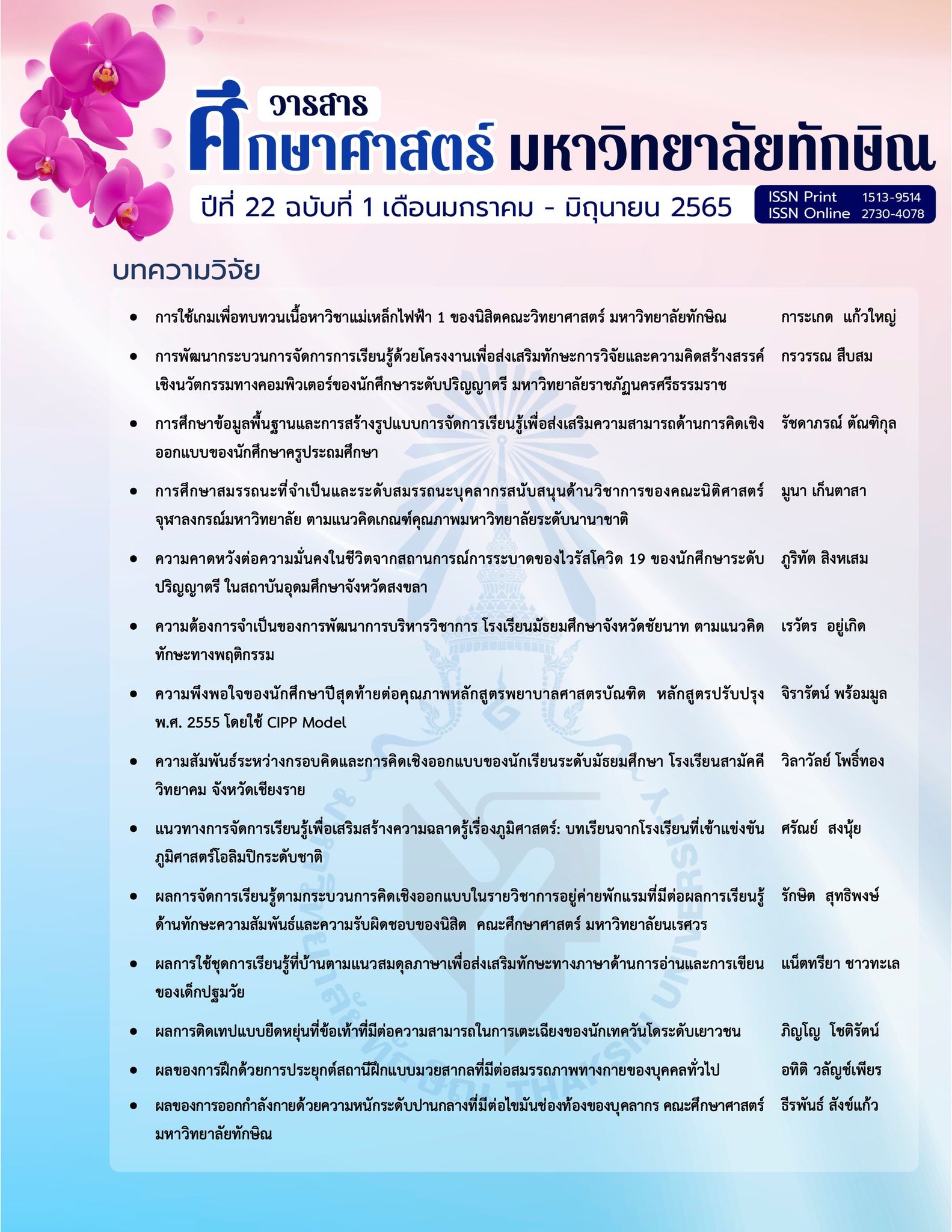
Expectation of Life Security towards COVID – 19 Pandemic of Higher Education Students in Songkhla Province
Article Sidebar
Main Article Content
Abstract
The objective of this study was to study the current conditions, and to study expectation on life security under COVID-19 pandemic of undergraduate students in Songkhla Province. The research was conducted by using quantitative research methodology. The data collected and analyze four factors level expectation of life security work, family, right and freedom, and life security on 400 higher education students in Songkhla Province. The data indicated that the students mostly lived in their own houses or their parents’, and their parents were responsible for students’ educational fees. In addition, the research found that the students’ average income was from their parents approximately 5,001-7,500 Bath per months. The additional money would be given from parents if they had financial problems. Finally, the overall family finance was adequate, and they still had some family savings.
The findings also showed that the overall expectation of senior students on life security in COVID – 19 Pandemic was high; life security was the most expectation, then right and freedom, job security, and family security as following. In addition, considering the expectations of each area in COVID – 19 Pandemic, the study showed that higher education students in Songkhla Province mostly expected three priorities of life security as follows: right and freedom, job security, and family security.
Article Details

This work is licensed under a Creative Commons Attribution-NonCommercial-NoDerivatives 4.0 International License.
ในกรณีที่กองบรรณาธิการ หรือผู้เชี่ยวชาญ ซึ่งได้รับเชิญให้เป็นผู้ตรวจบทความวิจัย หรือ บทความทางวิชาการมีความเห็นว่าควรแก้ไขความบกพร่อง ทางกองบรรณาธิการจะส่งต้นฉบับให้ ผู้เขียนพิจารณาจัดการแก้ไขให้เหมาะสมก่อนที่จะลงพิมพ์ ทั้งนี้ กองบรรณาธิการจะยึดถือความคิด เห็นของผู้เชี่ยวชาญเป็นเกณฑ์
References
กรมควบคุมโรค. (2564). โรคติดเชื้อไวรัสโคโรนาสายพันธุ์ใหม่ 2019. วันที่ค้นข้อมูล 25 มิถุนายน 2564,
กาญจนา บุญภักดิ์ (2563). การจัดการเรียนรู้ ยุค New Normal. [ข้อมูลอิเล็กทรอนิกส์] วารสารครุศาสตร์อุตสาหกรรม, ปีที่ 19(2) A1-A6.
ฐิยาพร กันตาธนวัฒน์. (2563). จิตวิทยาการศึกษาเพื่อพัฒนาผู้เรียน. กรุงเทพฯ: หจก.มีน เซอร์วิส ซัพพลาย.
พรรณทิพย์ ศิริวรรณบุศย์. (2563). จิตวิทยาพัฒนาการ. พิมพ์ครั้งที่ 2 กรุงเทพฯ: สำนักพิมพ์จุฬาลงกรณ์มหาวิทยาลัย.
ศรีเรือน แก้วกังวาล. (2562). จิตวิทยาพัฒนาการชีวิตทุกช่วงวัย (เล่ม2) วัยรุ่น-วัยสูงอายุ. พิมพ์ครั้งที่ 7 กรุงเทพฯ: มหาวิทยาลัยธรรมศาสตร์.
สำนักงานสภาพัฒนาการเศรษฐกิจและสังคมแห่งชาติ. (2564). แผนพัฒนาเศรษฐกิจและสังคมแห่งชาติ แผนที่ 12 (พ.ศ.2560-2565). วันที่ค้นข้อมูล 2 มิถุนายน 2564, เข้าถึงได้จาก https://www.nesdc.go.th เข้าถึงได้จาก https://ddc.moph.go.th
สุพัตรา รุ่งรัตน์และคณะ. (2563). ผลกระทบทางเศรษฐกิจและสังคมจากสถานการณ์โควิด-19 ประชาชนในเขต เทศบาลเมืองยะลา จังหวัดยะลา. วันที่ค้นข้อมูล 1 เมษายน 2564, เข้าถึงได้จาก http://wb.yru.ac.th/bitstream.
สิน พันธุ์พินิจ. (2554). เทคนิคการวิจัยทางสังคมศาสตร์. กรุงเทพฯ : สำนักพิมพ์วิทยพัฒน์.
อ้อมใจ วงษ์มณฑา. (2564). พฤติกรรมที่กลายเป็นการดำเนินชีวิตวิถีใหม่ระหว่างมีการระบาดของโควิด 19. วันที่ค้นข้อมูล 1 เมษายน 2564, เข้าถึงได้จาก https://www.thaipost.net/main/detail/109439.
