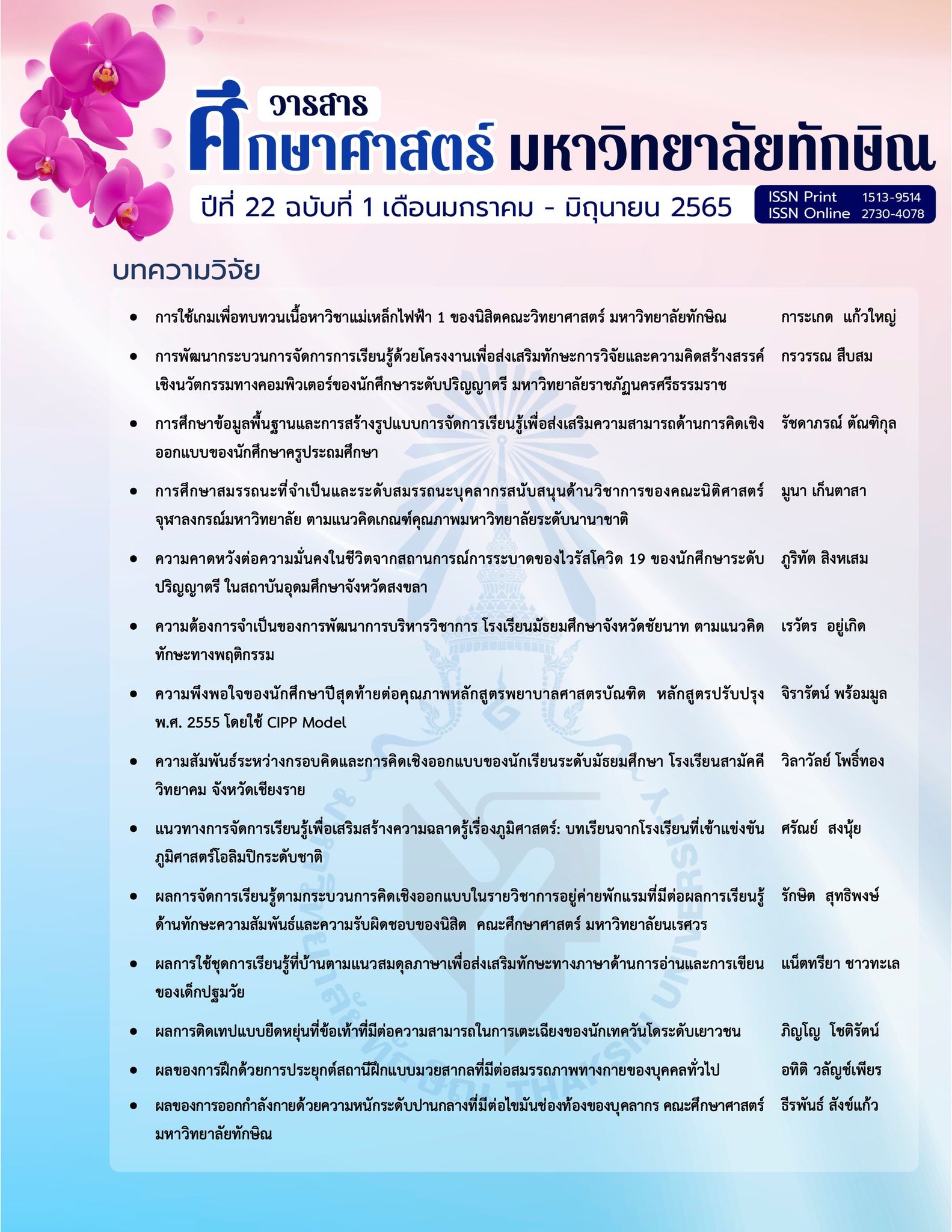
Using Games in Reviewing Content of Electromagnetic 1 to students in Science Faculty, Thaksin University
Article Sidebar
Main Article Content
Abstract
This research used games to review content of Electromagnetic 1 for 8 students in Department of Physics, Faculty of Science, Thaksin University. The objects were to compare the pretest and posttest scores of the students and study of the students’ satisfactions towards the games. Research instruments consisted of 10 games for Electromagnetic 1 content reviewal, pretest and posttest, the student’s satisfaction on using game for Electromagnetic 1 content reviewal, group interview and anecdotal record of students during the games. This research analyzed the pretest and posttest scores, analyzed the students’ satisfactions on using games for content reviewal of Electromagnetic 1 on each side, analyzed students’ behavior during games, and analyzed student opinions and suggestions receiving from group interviews by using descriptive statistics, percentage difference, mean, and standard deviation.
The results revealed that using games to go over content of electromagnetic 1 increased students’ score and led to learning with happiness. The mean of percentage difference between pretest and posttest was increased to 18.29. The student’s satisfaction on using game for content reviewal of Electromagnetic 1 were shown at the highest level in both of learning and emotion with a mean score of 4.77 and 4.85, respectively.
Article Details

This work is licensed under a Creative Commons Attribution-NonCommercial-NoDerivatives 4.0 International License.
ในกรณีที่กองบรรณาธิการ หรือผู้เชี่ยวชาญ ซึ่งได้รับเชิญให้เป็นผู้ตรวจบทความวิจัย หรือ บทความทางวิชาการมีความเห็นว่าควรแก้ไขความบกพร่อง ทางกองบรรณาธิการจะส่งต้นฉบับให้ ผู้เขียนพิจารณาจัดการแก้ไขให้เหมาะสมก่อนที่จะลงพิมพ์ ทั้งนี้ กองบรรณาธิการจะยึดถือความคิด เห็นของผู้เชี่ยวชาญเป็นเกณฑ์
References
ณัฏฐา ผิวมา. (2563). การจัดการเรียนรู้โดยใช้เกมเป็นฐานด้วยบูรณาการเทคโนโลยีเกมคอมพิวเตอร์. วารสารมนุษยศาสตร์และสังคมศาสตร์ มหาวิทยาลัยราชพฤกษ์ ฉบับพิเศษครบรอบ 15 ปี มหาวิทยาลัยราชพฤกษ์. 1-15
ทิศนา แขมมณี. (2560). รูปแบบการเรียนการสอน:ทางเลือกที่หลากหลาย (พิมพ์ครั้งที่ 9). กรุงเทพฯ: จุฬาลงกรณ์มหาวิทยาลัย.
ทิศนา แขมมณี. (2563). ศาสตร์การสอน องค์ความรู้เพื่อการจัดการเรียนการสอนที่มีประสิทธิภาพ (พิมพ์ครั้งที่ 24). กรุงเทพฯ: จุฬาลงกรณ์มหาวิทยาลัย.
ธีรศักดิ์ อุปไมยอธิชัย.(2560). พื้นฐานการจัดการการศึกษา (พิมพ์ครั้งที่ 2). กรุงเทพฯ: จุฬาลงกรณ์มหาวิทยาลัย.
เบลลันกา, เจมส์ และแบรนด์, รอน. (2556). ทักษะแห่งอนาคตใหม่: การศึกษาเพื่อศตวรรษที่ 21 (พิมพ์ครั้งที่ 2) [21st century skills: rethinking how students learn ] (วรพจน์ วงกิจรุ่งเรือง และอธิป จิตตฤกษ์, ผู้แปล). กรุงเทพฯ: โอเพ่นเวิลด์ส.
ไพฑูรย์ สินลารัตน์. (2563). หลักและเทคนิคการสอนระดับอุดมศึกษา (พิมพ์ครั้งที่ 5). กรุงเทพฯ: จุฬาลงกรณ์มหาวิทยาลัย.
วรัตต์ อินทสระ. (2562). Game Based Learning The Latest Trend Education ๒๐๑๙ เปลี่ยนห้องเรียนเป็นห้องเล่น. กรุงเทพฯ: มหาวิทยาลัยสวนดุสิต.
สุคนธ์ สินธพานนท์และคณะ. (2562). หลากหลายวิธีสอนเพื่อพัฒนาคุณภาพเยาวชน. กรุงเทพฯ: 9119 เทคนิค พริ้นติ้ง.
Cardinot, Adriana & Fairfield, Jessamyn. (2019). Game-Based Learning to Engage Students with Physics and Astronomy Using a Board Game. International Journal of Game-Based Learning. 9(1), 42-57.
Fizza Anwer. (2019). The effect of activity-based teaching techniques on student motivation and academic achievement. Journal of Education and Educational Development .6. 154-170.
