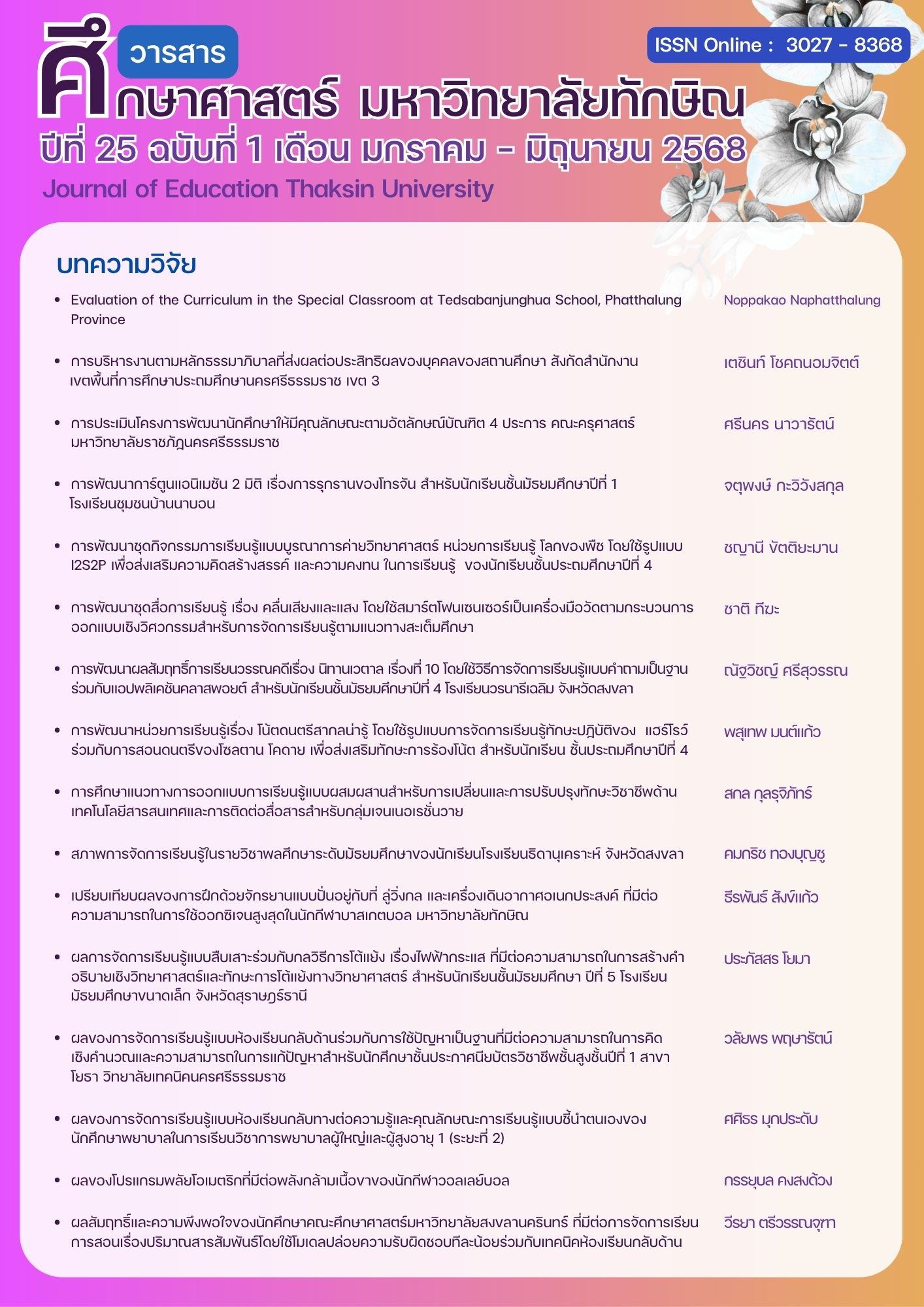
ผลของการจัดการเรียนรู้แบบห้องเรียนกลับทางต่อความรู้และคุณลักษณะการเรียนรู้แบบชี้นำตนเองของนักศึกษาพยาบาลในการเรียนวิชาการพยาบาลผู้ใหญ่และผู้สูงอายุ 1 (ระยะที่ 2)
Article Sidebar
Main Article Content
บทคัดย่อ
งานวิจัยนี้มีวัตถุประสงค์เพื่อศึกษาผลของการจัดการเรียนการสอนแบบห้องเรียนกลับทางต่อความรู้และคุณลักษณะการเรียนรู้แบบชี้นำตนเองของนักศึกษาพยาบาล เป็นการวิจัยกึ่งทดลองแบบกลุ่มเดียววัดผลก่อนและหลัง กลุ่มตัวอย่าง คือ นักศึกษาพยาบาลชั้นปีที่ 2 จำนวน 175 คน ที่ได้รับการจัดการเรียนการสอนแบบห้องเรียนกลับทางในหัวข้อการพยาบาลผู้ใหญ่และผู้สูงอายุที่มีปัญหาระบบกระดูกและกล้ามเนื้อ เก็บข้อมูลด้วย 1) แบบสอบถามข้อมูลทั่วไป 2) แบบทดสอบความรู้ก่อนและหลังเรียน 3) ข้อสอบปลายภาคแบบปรนัยหัวข้อระบบกระดูกและกล้ามเนื้อของรายวิชาการพยาบาลผู้ใหญ่และผู้สูงอายุ 1 และ 4) แบบวัดคุณลักษณะการเรียนรู้แบบชี้นำตนเองก่อนและหลังเรียน วิเคราะห์ข้อมูลด้วยสถิติเชิงพรรณนาและเปรียบเทียบความแตกต่างด้วยสถิติทดสอบค่าที
ผลการวิจัย พบว่า คะแนนเฉลี่ยของแบบทดสอบความรู้หลังเรียนสูงกว่าก่อนเรียนอย่างมีนัยสำคัญทางสถิติ (p < .001) ร้อยละ 89.70 ของกลุ่มตัวอย่าง มีคะแนนสอบในหัวข้อระบบกระดูกและกล้ามเนื้อเกินร้อยละ 50 และคะแนนเฉลี่ยรวมของคุณลักษณะการเรียนรู้แบบชี้นำตนเองหลังเรียนหัวข้อการพยาบาลผู้ใหญ่และผู้สูงอายุที่มีปัญหาระบบกระดูกและกล้ามเนื้อสูงกว่าก่อนเรียนอย่างมีนัยสำคัญทางสถิติ (p < .001) ดังนั้น ห้องเรียนกลับทางเป็นวิธีการจัดการเรียนรู้แบบหนึ่งที่ช่วยเพิ่มประสิทธิผลการเรียนรู้ของนักศึกษาและควรนำมาประยุกต์ใช้ในการจัดการเรียนการสอนทางการพยาบาล
Article Details

อนุญาตภายใต้เงื่อนไข Creative Commons Attribution-NonCommercial-NoDerivatives 4.0 International License.
ในกรณีที่กองบรรณาธิการ หรือผู้เชี่ยวชาญ ซึ่งได้รับเชิญให้เป็นผู้ตรวจบทความวิจัย หรือ บทความทางวิชาการมีความเห็นว่าควรแก้ไขความบกพร่อง ทางกองบรรณาธิการจะส่งต้นฉบับให้ ผู้เขียนพิจารณาจัดการแก้ไขให้เหมาะสมก่อนที่จะลงพิมพ์ ทั้งนี้ กองบรรณาธิการจะยึดถือความคิด เห็นของผู้เชี่ยวชาญเป็นเกณฑ์
เอกสารอ้างอิง
จิตรอนงค์ โสภณพัฒนากุล. (2565). การพัฒนาผลสัมฤทธิ์ทางการเรียนออนไลน์รายวิชา ชีววิทยา 3 ของนักเรียนชั้นมัธยมศึกษาปีที่ 5 ภายใต้การเรียนการสอนแบบออนไลน์ ผ่านการเรียนรู้ทางสื่อสังคมออนไลน์ Facebook. วารสารศิลปากรศึกษาศาสตร์วิจัย, 14(1), 369-385.
ดนุลดา จามจุรี. (2563). การออกแบบการเรียนรู้สำหรับผู้เรียน Gen Z. http://www.curriculumandlearning.com
ทวิมา ศิริรัศมี และ สรวุฒิ พงศ์โรจน์เผ่า. (2563). การจัดการเรียนการสอนแบบห้องเรียนกลับด้าน. วารสารการแพทย์และวิทยาศาสตร์สุขภาพ, 27(1), 136-146
นันทกานต์ มณีจักร, เสาวลักษณ์ สุขพัฒนศรีกุล, วรรณฤดี เชาว์อยชัย, และ พัสมณฑ์ คุ้มทวีพร. (2565). ผลการเรียนแบบห้องเรียนกลับทางด้วยเกมเปิดแผ่นป้ายต่อการเรียนรู้ของนักศึกษาพยาบาลและพฤติกรรมในชั้นเรียนรายวิชาทักษะพื้นฐานทางการพยาบาล. วารสารพยาบาลศาสตร์, 40(3), 105-119.
ศศิธร มุกประดับ, วิภา แซ่เซี้ย, รัดใจ เวชประสิทธิ์ และ เนตรนภา คู่พันธวี. (2561). ประสิทธิผลการจัดการเรียนรู้แบบห้องเรียนกลับทางและคุณลักษณะการเรียนรู้แบบชี้นำตนเองของนักศึกษาพยาบาล ชั้นปีที่ 2 ในรายวิชาการพยาบาลผู้ใหญ่และผู้สูงอายุ 1. วารสารพยาบาลสงขลานครินทร์, 38(1), 1-9.
สกาวเดือน โอดมี และ สุภาวดี เครือโชติกุล. (2566). ผลการเรียนรู้แบบกลับด้านต่อความรู้และการรับรู้สมรรถนะแห่งตนของนักศึกษาในการพยาบาลหญิงตั้งครรภ์ติดเชื้อโคโรนาไวรัส 2019. วารสารการพยาบาลและสุขภาพ, 17(3), 66-74.
Barranquero-Herbosa, M., Abajas-Bustillo, R., & Ortego-Maté, C. (2022). Effectiveness of flipped classroom in nursing education: A systematic review of systematic and integrative reviews. International Journal of Nursing Studies, 135, 104327. https://doi.org/https://doi.org/10.1016/j.ijnurstu.2022.104327
Burucu, R., & Arslan, S. (2021). Nursing Students' views and suggestions about case-based learning integrated into the nursing process: a qualitative study. Florence Nightingale Journal of Nursing, 29(3), 371-378. https://doi.org/10.5152/fnjn.2021.20180
Charoenchim, S., Kuntiya, T., Charoenchim, S., & Samakratkit, U. (2012). Self-directed learning ability of pre-service teachers. Faculty of Education and Development Sciences Kasetsart University. Kasetsart University. https://www.edu.kps.ku.ac.th/DBresearch/document/DB_RESEARCH/Research30.pdf
Etemi, B. P., Uzunboylu, H., Latifi, S., & Abdigapbarova, U. (2024). The Effect of the flipped learning approach on engineering students’ technology acceptance and self-directed learning perception. Sustainability, 16(2), 774. https://doi.org/https://doi.org/10.3390/su16020774
Fan, J.-Y., Tseng, Y.-J., Chao, L.-F., Chen, S.-L., & Jane, S.-W. (2020). Learning outcomes of a flipped classroom teaching approach in an adult-health nursing course: a quasi-experimental study. BMC Medical Education, 20(1), 317. https://doi.org/10.1186/s12909-020-02240-z
Khodaei, S., Hasanvand, S., Gholami, M., Mokhayeri, Y., & Amini, M. (2022). The effect of the online flipped classroom on self-directed learning readiness and metacognitive awareness in nursing students during the COVID-19 pandemic. BMC Nursing, 21, 1-10. https://doi.org/https://doi.org/10.1186/s12912-022-00804-6
Kritpracha, C., Sae-Sia, W., Nukaew, O., Jittanoon, P., Chunuan, S., & Kaosaiyaporn, O. (2018). The Development of cooperative learning using jigsaw activities for learning achievement and self-directed learning behaviors of master nursing students. International Journal of Information and Education Technology, 8(12), 913-917. https://doi.org/10.18178/IJIET
Love, B., Hodge, A., Corritore, C., & Ernst, D. C. (2015). Inquiry-based learning and the flipped classroom model. Problem, Resources, and Issues in Mathematics Undergraduate Studies, 25(8), 745-762. https://doi.org/10.1080/10511970.2015.1046005
Robinson, J. D., & Persky, A. M. (2020). Developing self-directed learners. American Journal of Pharmaceutical Education, 84(3), 847512. https://doi.org/10.5688/ajpe847512
Shi, Y., & Qu, S. (2021). Cognitive Ability and Self-Control’s Influence on High School Students’ Comprehensive Academic Performance. Frontiers in Psychology, 12.
YalÇIn-İNcİK, E. & Incik, T. (2022). Generation Z students’ views on technology in education: what they want what they get. Malaysian Online Journal of Educational Technology, 10(2), 109-124. https://doi.org/10.52380/mojet.2022.10.2.275
Youhasan, P., Chen, Y., Mataroria, L., & Henning, M. A. (2021). Exploring the pedagogical design features of the flipped classroom in undergraduate nursing education: a systematic review. BMC Nursing, 20, 1-13. https://doi.org/https://doi.org/10.1186/s12912-021-00555-w
Yuh, A. H., & Thamrongsotthisakul, W. (2020). The concept of active learning in the 21st century: who is active and what is considered as ‘’active’’ in active learning? The Golden Teak: Humanity and Social Science Journal (GTHJ.), 26(2), 91-99. https://so05.tci-thaijo.org/index.php/tgt/article/view/243956
Young, H. K., & Kim, H. R. (2021). Impact of blended learning on learning outcomes in the public healthcare education course: a review of flipped classroom with team-based learning. BMC Medical Education, 21, 1-8. https://doi.org/https://doi.org/10.1186/s12909-021-02508-y
Zhi Hong, N., Huang, J., Yang, D. P., & Wang, J. (2024). Nursing students’experience of flipped classroom combined with problem-based learning in a paediatric nursing course: a qualitative study. BMC Nursing, 23, 1-9. https://doi.org/https://doi.org/10.1186/s12912-024-01744-z
