
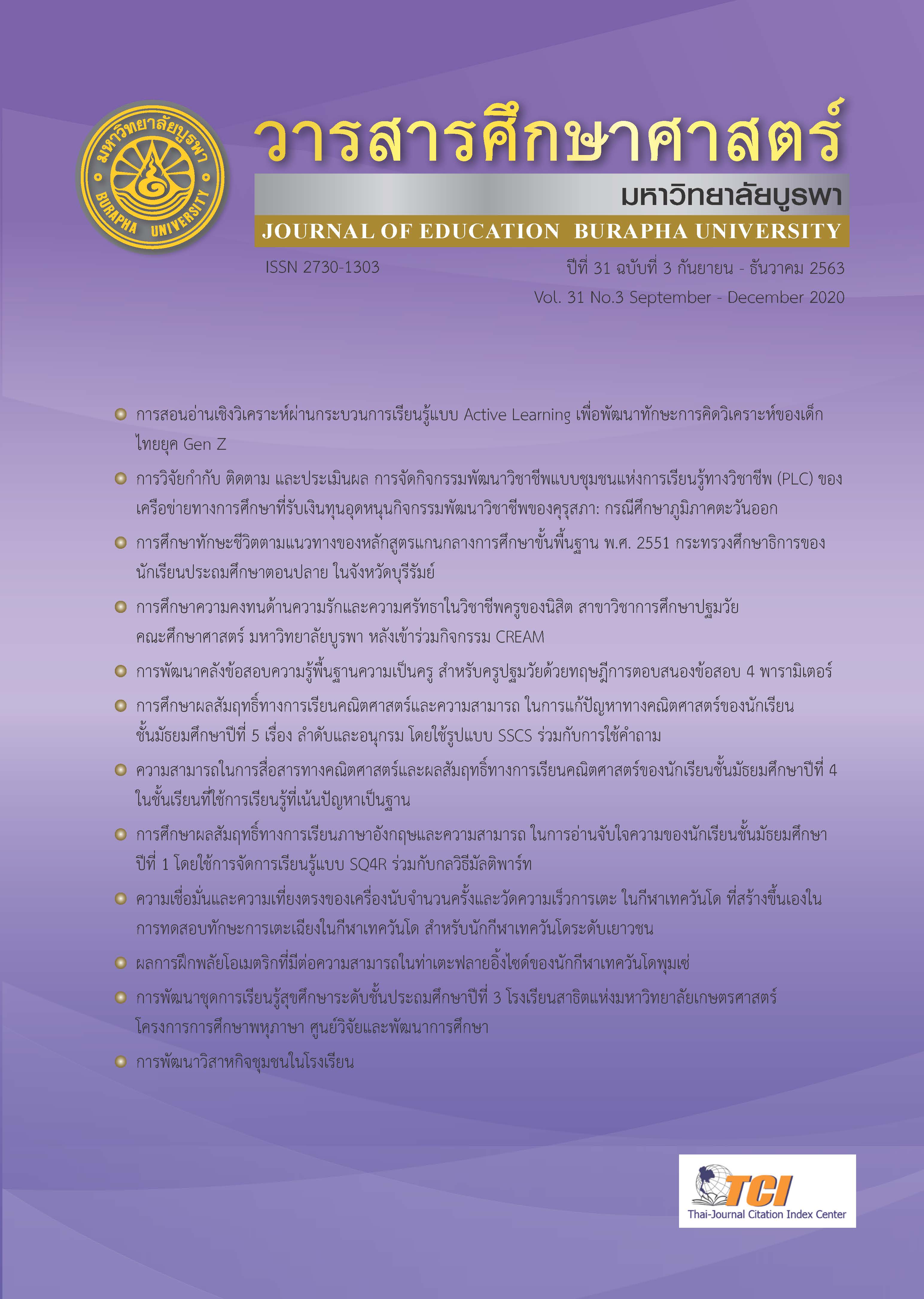
การพัฒนาคลังข้อสอบความรู้พื้นฐานความเป็นครูสำหรับครูปฐมวัย ด้วยทฤษฎีการตอบสนองข้อสอบ 4 พารามิเตอร์
คำสำคัญ:
ความรู้พื้นฐานความเป็นครู, ครูปฐมวัย, คลังข้อสอบ, ทฤษฎีตอบสนองข้อสอบ 4 พารามิเตอร์บทคัดย่อ
การวิจัยครั้งนี้มีวัตถุประสงค์เพื่อพัฒนาคลังข้อสอบความรู้พื้นฐานความเป็นครูสำหรับครูปฐมวัย ด้วยทฤษฎีการตอบสนองข้อสอบ 4 พารามิเตอร์ กลุ่มตัวอย่าง คือ นักศึกษาสาขาวิชาการศึกษาปฐมวัยคณะครุศาสตร์ มหาวิทยาลัยราชภัฏร้อยเอ็ด ปีการศึกษา 2563 จำนวน 200 คน ได้มาจากการสุ่มอย่างง่าย เครื่องมือที่ใช้ในการวิจัยเป็นแบบทดสอบแบบเลือกตอบชนิด 4 ตัวเลือก วิเคราะห์ค่าพารามิเตอร์ของข้อสอบด้วยโปรแกรม R แพ็กเกจ mirt, Psych และ GPArotation ผลจากการวิจัย พบว่า ข้อสอบที่สร้างขึ้นจำนวน 90 ข้อ ผ่านการพิจารณาของผู้เชี่ยวชาญจำนวน 60 ข้อ มีค่า IOC อยู่ระหว่าง 0.60-1.00 เมื่อนำไปตรวจสอบค่าพารามิเตอร์รายข้อกับเกณฑ์การคัดเลือกข้อสอบให้มีค่าอำนาจจำแนกตั้งแต่ 0.800 ถึง 5.000 ค่าความยาก (d) มีค่าตั้งแต่ -3.000 ถึง 3.000 ค่าโอกาสการเดา (g) มีค่าไม่เกิน 0.300 และ ความสะเพร่า (u) มีค่าไม่ต่ำกว่า 0.800 มีข้อสอบที่ผ่านเกณฑ์การคัดเลือกเข้าคลังข้อสอบจำนวน 29 ข้อ คิดเป็นร้อยละ 48.33 โดยมีค่าอำนาจจำแนกอยู่ระหว่าง 0.853 ถึง 3.009 ค่าเฉลี่ย เท่ากับ 1.786 แสดงว่า ข้อสอบมีอำนาจจำแนกค่อนข้างสูง ค่าจุดตัดความยาก อยู่ระหว่าง -2.674 ถึง 2.807 ค่าเฉลี่ย เท่ากับ ค่าเฉลี่ยเท่ากับ 0.312 แสดงว่า ข้อสอบมีระดับความยากอยู่ในเกณฑ์ปานกลางค่อนข้างง่าย และค่าโอกาสการเดา อยู่ระหว่าง 0.041 ถึง 0.286 ค่าเฉลี่ยเท่ากับ 0.183 และค่าความสะเพร่า อยู่ระหว่าง 0.848 ถึง 0.989 ค่าเฉลี่ยเท่ากับ 0.948 คลังข้อสอบสร้างขึ้นโดยใช้โปรแกรมการจัดการฐานข้อมูล PhpMyAdmin สามารถจัดเก็บข้อมูลได้ทั้งรูปภาพและตัวอักษร สามารถนำไปพัฒนาโปรแกรมการทดสอบแบบปรับเหมาะด้วยคอมพิวเตอร์ต่อไป
เอกสารอ้างอิง
คมสัน เอี่ยมจำรัส. (2547). การสร้างและพัฒนาโปรแกรมระบบการทดสอบ. วิทยานิพนธ์ปริญญาวิทยาศาสตรมหาบัณฑิต สาขาวิชาวิศวกรรมคอมพิวเตอร์ จุฬาลงกรณ์มหาวิทยาลัย.
นครินทร์ สุต๋า. (2545). การพัฒนาคลังข้อสอบด้วยคอมพิวเตอร์วิชาวิทยาศาสตร์1 ตามหลักสูตรประกาศนียบัตรวิชาชีพ พุทธศัก ราช 2538 ของกรมอาชีวศึกษา.วิทยานิพนธ์ปริญญาการศึกษาตามหลักสูตรครุศาสตร มหาบัณฑิต สาขาวิจัยและประเมินผลการศึกษา มหาวิทยาลัยราชภัฏอุบลราชธานี.
เบญจมาภรณ์ เสนารัตน์, บุญชม ศรีสะอาด และจริยา ภักตราจันทร์. (2559). การพัฒนาเครื่องมือประเมินความสามารถทางการวิจัยการศึกษาของนักศึกษาครูมหาวิทยาลัยราชภัฏในภาคตะวันออกเฉียงเหนือ.วารสารการวัดการศึกษา มหาวิทยาลัยมหาสารคาม, 22(1), 164-182.
เบญจมาภรณ์ เสนารัตน์ และ สมประสงค์ เสนารัตน์. (2552). แผนแบบการทดลองแบบสุ่มสมบูรณ์. วารสารการวัดผลการศึกษา มหาวิทยาลัยมหาสารคาม. 15(1), 25-36
เบญจมาภรณ์ เสนารัตน์ และ สมประสงค์ เสนารัตน์. (2561). หลักการวัดและประเมินผลทางการศึกษา. (พิมพ์ครั้งที่ 4). มหาสารคาม: อภิชาติการพิมพ์.
มหาวิทยาลัยสุโขทัยธรรมาธิราช. (2545).ประมวลสาระชุดวิชา สัมมนาการประเมินศึกษา หน่วยที่ 1-5.กรุงเทพฯ: สำนักพิมพ์มหาวิทยาลัยสุโขทัยธรรมาธิราช.
ศิริชัย กาญจนวาสี. (2555). ทฤษฎีทดสอบแนวใหม่. (พิมพ์ครั้งที่ 4), กรุงเทพฯ: โรงพิมพ์แห่งจุฬาลงกรณ์มหาวิทยาลัย.
ศิริชัย กาญจนวาสี. (2552), ทฤษฎีการทดสอบแบบดั้งเดิม พิมพ์ครั้งที่ 6 (ฉบับปรับปรุง). กรุงเทพฯ: โรงพิมพ์แห่งจุฬาลงกรณ์มหาวิทยาลัย.
สุวิมล กฤชคฤหาสน์. (2560). การพัฒนาคลังข้อสอบกลุ่มสาระการเรียนรู้คณิตศาสตร์ สำหรับระดับมัธยมศึกษาปีที่ 4. วารสารศรีนครินทรวิโรฒวิจัยและพัฒนา (สาขามนุษยศาสตร์และสังคมศาสตร์). 9(17), 145-159
Amarnani, R. (2009). Two theories, one theta: A gentle introduction to item response theory as an alternative to classical test theory. The International Journal of Educational and Psychological Assessment, 3, 104-109.
Baker, F. B. (2001). The basics of item response theory, (2nd ed). USA: ERIC Clearinghouse on Assessment and Evaluation. Retrieved from: http://echo.edres.org:8080/irt/baker/final.pdf
Barton, M. A., & Lord, F. M. (1981). An upper asymptote for the three-parameter logistic item-response model. Research Bulletin 81-20. Princeton, NJ: Educational Testing Service.
Chalmers, R. P. (2020). Package ‘mirt’. Retrieved June, 3, 2020, from https://cran.r- project.org/web/packages/mirt/mirt.pdf
Choi, Y.-J. & Asilkalkan, A (2019). R Packages for Item Response Theory Analysis: Descriptions And Features. Measurement: Interdisciplinary Research and Perspectives, 17(3),168-175, Retrieved May, 12, 2020, from DoI: 10.1080/15366367.2019.1586404
De Ayala, R. J. (2009). The theory and practice of item response theory. New York: The Guilford Press.
Dennis, C. (2006). The Essentials of Analysis. Third edition published by Continuum, Retrieved June, 3, 2020 from https://books.google.co.th/books?id=rQ2vdJgohH0C&pg=PA50&lpg=PA50&dq=comrey+and+lee+1992+sample+size&
source=bl&ots=mX9lHSkT3Q&sig=ACfU3U0Y2JTPlBZOWY2O_nNEBE6oeJnkhQ&hl
=th&sa=X&ved=2ahUKEwj64e6F_uXpAhXK7XMBHQDsCKAQ6AEwEXoECAoQAQ#v=onepage&q=comrey%20and%20lee%201992%20sample%20size&f=false.
Gross, J. & Ligges, U. (2015). Package ‘nortest’. Retrieved June, 3, 2020 from https://cran.r-project.org/web/packages/nortest/nortest.pdf
Harvey, R. J., & Hammer, A. L. (1999). Item response theory. The Counseling Psychologist, 27,353-383. Retrieved May, 12, 2020, from http://doi.org/b6czqv
Henson, R. K., & Roberts, J. K. (2006). Use of exploratory factor analysis in published research: Common errors and some comment on improved practice. Educational and Psychological measurement, 66(3), 393-416.
Liao, W.-W., Ho, R.-G., Yen, Y.-C., & Cheng, H.-C. (2012). The four-parameter logistic item response theory model as a robust method of estimating ability despite aberrant responses. Social Behavior and Personality, 40, 1679-1694.
Loken, E. & Rulison, K. L. (2010). Estimation of a 4-parameter Item Response Theory model. The British Journal of Mathematical and Statistical Psychology. Retrieved June, 3, 2020 from http://dx.doi.org/10.1348/000711009X474502.
Magis, D. (2013). A Note on the Item Information Function of the Four-Parameter Logistic Model. Department of Education (B32), University of Lie`ge, Boulevard du Rectorat 5, B-4000 Lie`ge, Belgium. Applied Psychological Measurement. 37(4) 304–315
McDonald, M. E. (2002). Systematic Assessment of Learning Outcomes: Developing Multiple-Choice Exams. Published by Jones and Bartlett Publishers
Revelle, W. (2020). Package ‘psych’. Retrieved June, 3, 2020, from https://personality-project.org/r/psych-manual.pdf
Senarat, S., Tayraukham, S., Piyapimonsit, C., & Tongkhambanjong, S. (2012). Development of an Item Bank of Order and Graph by Applying Multidimensional Item Response Theory. Canadian Social Science, 8(4), 21-27. DOI:10.3968/j.css.1923669720120804.1263
ดาวน์โหลด
เผยแพร่แล้ว
รูปแบบการอ้างอิง
ฉบับ
ประเภทบทความ
สัญญาอนุญาต
ลิขสิทธิ์ของบทความที่ปรากฏในวารสารศึกษาศาสตร์ มหาวิทยาลัยบูรพา เป็นของวารสารศึกษาศาสตร์ มหาวิทยาลัยบูรพา ทั้งนี้บทความทุกเรื่องผ่านการตรวจสอบความถูกต้องทางวิชาการจากผู้ทรงคุณวุฒิ ข้อความและข้อมูลของบทความในวารสารฯ เป็นแนวคิดของผู้แต่ง มิใช่เป็นความคิดเห็นของกองบรรณาธิการ และมิใช่ความรับผิดชอบของคณะศึกษาศาสตร์ มหาวิทยาลัยบูรพา ไม่สงวนลิขสิทธิ์การนำไปใช้ประโยชน์ทางวิชาการแต่ต้องอ้างอิงแสดงแหล่งที่มาและอยู่ในขอบเขตของกฎหมายลิขสิทธิ์


