
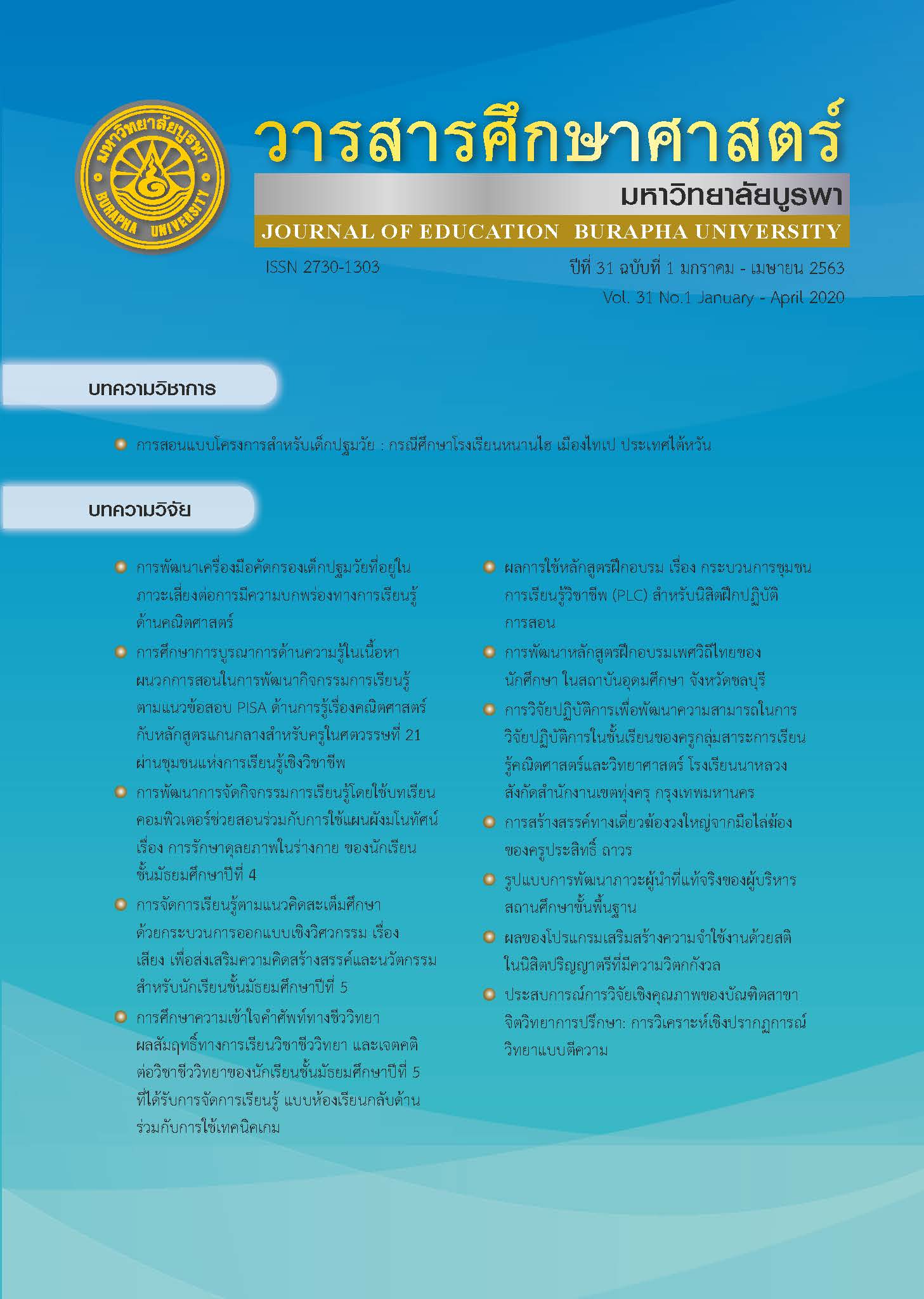
การจัดการเรียนรู้ตามแนวคิดสะเต็มศึกษาด้วยกระบวนการออกแบบเชิงวิศวกรรม เรื่อง เสียง เพื่อส่งเสริมความคิดสร้างสรรค์และนวัตกรรม สำหรับนักเรียนชั้นมัธยมศึกษาปีที่ 5
คำสำคัญ:
การจัดการเรียนรู้ตามแนวสะเต็มศึกษาด้วยกระบวนการออกแบบเชิงวิศวกรรม, ความคิดสร้างสรรค์และนวัตกรรม, เสียงบทคัดย่อ
การวิจัยครั้งนี้ เป็นวิจัยปฏิบัติการมีวัตถุประสงค์ 1) เพื่อศึกษาแนวทางการจัดการเรียนรู้ตามแนว สะเต็มศึกษาด้วยกระบวนการออกแบบเชิงวิศวกรรม เรื่อง เสียง สำหรับนักเรียนชั้นมัธยมศึกษาปีที่ 5 2) เพื่อศึกษาความคิดสร้างสรรค์และนวัตกรรมของนักเรียนชั้นมัธยมศึกษาปีที่ 5 หลังการจัดการเรียนรู้ตามแนว สะเต็มศึกษาด้วยกระบวนการออกแบบเชิงวิศวกรรม เรื่อง เสียง กลุ่มเป้าหมาย คือ นักเรียนชั้นมัธยมศึกษาปีที่ 5 โรงเรียนแห่งหนึ่งในจังหวัดพิษณุโลก ภาคเรียนที่ 2 ปีการศึกษา 2561 จำนวน 23 คน เครื่องมือวิจัยที่ใช้ประกอบด้วย แผนการจัดการเรียนรู้ ใบกิจกรรม แบบสะท้อนผลการจัดการเรียนรู้ แบบประเมินความคิดสร้างสรรค์และนวัตกรรม วิเคราะห์ข้อมูลโดยวิเคราะห์เนื้อหาและสถิติบรรยายค่าเฉลี่ย ร้อยละ
ผลการวิจัยพบว่า 1) แนวทางจัดการเรียนรู้ตามแนวสะเต็มศึกษาด้วยกระบวนการออกแบบเชิงวิศวกรรมที่ส่งเสริมความคิดสร้างสรรค์และนวัตกรรม สำหรับนักเรียนชั้นมัธยมศึกษาปีที่ 5 ประกอบด้วย 6 ขั้นตอน คือ ขั้นระบุปัญหา ครูสร้างความตระหนัก ความสำคัญของสถานการณ์ ที่สำคัญสถานการณ์ต้องมีเงื่อนไขสร้างความท้าทายให้กับนักเรียน ขั้นรวบรวมข้อมูลและแนวคิดที่เกี่ยวข้องกับปัญหา นักเรียนต้องได้วิเคราะห์ถึงบริบท ความต้องการ เป้าหมาย ข้อจำกัดของสถานการณ์ผ่านการระดมสมอง สืบค้นข้อมูลที่เกี่ยวข้องกับสถานการณ์ ขั้นออกแบบวิธีการแก้ปัญหานักเรียนจะได้ออกแบบชิ้นงานหลากหลาย เพื่อเลือกชิ้นงานที่ดีที่สุดไปสู่การบรรลุเป้าหมายของสถานการณ์ ขั้นวางแผนและดำเนินการแก้ปัญหา นักเรียนต้องได้วางแผนขั้นตอนการดำเนินการ โดยครูผู้สอนต้องตรวจสอบการวางแผนการดำเนินงานว่าใช้หลักการทางวิทยาศาสตร์หรือไม่ ขั้นทดสอบ ประเมินผล และปรับปรุงแก้ไขวิธีการแก้ปัญหาหรือชิ้นงาน นักเรียนต้องเลือกวิธีการทดสอบชิ้นงานที่มีความเหมาะสม ทำการประเมินผลชิ้นงาน ปรับปรุงชิ้นงานให้ดียิ่งขึ้น ขั้นนำเสนอวิธีการแก้ปัญหา ผลการแก้ปัญหาหรือชิ้นงาน นักเรียนจะได้นำเสนอชิ้นงาน และการแก้ไขชิ้นงานของตนเอง และ 2) นักเรียนพัฒนาความคิดสร้างสรรค์และนวัตกรรมได้อย่างต่อเนื่อง นักเรียนมีคะแนนเพิ่มขึ้นในหลาย พฤติกรรม อย่างไรก็ตามพฤติกรรมการทำงานร่วมกับผู้อื่นอย่างสร้างสรรค์เป็นพฤติกรรมที่นักเรียนแสดงออกได้มากตลอดการจัดการเรียนรู้
เอกสารอ้างอิง
บริษัทซัคเซสพับลิเคชั่น จำกัด
พรทิพย์ ศิริภัทราชัย.(2556). STEM Education กับการพัฒนาทักษะในศตวรรษที่ 21.วารสารนักบริหาร,33 (2),50
ลือชา ลดาชาติ.(2562).สะเต็มศึกษาและการออกแบบเชิงวิศวกรรมตามความเข้าใจและมุมมองของครู. วารสารศึกษาศาสตร์ มหาวิทยาลัยบูรพา, 30(1) , 89-101
วัชรา เล่าเรียนดี และคณะ. (2560). กลยุทธ์การจัดการเรียนรู้เชิงรุก เพื่อพัฒนาการคิดและยกระดับคุณภาพการศึกษา สำหรับศตวรรษที่ 21. กรุงเทพฯ : เพชรเกษมพริ้นติ้ง
กรุ๊ป.
วิจารณ์ พานิช. (2556). การสร้างการเรียนรู้สู่ศตวรรษที่ 21. กรุงเทพฯ: ส. เจริญการพิมพ์
วีทิต วรรณเลิศลักษณ์. (2560). คลื่นเสียง.สืบค้นเมื่อวันที่ 11 มิถุนายน 2562,จาก https://www.scimath.org/lesson-physics/item/7247-2017-06-12-15-31-26
จรูญพงษ์ ชลสินธุ์ (2561).การวิจัยปฏิบัติการเพื่อพัฒนาการจัดการเรียนรู้เรื่องปริมาณสารสัมพันธ์ตามแนวสะเต็มศึกษาที่เน้นกระบวนการออกแบบเชิงวิศวกรรม ที่ส่งเสริม
สมรรถนะการแก้ปัญหาแบบสัมพันธ์. วารสารศึกษาศาสตร์ มหาวิทยาลัยนเรศวร, 20(2) , 32-46
สถาบันส่งเสริมการสอนวิทยาศาสตร์และเทคโนโลยี.(2557).สะเต็มศึกษา.สืบค้นเมื่อวันที่ 16 ตุลาคม 2561,จาก http://www.stemedthailand.org/wp-
content/uploads/2015/03/newIntro-to-STEM.pdf.pdf
สถาบันส่งเสริมการสอนวิทยาศาสตร์และเทคโนโลยี.(2558).สรุปผลการวิจัยโครงการ TIMSS 2015 .สืบค้นเมื่อวันที่ 16 ตุลาคม 2561,จาก https://drive.google.com/
file/d/0Bza8voFmdFsrRGlYbmdPa0pkXzg/view
สิรินภา กิจเกื้อกูล.(2558).สะเต็มศึกษา.วารสารศึกษาศาสตร์ มหาวิทยาลัยนเรศวร,17(2) , 201-207
สุธิดา การีมี. (2560,17 พฤศจิกายน) . การใช้กระบวนการออกแบบเชิงวิศวกรรมเพื่อเสริมสร้างความคิดสร้างสรรค์และทักษะการแก้ปัญหา.สืบค้นเมื่อวันที่ 16 ตุลาคม
2561,จาก http://oho.ipst.ac.th/edp-creative-problem-solving1/
สุพรรณี ชาญประเสริฐ.(2558).การออกแบบการจัดการเรียนรู้ตามแนวทางสะเต็มศึกษากับการพัฒนาทักษะในศตวรรษที่ 21.นิตยสาร สสวท.,43(192),3-5
สุธีระ ประเสริฐสรรพ์.(2559).สะเต็มศึกษา:ปัญหาจากกระบวนการออกแบบเชิงวิศวกรรม. สงขลา:นำศิลป์โฆษณา.
ดารารัตน์ ชัยพิลา. (2559).ผลการจัดกิจกรรมการเรียนรู้แบบโครงงานตามแนวคิด STEM Education เพื่อส่งเสริมความสามารถในการแก้ปัญหาอย่างสร้างสรรค์ทาง
วิทยาศาสตร์ เรื่อง ปฏิกิริยาเคมี ของนักเรียนชั้นมัธยมศึกษาปีที่2 .วารสารศึกษาศาสตร์ มหาวิทยาลัยบูรพา, 27(2) , 98-109
Catalina Foothills School District (2018). Creativity and Innovation Rubric Grades 9-12 Retrieved from
https://www.cfsd16.org/application/files/4715/2989/2859/K-12_CREATIVITY-INNOVATION_2018.pdf
Kemmis,S. and McTaggart,R. (1988). The action research planer (3rded.). Victoria: Deakin University
Partnership for 21st Century Learning. (2015). P21 Framework Definitions. p.1-9
ดาวน์โหลด
เผยแพร่แล้ว
รูปแบบการอ้างอิง
ฉบับ
ประเภทบทความ
สัญญาอนุญาต
ลิขสิทธิ์ของบทความที่ปรากฏในวารสารศึกษาศาสตร์ มหาวิทยาลัยบูรพา เป็นของวารสารศึกษาศาสตร์ มหาวิทยาลัยบูรพา ทั้งนี้บทความทุกเรื่องผ่านการตรวจสอบความถูกต้องทางวิชาการจากผู้ทรงคุณวุฒิ ข้อความและข้อมูลของบทความในวารสารฯ เป็นแนวคิดของผู้แต่ง มิใช่เป็นความคิดเห็นของกองบรรณาธิการ และมิใช่ความรับผิดชอบของคณะศึกษาศาสตร์ มหาวิทยาลัยบูรพา ไม่สงวนลิขสิทธิ์การนำไปใช้ประโยชน์ทางวิชาการแต่ต้องอ้างอิงแสดงแหล่งที่มาและอยู่ในขอบเขตของกฎหมายลิขสิทธิ์


