
การพัฒนาเกณฑ์การประเมินทักษะการสื่อสารทางวิทยาศาสตร์ในการแสดงทางวิทยาศาสตร์ สำหรับนักเรียนระดับประถมศึกษาตอนปลาย
Article Sidebar
Main Article Content
บทคัดย่อ
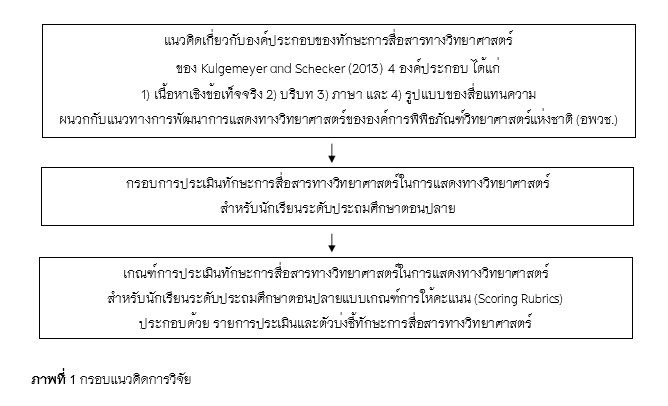
การแสดงทางวิทยาศาสตร์สามารถนำมาประยุกต์ใช้เป็นกิจกรรมการเรียนรู้ในชั้นเรียนเพื่อส่งเสริมทักษะการสื่อสารทางวิทยาศาสตร์ของผู้เรียน การมีเครื่องมือวัดและประเมินผลการเรียนรู้ที่ดีจะช่วยในการติดตามพัฒนาการของทักษะการสื่อสารทางวิทยาศาสตร์ของผู้เรียนได้ การวิจัยนี้มีวัตถุประสงค์เพื่อพัฒนาและตรวจสอบคุณภาพของเกณฑ์การประเมินทักษะการสื่อสารทางวิทยาศาสตร์ในการแสดงทางวิทยาศาสตร์ สำหรับใช้ในรายวิชาเพิ่มเติมการแสดงทางวิทยาศาสตร์ สำหรับนักเรียนระดับประถมศึกษาตอนปลาย กลุ่มตัวอย่างประกอบด้วยสามกลุ่ม ได้แก่ ผู้เชี่ยวชาญ 3 คน สำหรับประเมินความสอดคล้องของเกณฑ์ นักเรียนระดับประถมศึกษาตอนปลาย 3 ทีมจากการแข่งขันการแสดงทางวิทยาศาสตร์ที่ใช้วิดีทัศน์ในการทดลองใช้เกณฑ์ และครูผู้สอนวิทยาศาสตร์ 5 คน ที่มีประสบการณ์ประเมินการแสดงเพื่อทดสอบการใช้เกณฑ์ เครื่องมือวิจัยคือเกณฑ์ประเมินทักษะการสื่อสารทางวิทยาศาสตร์ในการแสดงทางวิทยาศาสตร์สำหรับนักเรียนระดับประถมศึกษาตอนปลายที่ประกอบด้วย แบบประเมินประกอบด้วย 6 รายการ ครอบคลุมทักษะการสื่อสารทางวิทยาศาสตร์ 4 ด้าน ได้แก่ เนื้อหาเชิงข้อเท็จจริง (การสื่อสารเนื้อหาและการอ้างอิงแหล่งข้อมูล) บริบท (การเชื่อมโยงตัวอย่างและการใช้คำศัพท์ที่เหมาะสม) ภาษา (การขยายความหมายของคำศัพท์เฉพาะ) และรูปแบบของสื่อแทนความ (การเลือกและใช้วิธีการนำเสนอ) วิเคราะห์ผลการประเมินด้วยค่าดัชนีความสอดคล้อง (IOC) เพื่อยืนยันความตรงเชิงเนื้อหาของรายการ และความเที่ยงระหว่างผู้ประเมิน (ICC) เพื่อยืนยันความเสถียรของเกณฑ์การประเมิน
ผลการวิจัยพบว่า เกณฑ์การประเมินที่พัฒนาขึ้นประกอบด้วย 6 รายการประเมินที่ครอบคลุมองค์ประกอบของทักษะการสื่อสารทางวิทยาศาสตร์ 4 ด้าน ได้แก่ ด้านที่ 1 เนื้อหาเชิงข้อเท็จจริง ประกอบด้วยรายการที่ (1) การสื่อสารเนื้อหาทางวิทยาศาสตร์ และ (2) การอ้างอิงแหล่งที่มาของเนื้อหาทางวิทยาศาสตร์ ด้านที่ 2 บริบท ประกอบด้วยรายการที่ (3) การเชื่อมโยงเนื้อหาทางวิทยาศาสตร์เข้ากับตัวอย่าง และ (4) การเลือกใช้คำศัพท์เฉพาะทางวิทยาศาสตร์และคำศัพท์ทั่วไป ด้านที่ 3 ภาษา ประกอบด้วยรายการที่ (5) การขยายความหมายของคำศัพท์เฉพาะทางวิทยาศาสตร์ และด้านที่ 4 รูปแบบของสื่อแทนความ ประกอบด้วยรายการที่ (6) การเลือกและใช้วิธีการนำเสนอ มีค่าดัชนีความสอดคล้อง (IOC) เฉลี่ยเท่ากับ 0.67 ความเหมาะสมด้านภาษาและการนำไปใช้อยู่ในระดับมาก (ค่าเฉลี่ย 4.27 ± 0.48) และค่าความเที่ยงระหว่างผู้ประเมิน (ICC) เท่ากับ 0.83 ซึ่งอยู่ในระดับสูงมาก สะท้อนว่าเกณฑ์การประเมินที่พัฒนาขึ้นมีคุณภาพในด้านความสอดคล้อง ความเหมาะสม และความเที่ยง สามารถนำไปใช้ในการจัดกิจกรรมการเรียนรู้เพื่อพัฒนาทักษะการสื่อสารทางวิทยาศาสตร์ในการแสดงทางวิทยาศาสตร์ของนักเรียนระดับประถมศึกษาตอนปลายได้อย่างมีประสิทธิภาพ
Downloads
Article Details

อนุญาตภายใต้เงื่อนไข Creative Commons Attribution-NonCommercial-NoDerivatives 4.0 International License.
เอกสารอ้างอิง
Atjanawat, T. (2015). Development of science communication and teamwork abilities of eleventh grade students using group investigation. (Master's thesis, Science Education Program, Chulalongkorn University). DOI: 10.58837/CHULA.THE.2015.102 [In Thai]
Austin, S. R. P., & Sullivan, M. (2018). How are we performing? Evidence for the value of science shows. International Journal of Science Education, Part B, 9(1), 1–12. https://doi.org/10.1080/21548455.2018.1532620
Brookhart, S. M. & Nitko, A. J. (2019). Educational assessment of students. New York: Pearson. Retrieved from https://www.pearsonhighered.com/assets/preface/0/1/3/4/0134806972.pdf
Burns, T. W., O’Connor, D. J., & Stocklmayer, S. M. (2003). Science communication: A contemporary definition. Public Understanding of Science, 12(2), 183–202. https://doi.org/10.1177/09636625030122004
Chanchaichana, S. & Saeng-Xuto, V. (2018). Effect of instruction with science show to promote science process skills of Prathom Suksa 6 students. Journal of Education and Innovation, 20(4), 219-229. [In Thai]
Chiang Rai Primary Educational Service Area Office 2. (2024). The 72nd Student arts and culture competition, 2024, science and technology learning group: Summary of science and technology learning group activities. Retrieved from https://sillapa.cri2.go.th/art72/files/docs/2024-12-126HV0FSWRL1-482581512.75834.pdf [In Thai]
Faculty of Science, Burapha University. (2023). Science show contest. Retrieved from
https://share.google/rLZ6y0czoSNcfjAKS [In Thai]
Fledelius, J., Khalil, A., Hjorthaug, K., & Frokaer, J. (2016). Inter-observer agreement improves with PERCIST 1.0 as opposed to qualitative evaluation in non-small cell lung cancer patients evaluated with F-18-FDG PET/CT early in the course of chemo-radiotherapy. EJNMMI Research, 6(1), 1-10. DOI: 10.1186/s13550-016-0223-6
Gumjudpai, S. (2022). Using rubrics for learning assessment. Journal of Curriculum and Instruction, Sakon Nakhon Rajabhat University, 14(39), 211–223. Retrieved from https://jci.snru.ac.th/Files/Article/986-ArticleTextFile-20230524162320.pdf [In Thai]
Haputon, K. (2020). The development of science communication ability and science communication self-efficacy of high school biology students using science communication-based Learning. (Master’s thesis, Science Teachnalogy Education Program, Khon Kaen University). [In Thai]
Jeon, S. (2019). The Development and Application of Process-focused Assessment for Improving Scientific Communication Skill. Journal of Korean Elementary Science Education, 38(1), 16-30. https://doi.org/10.15267/keses.2019.38.1.16
Karim, N. & Roslan, R. (2020). The impact of interactive science shows on student’s learning achievement on fire and pressure science concept for 9th grader in Brunei. Jurnal Pendidikan IPA Indonesia, 9(3), 294-308. https://doi.org/10.15294/jpii.v9i3.23684
Keawpoosee, A. (2013). Science communication ability of Prathom Suksa 6 Students learned through group investigation. (Master’s thesis, Science Education Program, Chiang Mai University). [In Thai]
Kulgemeyer, C. & Schecker, H. (2013). Students explaining science - assessment of science communication competence. Research in Science Education, 43, 2235 – 2256. https://doi.org/10.1007/s11165-013-9354-1
Landis, J. R. & Koch, G. G. (1977). An application of hierarchical kappa-type statistics in the assessment of majority agreement among multiple observers. Biometrics, 33, 363-374. https://doi.org/10.2307/2529786
Ling, J. H. (2024). A review of rubrics in education: Potential and challenges. Indonesian Journal of Teaching and Learning Research, 2(1), 1–14. https://doi.org/10.64420/ijitl.v2i1.197
Meebut, T. & Promkatkeaw, T. (2023). Science show to competency-based learning for developing scientific communication skills of upper elementary students: Opinions of competition’s participators. In The 10th International Conference for Science Educators and Teachers 2023 (pp. 396 - 402), May 13 – 14, 2023, Duangjitt Resort and Spa. Patong Phuket, Thailand. Retrieved from https://www.researchgate.net/publication/391511989_Science_Show_to_Competency-Based_Learning_for_Developing_Scientific_Communication_Skills_of_Upper_Elementary_Students_Opinions_of_Competition's_Participators
Ministry of Education. (2021). National education plan 2021. Bangkok: Ministry of Education. [In Thai]
Ministry of Education. (2022). National education plan 2022. Bangkok: Ministry of Education. [In Thai]
National Science Museum Organization. (2023). Science shows development manual. Pathum Thani: National Science Museum Organization. [in Thai]
Office of the Basic Education Commission. (2021). Guidelines for competency-based learning management in educational institutions. Retrieved from https://cbethailand.com/หลักสูตร-2/กรอบหลักสูตร/แนวทางการจัดการเรียนรู/การประเมินการเรียนรู้/ [In Thai]
Office of the Education Council. (2017). National scheme of education B.E. 2560–2579 (2017–2036). Bangkok: Office of the Education Council. [In Thai]
Phinin, T. (2020). The effects of model-based learning for developing science communication skill of the changes of state of matter for the 5th grade students. (Master’s independent study, Science Education Program, Naresuan University). [In Thai]
Phranakhon Si Ayutthaya Science Education Center. (2024, March 19). Webpage on science show learning activities. Retrieved from https://aru.ac.th/sci/?id=2784&page=activity&subpage=activity_gallery [In Thai]
PlearnScience. (2021). Science communication. Retrieved from https://www.plearnscience.com/course/science-communication/58 [In Thai]
Pongsue, T. (2021). Development of SSCS learning activity cooperated with context-based situations enhancing scientific communication skills of mathayomsuksa 4 students. (Master's thesis, Science and Mathematics Teaching Program, Mahasarakham University). [In Thai]
Silpachai, N., Panprueksa, K., & Singlop, S. (2017). The study of learning achievement, science communication skills and teamwork skills on structure and function of angiosperms using 5E learning cycle with cooperative learning. Journal of Education and Social Development, 13(1), 169-182. [In Thai]
Spektor-Levy, O., Eylon, B.-S., & Scherz, Z. (2009). Teaching scientific communication skills in science studies: Does it make a difference? International Journal of Science and Mathematics Education, 7(5), 875–903. https://doi.org/10.1007/s10763-009-9150-6
Srisa-ard, B. (2013). Statistical methods for research (5th ed., Vol. 1). Bangkok, Thailand: Suweeriyasarn Publishing.
Sukkasem, K. (2017). Development of the science show learning process via the world wide web on the Internet. Retrieved from http://research.otepc.go.th/files/OTEPC62022_CH1_bauxzlh7.pdf [In Thai]
Suwarat, K. (2020). Development of science communication of 11th grade ethnically diverse students using phenomenon – based learning in topic of respiratory system. (Master's thesis, Science Education Program, Naresuan University). [In Thai]
Suwattanapornkul, I. (2019). Educational research: Concepts and applications. Bangkok: Department of Educational Measurement and Research, Faculty of Education, Srinakharinwirot University. [In Thai]
The National Science Museum. (2023). Annual report 2023. Pathum Thani: The National Science Museum. [In Thai]
Yuen, B. P. L. & Sawatdeenarunat, S. (2020). Applying a rubric development cycle for assessment in higher education: An evidence-based case study of a science communication module. Asian Journal of the Scholarship of Teaching and Learning, 10(1). 54-67. Retrieved from https://ctlt.nus.edu.sg/wp-content/uploads/2024/04/v10n1 _yuen_sawatdeenarunat.pdf
