
การพัฒนาแอปพลิเคชันเพื่อส่งเสริมการเรียนรู้ภาษาอังกฤษสำหรับเด็กปฐมวัยในโรงเรียนเครือข่ายชุมชนแห่งการเรียนรู้ทางวิชาชีพ
Article Sidebar
Main Article Content
บทคัดย่อ
การวิจัยนี้มีวัตถุประสงค์เพื่อ 1) พัฒนาแอปพลิเคชันเพื่อส่งเสริมการเรียนรู้ภาษาอังกฤษสำหรับเด็กปฐมวัย 2) ทดลองใช้แอปพลิเคชันเพื่อส่งเสริมการเรียนรู้ภาษาอังกฤษสำหรับเด็กปฐมวัย และ 3) ประเมินความพึงพอใจต่อการนำแอปพลิเคชันเพื่อส่งเสริมการเรียนรู้ภาษาอังกฤษสำหรับเด็กปฐมวัยไปใช้งาน ผู้ให้ข้อมูลสำคัญ ได้แก่ สมาชิกเครือข่ายชุมชนแห่งการเรียนรู้ทางวิชาชีพ จำนวน 21 คน และกลุ่มตัวอย่าง ได้แก่ เด็กปฐมวัยในโรงเรียนเครือข่ายชุมชนแห่งการเรียนรู้ทางวิชาชีพ จังหวัดนครสวรรค์ จำนวน 50 คน โดยการเลือกแบบเจาะจง เครื่องมือที่ใช้ในการวิจัย ได้แก่ แบบบันทึกการสนทนากลุ่ม แอปพลิเคชันเพื่อส่งเสริมการเรียนรู้ภาษาอังกฤษสำหรับเด็กปฐมวัย แบบทดสอบความสามารถในการออกเสียงภาษาอังกฤษได้อย่างถูกต้องของเด็กปฐมวัย แบบประเมินความพึงพอใจของเด็กปฐมวัยต่อการใช้แอปพลิเคชันเพื่อส่งเสริมการเรียนรู้ภาษาอังกฤษสำหรับเด็กปฐมวัย และแบบประเมินความพึงพอใจต่อการนำแอปพลิเคชันเพื่อส่งเสริมการเรียนรู้ภาษาอังกฤษสำหรับเด็กปฐมวัยไปใช้งาน วิเคราะห์ข้อมูลด้วยการวิเคราะห์เนื้อหา การหาค่าเฉลี่ย ส่วนเบี่ยงเบนมาตรฐาน และค่าสถิติ t-test แบบ Paired Samples Test
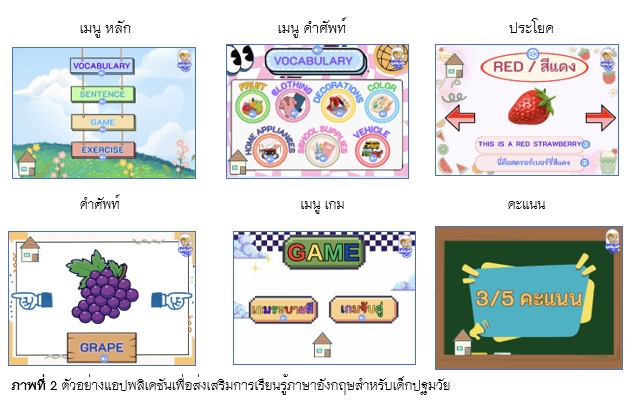
ผลการวิจัย พบว่า 1) แอปพลิเคชันเพื่อส่งเสริมการเรียนรู้ภาษาอังกฤษสำหรับเด็กปฐมวัยเป็นแอปพลิเคชันที่สามารถใช้กับเครื่องคอมพิวเตอร์และสมาร์ทโฟนระบบปฏิบัติการแอนดรอยด์ เนื้อหาประกอบด้วย คำศัพท์เกี่ยวกับสิ่งของต่าง ๆ ในชีวิตประจำวัน ประโยค เกม และแบบฝึกหัด มีผลการประเมินคุณภาพโดยภาพรวมอยู่ในระดับเหมาะสมมากที่สุด ( = 4.83, S.D. = 0.13) 2) การทดลองใช้แอปพลิเคชันเพื่อส่งเสริมการเรียนรู้ภาษาอังกฤษสำหรับเด็กปฐมวัย พบว่า 2.1) ความสามารถในการออกเสียงภาษาอังกฤษได้อย่างถูกต้องของเด็กปฐมวัยที่ได้รับการจัดกิจกรรมโดยใช้แอปพลิเคชันเพื่อส่งเสริมการเรียนรู้ภาษาอังกฤษสำหรับเด็กปฐมวัย มีคะแนนเฉลี่ยหลังเรียนสูงกว่าก่อนเรียน และ 2.2) ผลการประเมินความพึงพอใจของเด็กปฐมวัยที่มีต่อการใช้แอปพลิเคชันเพื่อส่งเสริมการเรียนรู้ภาษาอังกฤษสำหรับเด็กปฐมวัย อยู่ในระดับมาก ( = 2.63, S.D. = 0.46) และ 3) ผลการประเมินความพึงพอใจต่อการนำแอปพลิเคชันเพื่อส่งเสริมการเรียนรู้ภาษาอังกฤษสำหรับเด็กปฐมวัยไปใช้งาน อยู่ในระดับมากที่สุด (
= 4.53, S.D. = 0.51) ทั้งนี้ ชุมชนแห่งการเรียนรู้ทางวิชาชีพในงานวิจัยนี้ทำหน้าที่เป็นบริบทของสถานศึกษาและเป็นกลไกสนับสนุนการออกแบบและพัฒนาแอปพลิเคชันผ่านความร่วมมือของครูในเครือข่าย มิได้ใช้เป็นเครื่องมือหรือตัวแปรต้นในการทดลองทางสถิติ
Downloads
Article Details

อนุญาตภายใต้เงื่อนไข Creative Commons Attribution-NonCommercial-NoDerivatives 4.0 International License.
เอกสารอ้างอิง
Chairob, A. & Ratanachoto, P. J. (2023). The development of English vocabulary learning using game-based learning management for Prathomsuksa 5 students. Journal of Modern Learning Development, 8(8), 1-11. [In Thai]
Dore, R. A. & Dynia, J. M. (2020). Technology and media use in preschool classrooms: Prevalence, purposes, and contexts. Frontiers in Education, 5, 600305.
Fokides, E. (2020). Perceptions of early childhood teachers regarding the use of tablets in the classroom. Technology, Knowledge and Learning, 25(2), 349–370.
Kittitongsophon, W. & Kaewurai, W. (2023). The development of a model for promoting language development in children aged 1-3 years by parents using mobile applications. Journal of Public Health Nursing, 37(2), 1-16. [In Thai].
Klangboonkrong, K. (2012). A web application to assist mothers in monitoring health and recording childdevelopment. Bangkok: King Mongkut's University of Technology Thonburi. [In Thai]
Kluabsamran, J., Saenwat, J., Kraiyasuan, K., & Kingsaeng, A. (2021). The development of English listening and speaking skills through multimedia for early childhood. The Academic Journal of Eastern Management and Technology University, 18(1), 119–124. [In Thai]
Mayer, R. E. (2009). Multimedia learning. (2nd ed.). Cambridge: Cambridge University Press.
Ministry of Education. (2024). Educational policy of the Ministry of Education for the fiscal year 2024–2025. Bangkok: Ministry of Education. [In Thai]
Muendech, S. & Kaewurai. R. (2018). The development of a project-based learning model integrated with social media to enhance creativity for lower secondary school students. Naresuan University Journal: Education, 22(2), 182-192. [In Thai]
Nikolopoulou, K. (2021). Mobile devices in early childhood education: Teachers' views on benefits and barriers. Education and Information Technologies, 26(3), 3279–3292.
Papadakis, S. & Kalogiannakis, M. (2022). Mobile educational applications for children: What do parents and teachers think? International Journal of Child-Computer Interaction, 31, 100356.
Papadakis, S., Kalogiannakis, M., & Zaranis, N. (2018). Educational apps from the Android Google Play for Greek preschoolers: A systematic review. Computers & Education, 116, 139–160.
Phonphun, S., Rawengwan, P., & Somjainueck, S. (2024). The developing a fun learning app for preschool children. In Proceedings of the 11th National and International Conference on Academic Research Presentation (pp. 362–372), May 3–4, 2024, Khon Kaen: Northeastern University. [In Thai]
Rawengwan, P. (2021). The development of learning materials to enhance vocabulary skills in 3 languages for early childhood on smart phone. Neu Academic and Research Journal, 11(2), 167–180. [In Thai]
Salman, A. & Antonius, C. (2017). Interactive educational game, an android mobile app for children learning alphabets. Library Hi Tech News, 34(5), 20-22. [In Thai]
Sitti, N. (2022). The development of English reading aloud skill using an application combined with the CIRC technique for Mathayom 1 Students. (Master's thesis, Rangsit University). [In Thai]
Skinner, B. F. (1953). Science and Human Behavior. New York: Macmillan.
Srisa-ard, B. (2017). Preliminary research. (10th ed.). Bangkok: Suwiriyasan. [In Thai]
Suttijak, O. (2018). An English vocabulary game on Android mobile devices for children with moderate intellectual disabilities. Naresuan University Academic Journal of Art and Architecture, 9(1), 406–416. [In Thai]
Waluyo, B., Phanrangsee, S., & Whanchit, W. (2023). Gamified grammar learning in online English courses in Thai higher education. Online Journal of Communication and Media Technologies, 13(4), e202354. [In Thai]
Wiyaporn, N. (2004). Reading and writing readiness of early childhood children. Early Childhood Education, 8(3), 16–17. [In Thai]
Wongrattana, C. (2017). Techniques for creating research instrument: Professional use guidelines. Bangkok: Amorn Printing Press. [In Thai]
Wongyai, V. & Phatphon, M. (2019). The development of learning management quality based on the concept of professional learning community (PLC). Bangkok: Center for Curriculum and Learning Innovation Leaders. [In Thai]
