
การวิเคราะห์ปัจจัยที่มีอิทธิพลในการเลือกสถานประกอบการสหกิจศึกษากับการเชื่อมโยงมาตรฐานการประกันคุณภาพการศึกษา
Article Sidebar
Main Article Content
บทคัดย่อ
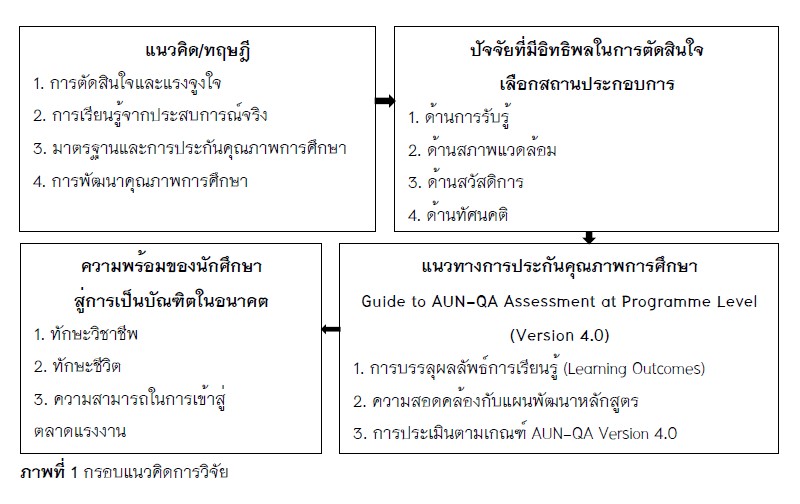
การวิจัยนี้มีวัตถุประสงค์เพื่อ 1) วิเคราะห์ปัจจัยที่มีอิทธิพลในการเลือกสถานประกอบการสหกิจศึกษาของนักศึกษาชั้นปีที่ 4 2) ศึกษาความเชื่อมโยงระหว่างปัจจัยในการเลือกสถานประกอบการสหกิจศึกษากับมาตรฐานการประกันคุณภาพการศึกษา และ 3) เสนอแนวทางการเตรียมความพร้อมของนักศึกษาสู่การเป็นบัณฑิตในอนาคต การวิจัยเป็นเชิงคุณภาพ กลุ่มตัวอย่าง ได้แก่ นักศึกษาชั้นปีที่ 4 โครงการสหกิจศึกษา ปีการศึกษา 2567 จำนวน 154 คน คำนวณจากสูตร Yamane ที่ระดับความคลาดเคลื่อน 0.05 เครื่องมือการวิจัยประกอบด้วยแบบสอบถามปลายเปิด 4 ด้าน (การรับรู้ สภาพแวดล้อม สวัสดิการ และทัศนคติ) และการวิเคราะห์เอกสาร แบบสอบถามผ่านการตรวจสอบความเหมาะสม ครอบคลุมเนื้อหา และความตรงตามเนื้อหาโดยผู้เชี่ยวชาญ 3 คน (IOC = 0.94) ทดสอบความน่าเชื่อถือกับกลุ่มตัวอย่าง 15 คน (Cronbach’s Alpha = 0.70) วิเคราะห์ข้อมูลโดยใช้กรอบแนวคิดการวิจัยเป็นแนวทางกับความถี่ของประเด็นที่ปรากฏในคำตอบแบบสอบถามปลายเปิด และเปรียบเทียบกับเกณฑ์ประกันคุณภาพการศึกษาระดับหลักสูตร (AUN-QA Version 4.0) ด้วยวิธีการวิเคราะห์เนื้อหา และการจัดกลุ่มข้อมูล
ผลการวิจัยพบว่า 1) ปัจจัยที่มีอิทธิพลในการเลือกสถานประกอบการสหกิจศึกษาของนักศึกษาชั้นปีที่ 4 ประกอบด้วย (1) การรับรู้ ได้แก่ ชื่อเสียง ภาพลักษณ์ ความเกี่ยวข้องกับวิชาชีพ และทรัพยากรองค์กร (2) สภาพแวดล้อม ได้แก่ การเดินทาง สิ่งอำนวยความสะดวก วัฒนธรรมการทำงาน ความปลอดภัยและบรรยากาศในองค์กร (3) สวัสดิการ ได้แก่ ค่าตอบแทน ที่พัก และอุปกรณ์การทำงาน และ (4) ทัศนคติ ได้แก่ คำแนะนำอาจารย์ รุ่นพี่ ศิษย์เก่า และข้อมูลที่เชื่อถือได้ ปัจจัยเหล่านี้สะท้อนถึงความต้องการพัฒนาทักษะวิชาชีพ การเรียนรู้ในสภาพจริง และการเตรียมความพร้อมเข้าสู่ตลาดแรงงาน 2) การเลือกสถานประกอบการที่มีคุณภาพส่งผลโดยตรงต่อการบรรลุผลลัพธ์การเรียนรู้ตามมาตรฐานการประกันคุณภาพการศึกษา (AUN-QA Version 4.0) โดยเฉพาะด้านผลการเรียนรู้ที่คาดหวัง ผลผลิต และผลลัพธ์ของหลักสูตร และ 3) แนวทางการเตรียมความพร้อมของนักศึกษาสู่การเป็นบัณฑิตในอนาคต คือ เข้าถึงข้อมูลอาชีพที่เชื่อถือได้ การเลือกสถานประกอบการที่ปลอดภัย มีระบบพี่เลี้ยง และสวัสดิการที่สนับสนุน การพัฒนาทัศนคติผ่านกิจกรรมเตรียมความพร้อม ช่วยเสริมความมั่นใจ ลดความกังวล และผลักดันให้นักศึกษาก้าวสู่การทำงานได้อย่างมีประสิทธิภาพ
Downloads
Article Details

อนุญาตภายใต้เงื่อนไข Creative Commons Attribution-NonCommercial-NoDerivatives 4.0 International License.
เอกสารอ้างอิง
ASEAN University Network - Quality Assurance. (2020). Guide to AUN-QA assessment at programme level (Version 4.0). ASEAN University Network. Retrieved from https://www.aunsec.org/application/files/2816/7290/3752/Guide_to_AUN-QA_Assessment_at_Programme_Level_Version_4.0_4.pdf
Boonchanda, P., Sonthirak, T., Ruksasri, T., Lakhajma, R., & Rawengwan, W. (2021). A study of factors affecting decision making on selection of establishment for professional experiences for English major students of the Faculty of Humanities and Social Sciences, Nakhon Sawan Rajabhat University. Journal of MCU Humanities Review, 7(2), 95-110. [In Thai]
Buacharoen, P., Somsathan, P., & Techapunratankul, N. (2022). The general information of students and factors affecting the selection of internships in the workplace of undergraduate students Faculty of Engineering at Rajamangala University of Technology Lanna, Chiang Mai. Payap University Journal, 32(2), 112-127. [In Thai]
Bucha, S. & Sakulchan, W. (2021). Image of students of the Faculty of Liberal Arts Rajamangala University of Technology Thanyaburi that affects the decision to accept students to practice cooperative education in the Organization. Pathum Thani: Rajamangala University of Technology Thanyaburi. [In Thai]
Buntanoht, K. (2024). Research for educational quality development in educational institutions: A case study of a model school in Phichit
Province. Phichit: The Secondary Educational Service Area Office Phichit. [In Thai]
Chintrakulchai, W. (2021). Personal data and sensitive data: Definitions, types, and categories. Retrieved from https://openpdpa.org/personal-data-type/ [In Thai]
Constructivist Teacher. (2021). Teaching children through real experiences. Retrieved from https://inskru.com/idea/-MdFxKufHRJm-KkhbL1u/ [In Thai]
Doramarn, N., Malakul Na Ayudhaya, P., & Kirdpitak, P. (2020). An experiential learning and critical reflection. Journal of Psychology Kasem Bundit University, 10(2), 20–28. [In Thai]
Higher Education Standards Committee. (2022). Announcement of the Higher Education Standards Committee: Standard criteria for bachelor's degree programs, B.E. 2565. Bangkok: Office of the Permanent Secretary, Ministry of Higher Education, Science, Research and Innovation. [In Thai]
Kaewka, C., Klinsukon, S., & Kamkaew, R. (2022). Factors influencing the choices of jobs for the undergraduates of the Faculty of Management Science at Loei Rajabhat University. Journal of Research and Development, Loei Rajabhat University, 17(60), 62-72. [In Thai]
Kaewseetong, T., Chawara, K., Limproyarom, P., Jansuri, A., & Ruangkam, K. (2023). A study of desirable characteristics of hotel management interns according to hotel requirements in the Koh Chang area, Trat Province, Thailand. Journal of Yongchalermwittaya University (Humanities and Social Sciences), 1(1), 49–64. [In Thai]
Kongkoon, S. (2023). The decision making on selection of organizations for professional experiences for students of Sisaket Rajabhat University. Academic Journal for the Humanities and Social Sciences Dhonburi Rajabhat University, 6(1), 15-25. Retrieved from https://so02.tci-thaijo.org/index.php/human_dru/article/view/258895/175247 [In Thai]
Labor Market Information Division, Department of Employment. (2022). Future trends of the Thai labor market. Retrieved from https://www.doe.go.th/prd/assets/upload/files/lmia_th/1518f36b23b0da4e6a26fb1a5ae262d6.pdf [In Thai]
Office of the Permanent Secretary, Ministry of Higher Education, Science, Research and Innovation. (2024). Education criteria for performance excellence 2024-2027. Retrieved from http://www.edpex.org/p/download-edpex.html?m=0 [In Thai]
Phimklang, P. (2019). Important factors affecting the selection of internship placement. In The 2nd National Student Research Conference in Humanities and Social Sciences (p. 443-450), January 19, 2019. Faculty of Humanities and Social Sciences, Suan Sunandha Rajabhat University.
Pholklang, N. (2023). Experiential learning theory or ELT. Retrieved from https://shorturl.at/0YwAD [In Thai]
Prince of Songkla University, Phuket Campus. (2024). Strategic plan of Prince of Songkla University, Phuket Campus. Retrieved from https://www.psu.ac.th/phuket/vision-mission/ [In Thai]
Rattanasereekiat, S. (2024). Theories of motivation. Retrieved from https://n9.cl/xmltr [In Thai]
Rungfamai, K. (2018). Characteristics of a quality curriculum in higher education: Perspective of students from the field of tourism and hospitality. Journal of Education Khon Kaen University, 41(3), 65-76. [In Thai]
Sangtong, K. & Tongtep, N. (2024). Study of the competencies of cooperative education students: A comparison among employers, instructors, and cooperative education students from Prince of Songkla University, Phuket Campus. Journal of Education Studies, 52(1), 1-15. [In Thai]
Srireepop, P. & Tehlah, A. (2025). The attitudes of employers towards internship students of Rattaphum College, Rajamangala University of Technology Srivijaya. Journal of MCU NakhonDhat, 12(2), 213–223. [In Thai]
Sukpreeprem, P. & Phiphopaekasit, P. (2024). Requirements, expectations, and satisfaction of business firms toward to performance of cooperative students, and internship students major in Industrial Business Administration and Trade, Mongkut's University of Technology North Bangkok Prachinburi Campus. Journal of Multidisciplinary in Humanities and Social Sciences. 7(2), 772-788. [In Thai]
Summart, D. (2020). Causal factors influencing satisfaction on selection of internship units for students of Management Science Faculty, Udon Thani Rajabhat University. Journal of Management Science, Udon Thani Rajabhat University, 2(2), 13-25. [In Thai]
Techanok, A., Jaronggsirawat, R., & Vatasatto, P. (2020). Educational management in the 21st century. Journal of MCU Nakhondhat, 7(9), 1-15. [In Thai]
Thaneeyai, P. (2022). The factors affecting generation Z decision to join the organization. (Master’s thesis, Naresuan University). [In Thai]
Tuntirojanawong, S. (2017). A direction of educational management in the 21st century. Veridian E-Journal, Silpakorn University, 10(2), 2843-2854. [In Thai]
Yamane, T. (1973). Statistics: An introductory analysis. (3rd ed.). New York: Harper & Row.
Younghaiphon, D. (2023). Conditions of decision-making in choosing an establishment and information on establishments for internships of diploma students towards becoming practitioners in the 21st century. Journal of Humanities and Social Sciences Surin Rajabhat University, 25(1), 220-236. [In Thai]
