
การพัฒนาชุดคู่มือการเล่านิทานเพื่อส่งเสริมทักษะทางสมองเพื่อบริหารจัดการชีวิตสู่ความสำเร็จของเด็กปฐมวัย
Article Sidebar
Main Article Content
บทคัดย่อ
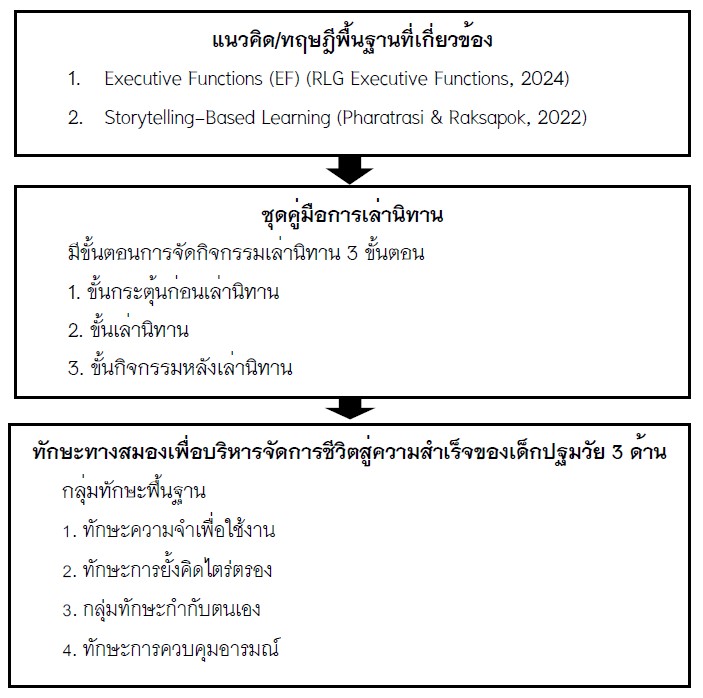
การวิจัยครั้งนี้มีวัตถุประสงค์เพื่อ 1) สร้างและพัฒนาชุดคู่มือการเล่านิทานเพื่อส่งเสริมทักษะทางสมองเพื่อบริหารจัดการชีวิตสู่ความสำเร็จของเด็กปฐมวัย 2) ศึกษาพัฒนาการด้านทักษะทางสมองของเด็กที่ได้รับการจัดกิจกรรมตามชุดคู่มือการเล่านิทาน และ 3) เปรียบเทียบระดับทักษะทางสมองของเด็กก่อนและหลังการจัดกิจกรรม และ 4) ศึกษาความพึงพอใจของครูปฐมวัยที่ใช้ชุดคู่มือการเล่านิทาน เป็นการวิจัยเชิงทดลอง โดยใช้แบบแผนการทดลองแบบกลุ่มเดียววัดก่อนและหลังการทดลอง กลุ่มตัวอย่างประกอบด้วย ครูปฐมวัย 20 คน และเด็กปฐมวัย 60 คน จากโรงเรียนในสังกัดสำนักงานเขตพื้นที่การศึกษาประถมศึกษาเลย เขต 1 ที่สุ่มแบบหลายขั้นตอน เครื่องมือวิจัย ได้แก่ 1) ชุดคู่มือการเล่านิทานที่ออกแบบตามกระบวนการ 3 ขั้นตอน คือ ขั้นกระตุ้นก่อนเล่านิทาน ขั้นเล่านิทาน และขั้นกิจกรรมหลังเล่านิทาน ดำเนินกิจกรรมต่อเนื่อง 8 สัปดาห์ 2) แบบประเมินทักษะทางสมองเพื่อบริหารจัดการชีวิตสู่ความสำเร็จ (Executive Functions: EF) และ 3) แบบประเมินความพึงพอใจของครูปฐมวัย วิเคราะห์ข้อมูลด้วยสถิติเชิงพรรณนา ได้แก่ ค่าเฉลี่ย ส่วนเบี่ยงเบนมาตรฐาน และสถิติ t-test แบบจับคู่ (Paired Sample t-test)
ผลการวิจัยพบว่า 1) ชุดคู่มือการเล่านิทานมีดัชนีความสอดคล้อง (IOC) ≥ 0.67 ทุกรายการ แสดงถึงความเที่ยงตรงเชิงเนื้อหา และมีค่าความเชื่อมั่นของเครื่องมือในระดับสูง (α = 0.92) เหมาะสมต่อการนำไปใช้ในบริบทการเรียนรู้ของเด็กปฐมวัย 2) เด็กที่ได้รับการจัดกิจกรรมด้วยชุดคู่มือการเล่านิทานมีพัฒนาการด้านทักษะทางสมองเพื่อบริหารจัดการชีวิตเพิ่มขึ้นในทุกด้าน ได้แก่ ความจำเพื่อใช้งาน การยั้งคิดไตร่ตรอง และการควบคุมอารมณ์ 3) ผลการเปรียบเทียบก่อนและหลังการจัดกิจกรรมพบว่า ระดับทักษะ EF ของเด็กสูงขึ้นอย่างมีนัยสำคัญทางสถิติที่ระดับ .01 ได้แก่ ความจำเพื่อใช้งาน (𝑥̄ก่อน = 3.43 ± 0.73; 𝑥̄หลัง = 4.43 ± 0.90), การยั้งคิดไตร่ตรอง (𝑥̄ก่อน = 1.83 ± 0.38; 𝑥̄หลัง = 3.60 ± 0.62) และการควบคุมอารมณ์ (𝑥̄ก่อน = 1.70 ± 0.47; 𝑥̄หลัง = 3.63 ± 0.49) และ 4) ครูปฐมวัยมีความพึงพอใจต่อชุดคู่มือการเล่านิทานในระดับมาก (𝑥̄ = 4.21 ± 0.51 จากคะแนนเต็ม 5) สะท้อนถึงความเหมาะสมและประสิทธิภาพของชุดกิจกรรมในการส่งเสริมทักษะสมองในบริบทปฐมวัยได้อย่างมีประสิทธิผล
Downloads
Article Details

อนุญาตภายใต้เงื่อนไข Creative Commons Attribution-NonCommercial-NoDerivatives 4.0 International License.
เอกสารอ้างอิง
Aksorn Charoen Tat. (2024). The power of storytelling: A meaningful learning process through stories for early childhood. Retrieved from https://www.aksorn.com/storytelling. [In Thai]
Bruner, J. S. (1963). The process of education. New York: Harvard University Press Vintage.
Bureau of Academic Affairs and Educational Standards, Ministry of Education. (2018). Early childhood education curriculum guide B.E. 2560 (2017) for children aged 3–6 years. Bangkok: Bureau of Academic Affairs and Educational Standards. [In Thai]
Center on the Developing Child, Harvard University. (2011). Building the brain’s “air traffic control” system: How early experiences shape the development of executive function. Retrieved from https://developingchild.harvard.edu/resources/building-the-brains-air-traffic-control-system-how-early-experiences-shape-the-development-of-executive-function/
Chutapakkadeekul, N. (Ed.). (2017). Development and standardization of an assessment tool for executive function in early childhood. Bangkok: Neuroscience Research Center, Institute of Molecular Biosciences, Mahidol University. [In Thai]
Eyre, E., Ruffini, M., & Duncan, P. (2020). Effects of cognitively engaging physical activity on preschool children’s cognitive outcomes: movement integration with storytelling. Early Childhood Education Journal, 48(6), 725–734. Retrieved from https://www.shapeamerica.org//Effects-of-Cognitively-Engaging-Physical-Activity-on-Preschool-Childrens-Cognitive-Outcomes.pdf
Exchange Press. (2022). Storytelling: A powerful cognitive tool in the early years. Retrieved from https://hub.exchangepress.com/eed/storytelling-a-powerful-cognitive-tool-in-the-early-years
Hanmethee, S. (2016). Developing executive function (EF) through reading. Bangkok: Rakluk Books. [In Thai]
Janssen, L., Scheper, A., & Vissers, C. (2024). Controlling the narrative: The relationship between narrative ability and executive functioning in children with developmental language disorders. Frontiers in Psychology, 15, Article 1344409. Retrieved from https://www.frontiersin.org/articles/10.3389/fpsyg.2024.1489997/full
Kaewphila, T. (2021). The effects of storytelling with big books on the language development of kindergarten level 2 children. MCU Ubonn International Journal, 6(2), 171-181. [In Thai]
Likert, R. (1961). New pattern of management. New York: McGraw – Hill.
Ministry of Education. (2017). Early childhood education curriculum B.E. 2560 (2017). Bangkok: Kurusapha Ladprao Printing House. [In Thai]
Namazi, S. A. & Sadeghi, S. (2024). The immediate impacts of TV programs on preschoolers’ executive functions and attention: A systematic review. BMC Psychology, 12, 226. Retrieved from https://bmcpsychology.biomedcentral.com/articles/10.1186/s40359-024-01738-1
Nawarat, J. (2023). Developing a training curriculum on designing activities to promote executive function (EF) skills in early childhood. Chaiyaphum Parithat Journal, 3(6), 109-121. [In Thai]
Noppakhun, C. (2018). Developing executive function skills for 21st century success in early childhood through Montessori assessment. Silpakorn University Journal of Education, 16(1), 75–90. [In Thai]
Perskaew, S. (2020). Development of executive brain function (EF) in early childhood children through storytelling activities, Kindergarten 1/3 (age 3 years), Early Childhood Training Center in Wat Thung, under the Aekkasamai Subdistrict Municipality. MCU Humanities Review, 6(1), 351-361. [In Thai]
Pharatrasi, S. & Raksapok, C. (2022). The effect of learning experiences through storytelling to develop executive brain function (EF) in early childhood children. Journal of Nakhonratchasima College Humanities and Social Sciences, 16(2), 353-368. [In Thai]
RLG Executive Functions. (2024). What are executive functions (EF). Retrieved from https://www.rlg-ef.com/
Sribua, W. (2017). Using puppets with early childhood children [Teaching material for the course: Stories and puppets for early childhood, Udon Thani Rajabhat University]. [In Thai]
Schunk, D. H. (2012). Learning theories: An educational perspective. (6th ed.). Boston, MA: Pearson.
Sukpridee, N. (2021). Development of executive brain function (EF) in crisis.Retrieved from https://www.eef.or.th/article-executive-functions-151221/ [In Thai]
Yamane, T. (1973). Statistics: An introductory analysis. New York: Harper & Row.
White, R. E., & Carlson, S. M. (2021). Pretending with realistic and fantastical stories facilitates executive function in 3-year-old children. Journal of Experimental Child Psychology, 207, 105090. Retrieved from https://doi.org/10.1016/j.jecp.2021.105090
Wongkhaluang, J. (2020). Reading stories to children to enhance EF power. Retrieved from https://www.jarutus.com/17541498-ef [In Thai]
