
The Life Development Project Model: An Innovative Learning Process Management of the Learning Institute for Everyone
Article Sidebar
Main Article Content
Abstract
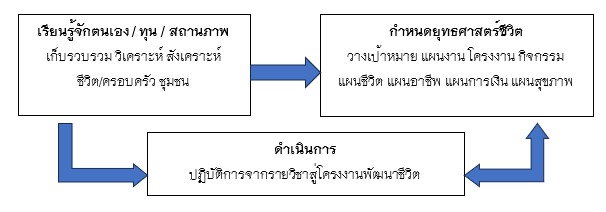
Learning Institute for Everyone is committed to expanding educational opportunities and fostering lifelong learning. As a higher education institution, it empowers learners to have dignity and self-sufficiency within their local communities. Through experiential learning, the institute seamlessly integrates academic knowledge with everyday life and the local context. Education here is deeply connected to culture, traditions, and local wisdom. The community serves as both a learning resource and a key supporter of education, while local scholars and community sages transmit knowledge, local wisdom, and foster a lifelong learning mindset. This approach ensures continuous personal and professional growth for all learners. Furthermore, the Life Development Project Model is one of the graduation criteria for the students of the Learning Institute for Everyone. Every learner must actively work on enhancing their own lives or advancing their careers, demonstrating the tangible impact of the institute’s learning philosophy, using the learners' lives and the academic content to unify life development, career advancement, and learning into a single entity.
Downloads
Article Details

This work is licensed under a Creative Commons Attribution-NonCommercial-NoDerivatives 4.0 International License.
References
Bonwell, C. C. & Eison, J. A. (1991). Active learning: Creating excitement in the classroom. Washington, D.C.: George Washington University.
Buck Institute for Education. (2015). Project-based learning: A strategy for enhancing student engagement and learning. Retrieved from https://www.pblworks.org
Kongrat, C. (2024). Active learning: Discourse in education for student development. Journal of Education Studies, Chulalongkorn
University, 52(1), EDUCU5201002. https://doi.org/10.14456/educu.2024.2 [In Thai]
Kurukarnkaset, S. (Process Editor). (2020). Bachelor of arts program student handbook major: Life development and community entrepreneurship (revised curriculum 2020) Bachelor of Arts Program, Faculty of Liberal Arts. Samut Songkhram: Learning Institute for Everyone. [In Thai]
Markham, T. (2011). Project-based learning: A bridge just far enough. Novato, CA: The Buck Institute for Education.
Ministry of Education. (2017). National Education Plan 2017-2036. Bangkok: Office of the Secretariat of the Education Council. [In Thai]
Office of the Education Council. (2018). Education in the 21st century. Bangkok: Ministry of Education. [In Thai]
Organization for Economic Cooperation and Development (OECD). (2018). The future of education and skills: Education 2030. Retrieved from https://www.oecd.org/education/2030-project/
Pennsylvania Department of Education. (2008). Commitment to the role of the teacher as a facilitator of learning, 2007. Retrieved from https://lms.pdesas.org/content/courses/General_PD/T21-NFC/course_attachments/m2tA_01.pdf
Partnership for 21st Century Skills (P21). (2011). Framework for 21st century learning. Retrieved from https://www.battelleforkids.org/networks/p21/frameworks-resources
Suthirat, C. & Suthirat, P. (2024). Active learning: Concepts, methods, and techniques. Phitsanulok: Rattanasuwan Printing House. [In Thai]
Taepngern, A. (2021). Change your thinking, change your life (Arunuma) [Video interview]. Interview by LIFE Learning Institute for Everyone. YouTube. Retrieved from https://www.youtube.com/watch?v=RxV0Dq8-erg
Trisuwan, C. (2021). Life degree: Study at the university of life and conquer 80 million in debt within three years [Video interview]. Interview by LIFE Learning Institute for Everyone. YouTube. Retrieved from https://www.youtube.com/watch?v=dC9XMYex_lE&t=23s
United Nations Educational, Scientific and Cultural Organization (UNESCO). (2015). Global citizenship education: Topics and learning objectives. Retrieved from https://unesdoc.unesco.org/
Vetchapitak, S. (2012). Higher education for life and community. Bangkok: Charoenwit Printing. [In Thai]
World Economic Forum (WEF). (2016). The future jobs report 2016. Retrieved from https://www.weforum.org/reports/the-future-of-jobs
