
Components of Intercultural Teaching Competence Among Traditional Thai Dance Teachers in Schools, Samut Sakhon Province
Article Sidebar
Main Article Content
Abstract
In the context of Samut Sakhon Province, which is characterized by ethnic and cultural diversity, the instructional design of traditional Thai dance presents both challenges and constraints for teachers. These include issues related to communication, comprehension, beliefs, and diverse values. This study is therefore significant in identifying and conceptualizing the essential components of intercultural teaching competency necessary for fostering a learning environment that promotes shared understanding and respect for differences.
This research aimed to examine the components of intercultural teaching competency among traditional Thai dance teachers in Samut Sakhon schools. A mixed-methods approach, combining both quantitative and qualitative data collection, was employed. Key informants included: (1) 47 traditional Thai dance teachers affiliated with the Samut Sakhon Primary Educational Service Area Office, and (2) 10 individuals involved in the research, including the Director of the Supervision, Monitoring, and Evaluation Division; supervision teams; school directors; and traditional Thai dance teachers in Samut Sakhon Province. The research instruments included: (1) an interview protocol designed to explore components of intercultural teaching competence, and (2) a competency assessment form focused on the same construct. Confirmatory Factor Analysis (CFA) was conducted using the LISREL program, and model fit was assessed through statistical indices including chi-square (χ²), Goodness of Fit Index (GFI), Adjusted Goodness of Fit Index (AGFI), Comparative Fit Index (CFI), and Root Mean Square Error of Approximation (RMSEA).
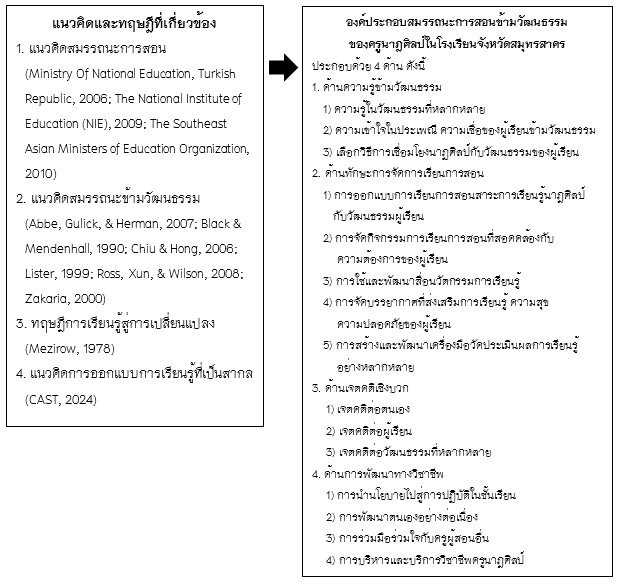
The findings revealed that the intercultural teaching competency of traditional Thai dance teachers in Samut Sakhon schools comprises four main components: intercultural knowledge, instructional management skills, positive attitudes, and professional development, with a total of 15 indicators. The second-order confirmatory factor analysis showed consistency with empirical data ( x ² = 413.54, df = 252, p = 0.522, GFI = 0.98, AGFI = 0.99, CFI = 0.98, RMSEA = 0.0421). All factor loadings were statistically significant (p < 0.001), confirming that the model is theoretically sound and reliable for assessing intercultural teaching competence among traditional Thai dance educators in this context.
Downloads
Article Details

This work is licensed under a Creative Commons Attribution-NonCommercial-NoDerivatives 4.0 International License.
References
Abbe, A., Gulick, L. M. V., & Herman, J. L. (2007). Cross-cultural competence in army leaders: A conceptual and empirical foundation (Technical Report 2007-01). Retrieved from https://apps.dtic.mil/sti/pdfs/ADA463989.pdf
Arphattananon, T. (2021). The transferring of knowledge to reduce educational inequality and increase educational opportunity for children of migrant workers in Samut Sakhon Province. Bangkok: National Research Council of Thailand. [In Thai]
Berry, J. W. (1997). Immigration, acculturation, and adaptation. Applied Psychology, 46(1), 5–34. https://doi.org/10.1111/j.1464-0597.1997.tb01087
Black, J. S. & Mendenhall, M. (1990). Cross-cultural training effectiveness: A review and a theoretical framework for future research. Academy of Management Review, 15(1), 113–136. Retrieved from https://doi.org/10.5465/amr.1990.11591834
CAST. (2024). Universal Design for Learning guidelines version 3.0. Retrieved from https://udlguidelines.cast.org
Center of Excellence in Migration and Development. (2021). The situation of education management for migrant children in Thailand. Retrieved from www.unicef.org/thailand/media/9891/file/Investing%20in%20a%20Global%20Future%20-%20Full%20Research%20Report%20TH.pdf [In Thai]
Chaiyapan, M. (2019). Human behavioral development. Bangkok: Chulalongkorn University Press. [In Thai]
Chinawong, P., Poopan, S., & Masantiah, J. (2022). A factor analysis of cross-cultural competence of teachers under the Bangkok Metropolitan Administration. Retrieved from www.digital.car.chula.ac.th/cgi/viewcontent.cgi?article=4015&context=educujournal [In Thai]
Chiu, C. Y. & Hong, Y. Y. (2006). Social psychology of culture. New York: Psychology Press.
Choompunuch, B., Kamdee, K., & Taksino, P. (2024). Cross-cultural competence of pre-service teachers in Thailand. Journal of Multicultural Education Studies, 12(1), 45–62. [In Thai]
Cronbach, L. J. (1951). Coefficient alpha and the internal structure of tests. Psychometrika, 16(3), 297–334. https://doi.org/10.1007/BF02310555
Department of Employment. (2025). Statistics from the Office of Foreign Workers Administration regarding the number of foreign nationals still in the Kingdom with valid work permits. Retrieved from https://www.doe.go.th/prd/alien/statistic/param/site/152/cat/82/sub/0/pull/category/view/list-label. [In Thai]
Hair, J. F. Jr., Babin, B. J., & Krey, N. (2017). Covariance-based structural equation modeling in the Journal of Advertising: Review and recommendations. Journal of Advertising, 46(1), 163-177.
Hammer, M. R. (1987). Behavioral dimensions of intercultural effectiveness: A replication and extension. International Journal of Intercultural Relations, 11(1), 65–88. https://doi.org/10.1016/0147- 1767(87)90027-6
Kaseamsuk, T., Mahavijit, P., & Fukushima, Y. (2024). Developing situational-based learning activities to enhance intercultural competence between Thailand and Japan. Journal of Comparative Education, 30(2), 88– 104. [In Thai]
Khamsook, S., Rerkjaree, S., & Tuksino, P. (2023). Development of a cultural intelligence enhancement program for teachers in multicultural schools. Journal of Educational Research and Innovation, 18(2), 75–92. [In Thai]
Kingdom of Thailand. (2017). Constitution of the Kingdom of Thailand B.E. 2560 (2017). Bangkok: Government Gazette. [In Thai]
Lister, R. (1999). Citizenship: Feminist perspectives. (2nd ed.). New York: New York University Press.
McDonald, D. P., McGuire, G., Johnston, J., Selmeski, B. R., & Abbe, A. (2008). A review of selected cross- cultural competence assessment tools for the U.S. military. Retrieved from https://cgsc.contentdm.oclc.org/digital/collection/p16040coll2/id/12/download.
Mezirow, J. (1978). Perspective transformation. Adult Education Quarterly, 28(2), 100–110. https://doi.org/10.1177/074171367802800202
Ministry of Education Thailand. (2008). Basic education core curriculum B.E. 2551. Bangkok: The Agricultural Cooperative Federation of Thailand., Limited. [In Thai]
Ministry of National Education, Turkish Republic. (2006). General competencies of teaching profession. Ankara, Turkey: Ministry of National Education.
Office of the Education Council. (2018). The provision of education for stateless children and children of migrant workers in Thailand. Bangkok: Office of the Education Council, Ministry of Education. [In Thai]
Organisation for Economic Co-operation and Development (OECD). (2018). Preparing our youth for an inclusive and sustainable world: The OECD PISA global competence framework. Retrieved from https://www.oecd.org/education/Global-competency-for-an-inclusive-world.pdf
Rattanapan, J. (2017). A multicultural early childhood education model among Thai and migrant students from Myanmar in Phangnga Province. (Doctoral Dissertation, Educational Administration, Phuket Rajabhat University). [In Thai]
Reaungsri, S. & Leepreecha, P. (2019). Multicultural education approaches in preparing new generation teachers. Journal of Education Studies, 47(3), 22–40. [In Thai]
Ross, L., Xun, W. Q. E., & Wilson, J. (2008). Language and the bicultural dynamics of persuasion and impression formation. Advances in Experimental Social Psychology, 40, 1–64. https://doi.org/10.1016/S0065-2601(07)00001-9
Samut Sakhon Provincial Education Office. (2021). Education development plan (2020–2022), Samut Sakhon Province. Retrieved from https://sknpeo.moe.go.th/79832-2/ [In Thai]
Samut Sakhon Provincial Employment Office. (2023). Report on migrant labor situation in Samut Sakhon Province. Retrieved from https://www.doe.go.th [In Thai]
Selmeski, B. R. (2007). Military cross-cultural competence: Core concepts and individual development. Retrieved from https://www.airuniversity.af.edu/Portals/10/AFCLC/03.%20Faculty/Practical%20Guides_Reports/selmeskimay2007.pdf
Srisa-art, B. (2010). Preliminary research. Bangkok: Phiriyasan. [In Thai]
The National Institute of Education (NIE). (2009). A teacher education model for the 21st century. Singapore: National Institute of Education.
The Southeast Asian Ministers of Education Organization (SEAMEO). (2010). SEAMEO regional guidelines on teacher competency standards. Bangkok: SEAMEO Secretariat.
Thinh, M. P. (2024). Adjusting teaching approaches and enhancing intercultural competence: Experiences of student teachers in international exchange programs. Journal of International Education and Development, 39(1), 55–72.
United Nations Children’s Fund (UNICEF). (2022). Investing in a global future: Education and employment opportunities for migrant children and youth in Thailand. Retrieved from https://www.unicef.org/thailand/media/9891/file/Investing%20in%20a%20Global%20Future%20-%20Full%20 Research%20Report%20TH.pdf [In Thai]
Vibulsri, Y. R. (2013). Measurement and achievement test construction. Bangkok: Chulalongkorn University Press. [In Thai]
Zakaria, N. (2000). The effects of cross-cultural training on the acculturation process of the global workforce. International Journal of Manpower, 21(6), 492–510. https://doi.org/10.1108/01437720010379320
