
Development of a Learning Management Model for Teachers to Foster Entrepreneurial Characteristics in Secondary School Students: A Case Study in the Learning City Context of Chachoengsao
Article Sidebar
Main Article Content
Abstract
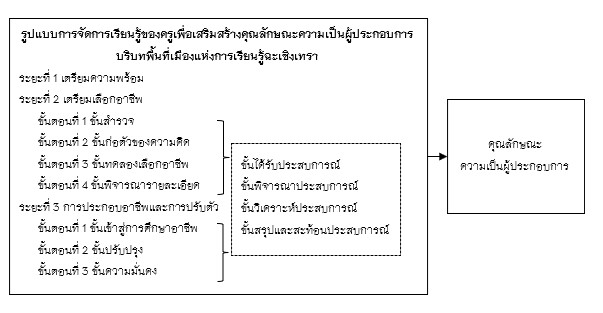
The objectives of the study were to 1) examine the entrepreneurial characteristics of secondary school students, 2) develop a learning management model for teachers to foster these characteristics within the context of the Learning City of Chachoengsao, and 3) evaluate the effectiveness of the developed model. The participants of the trial study of the learning management model were 60 secondary school students from 2 schools in Chachoengsao Province, selected from multi-Stage random sampling method. The research instruments included a semi-structured interview form, an instructional manual for teachers to promote students’ entrepreneurial characteristics, and an entrepreneurial characteristics assessment tool for secondary students. The data were analyzed using mean, standard deviation, and a t-test for dependent samples.
The findings were as follows: 1) The entrepreneurial orientation of secondary school students can be summarized into 5 components (10 indicator behaviors), namely 1.1) autonomy (2 indicator behaviors), 1.2) innovativeness (2 indicator behaviors), 1.3) proactiveness (2 indicator behaviors), 1.4) competitive aggressiveness (2 indicator behaviors), and 1.5) risk-taking (2 indicator behaviors). 2) The developed learning management model comprised principles, objectives, time spent on learning activities, learning management activities, learning activity organization guidelines, and measurement and evaluation. The results of the evaluation of the appropriateness of the learning management model were at a very high level, with an average score between 4.20 and 5.00. 3) The post-test means scores of students' entrepreneurial characteristics were significantly higher than the pre-test scores at the .05 level, both overall and by individual school.
Downloads
Article Details

This work is licensed under a Creative Commons Attribution-NonCommercial-NoDerivatives 4.0 International License.
References
Ali, A., Aima, A., Bhasin, J., & Hisrich, R. D. (2021). Measuring entrepreneurial orientation in developing economies: Scale development and validation. Jindal Journal of Business Research, 10(2), 147–162.
Bolton, D. L. & Lane, M. D. (2012), Individual entrepreneurial orientation: Development of a measurement instrument. Education + Training, 54(2/3), 219-233.
Canuzakov, K., Geri, S., Demirhan, B., & Tekeli, S. C. (2017). Entrepreneurship characteristics of university students who take ‘Physical Education and Sport’ education. International Journal of Humanities and Social Science, 7(2), 157-165.
Chachoengsao Provincial Education Office. (2024). Chachoengsao provincial education development plan 2023 - 2027, revised version 2024. https://ccopeo.moe.go.th [In Thai]
Chuchai, A. (1999). Participation. Bangkok: Odeon Store. [In Thai]
Clark, D. R., Covin, J. G., & Pidduck, R. J. (2025). Individual entrepreneurial orientation: Scale development and validation. Entrepreneurship Theory Practice, 49(3) 668–710
Covin, J. G., Rigtering, J. P. C., Hughes, M., Kraus, S., Cheng, C. F., & Bouncken, R. B. (2020). Individual and team entrepreneurial orientation: Scale development and configurations for success. Journal of Business Research, 112, 1–12.
Dess, G. G. & Lumpkin, G. T. (2005). The role of entrepreneurial orientation in stimulating effective corporate entrepreneurship. Academy of Management Perspectives, 19(1), 147-156.
Ephrem, A. N., & Murimbika, M. (2024). Development and validation of an individual entrepreneurial potential new measurement scale. Journal of Research in Marketing and Entrepreneurship, 26(1), 63-110. https://doi.org/10.1108/JRME-07-2022-0094
Felício, J. A., Rodrigues, R., & Caldeirinha, V. R. (2012). The effect of entrepreneurship on corporate performance. Management Decision, 50(10), 1717-1738.
Frese, M. (2000). Success and failure of microbusiness owners in Africa: A psychological approach. Westport, CT: Quorum/Greenwood.
Frese, M. & de Kruif, M. (2000). Success and failure of microbusiness owners in Africa: A psychological approach. Westport, Quorum Books/Greenwood Publishing Group. https://psycnet.apa.org/record/2000-03473-000
Frese, M., Friedrich, C., & Unger, J. M. (2005). Entrepreneurial orientation: Psychological model of success among southern African small business owners. European Journal of Work and Organizational Psychology, 14(3), 315–344.
Gorostiaga, A., Aliri, J., Ulacia, I., Soroa, G., Balluerka, N., Aritzeta, A., & Muela, A. (2019). Assessment of entrepreneurial orientation in vocational training students: Development of a new scale and relationships with self-efficacy and personal Initiative. Frontiers in Psychology, 10(1125), 1-10.
Hitt, M. A., Hoskisson, R. E., & Kim, H. (1997). International diversification: Effects on innovation and firm performance in product-market firms. Academy of Management Journal, 40(4), 767- 798.
Income, M. (2021). The development of entrepreneurship measuring tool for undergraduate students in higher education institutions. (Doctoral thesis, Naresuan University). NU Intellectual Repository. https://nuir.lib.nu.ac.th/dspace/handle/123456789/5016 [In Thai]
Joyce, B. & Weil, M. (1997). Models of teaching. (5th ed.). New Delhi: Prentice Hall of India Private Limited.
Köksal, O. & Yürük, N. (2022). Development of an entrepreneurship scale for students in the departments of foreign languages. International Journal of Curriculum and Instruction, 14(2), 1233–1248.
Lumpkin, G. T. & Dess, G. G. (1996). Clarifying the entrepreneurial construct and linking it to performance. Academy of Management Review, 21(1), 135-172.
Lumpkin, G. T., Cogliser, C. C., & Schneider, D. R. (2009). Understanding and measuring autonomy: An entrepreneurial orientation perspective. Entrepreneurship, Theory and Practice, 33(1), 47-69.
Lumpkin, G. T. & Dess, G. G. (2001). Linking two dimensions of entrepreneurial orientation to firm performance: The moderating role of environment and Industry Life Cycle. Journal of Business Venturing, 16(5), 429-451.
Miller, D. (1983). The correlations of entrepreneurship in three types of firms. Management Science, 29(7), 770-791.
Office of the Basic Education Commission. (2017). Announcement of the Office of the Basic Education Commission on the management of educational institution curriculum. http://academic.obec.go.th/web/news/view/75 [In Thai]
Office of the Secretary-General of the Education Council. (2017). National education plan 2017-2036. Office of the Secretary-General of the Education Council, Ministry of Education. Bangkok: Prik Wan Graphic Co., Ltd. [In Thai]
Onthanee, A. (2021). The effectiveness of participatory learning to promote occupational competency for secondary school students. Journal of Education and Innovation, 23(2), 336–350. [In Thai]
Rangabthuk, W. (1999). Student-centered teaching management. Bangkok: Love and Love Press. [In Thai]
Rauch, A., Wiklund, J., Lumpkin, G.T., & Frese, M. (2009), Entrepreneurial orientation and business performance: An assessment of past research and suggestions for the future. Entrepreneurship Theory and Practice, 33(3), 761-87.
Santos, G., Marques, C. S., & Ferreira, J. M. J. (2020), Passion and perseverance as two new dimensions of an Individual Entrepreneurial Orientation scale. Journal of Business Research, 112(2020), 190-199.
So, I. G., Ridwan, A., Simamora, B. H., & Aryanto, R. (2017). Confirming entrepreneurial orientation dimensions and linking it with entrepreneurial intention among business students in Indonesia. International Journal of Economics & Management, 11(2), 277–299.
Tamkal, Y., Charungkiattikun, S., & Amatayakul, K. (2018). Development of participatory learning processes based on green lifestyle principles to enhance family well-being. Journal of HR intelligence, 13(1), 20-45. [In Thai]
Thapsat, K. (2021). Learning city: Concepts for promoting lifelong learning with local base. Retrieved from https://research.eef.or.th/learning-city-101/ [In Thai]
Tiedeman, D. V., & O’hara, R. P. (1963). Career development: choice and adjustment: differentiation and integration in career development. New York: College Entrance Examination Board.
Wiklund, J. & Shepherd, D. (2003). Knowledge-based resources, entrepreneurial orientation, and the performance of small and medium-sized businesses. Strategic Management Journal, 24(13), 1307-1314. https://doi:10.1002/smj.360
Wisesing, N. (2017). Development of learning management potential of small schools emphasizing community participation. (Doctoral thesis, Curriculum Research and Development Program, Graduate School Srinakharinwirot University). [In Thai]
