
การพัฒนาความคิดสร้างสรรค์และผลสัมฤทธิ์ทางการเรียนของนักเรียนชั้นประถมศึกษาปีที่ 5 หน่วย การเปลี่ยนแปลงทางกายภาพและการเปลี่ยนแปลงทางเคมี โดยการจัดการเรียนรู้แบบสมองเป็นฐานร่วมกับความรู้ในเนื้อหาผนวกวิธีการสอนและเทคโนโลยี
Article Sidebar
Main Article Content
บทคัดย่อ
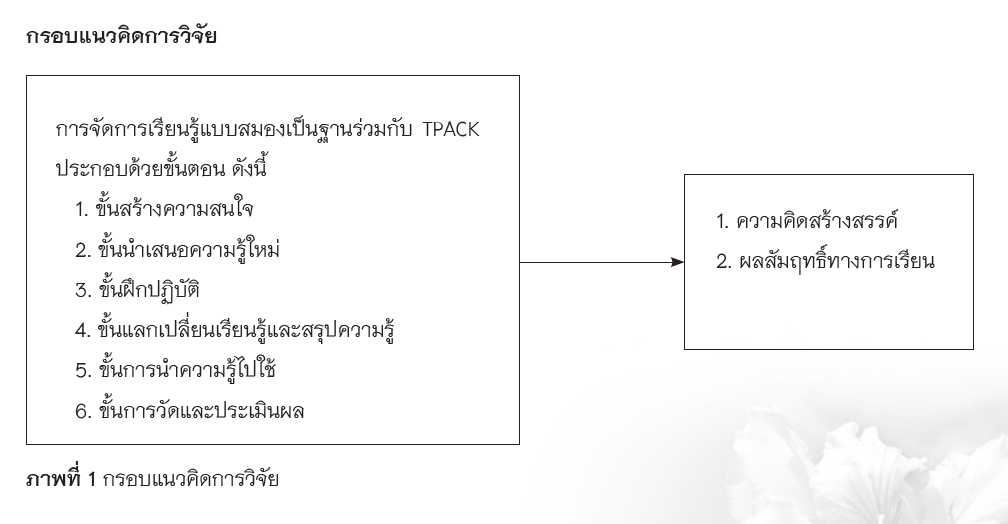
การวิจัยครั้งนี้มีวัตถุประสงค์เพื่อ 1) พัฒนาแผนการจัดการเรียนรู้ หน่วย การเปลี่ยนแปลงทางกายภาพและการเปลี่ยนแปลงทางเคมี ชั้นประถมศึกษาปีที่ 5 โดยการจัดการเรียนรู้แบบสมองเป็นฐานร่วมกับความรู้ในเนื้อหาผนวกวิธีการสอนและเทคโนโลยี (Technological Pedagogical Content Knowledge: TPACK) ให้มีประสิทธิภาพตามเกณฑ์ 80/80 2) เปรียบเทียบความคิดสร้างสรรค์ของนักเรียน ก่อนและหลังเรียน 3) เปรียบเทียบผลสัมฤทธิ์ทางการเรียนของนักเรียน ก่อนและหลังเรียน กลุ่มตัวอย่าง คือ นักเรียนชั้นประถมศึกษาปีที่ 5 โรงเรียนแห่งหนึ่ง สังกัดสำนักงานเขตพื้นที่การศึกษาประถมศึกษาสกลนคร เขต 1 ในจังหวัดสกลนคร ภาคเรียนที่ 2 ปีการศึกษา 2566 จำนวน 40 คน โดยการสุ่มตัวอย่างแบบกลุ่ม เครื่องมือที่ใช้ในการวิจัย ได้แก่ แผนการจัดการเรียนรู้ แบบวัดความคิดสร้างสรรค์ และแบบวัดผลสัมฤทธิ์ทางการเรียน สถิติที่ใช้ ได้แก่ ร้อยละ ค่าเฉลี่ย ส่วนเบี่ยงเบนมาตรฐาน และการทดสอบค่าทีแบบไม่เป็นอิสระต่อกัน (t-test for Dependent Samples)
ผลการวิจัยพบว่า 1) แผนการจัดการเรียนรู้แบบสมองเป็นฐานร่วมกับ TPACK หน่วย การเปลี่ยนแปลงทางกายภาพและการเปลี่ยนแปลงทางเคมี มีประสิทธิภาพเท่ากับ 81.67/80.94 ซึ่งสูงกว่าเกณฑ์ 80/80 2) ความคิดสร้างสรรค์ของนักเรียนหลังเรียนสูงกว่าก่อนเรียน อย่างมีนัยสำคัญทางสถิติ ที่ระดับ .01 3) ผลสัมฤทธิ์ทางการเรียนของนักเรียนหลังเรียนสูงกว่าก่อนเรียน อย่างมีนัยสำคัญทางสถิติ ที่ระดับ .01
Downloads
Article Details

อนุญาตภายใต้เงื่อนไข Creative Commons Attribution-NonCommercial-NoDerivatives 4.0 International License.
เอกสารอ้างอิง
Bunyo, S. (2024). The development of a mathematics teaching model based on brain-based learning about probability for grade 12 students. Journal of Psychological Educational and Social Sciences Research, 20(2), 44-56. [In Thai]
Caine, G. & Caine, R. N. (1990). Understanding a brain-based approach learning and teaching. Educational Leadership, 48(2), 66-70.
Chaichat, H. (2022). The development of brain-based instructional management through an online system with practicing Thai reading and writing skills for Prathom Suksa 2 students. (Master’s thesis, Curriculum and Instruction Program, Mahasarakham University). [In Thai]
Chareonwongsak, K. (2013). Creative thinking. (5th ed.). Bangkok: Success Media. [In Thai]
Choengchumratnukul School. (2021). Results of the ordinary national educational test: (O-NET) for Prathomsuksa 6, Academic Year 2021, 2022. Bangkok: National Institute of Educational Testing Service (Public Organization). [In Thai]
Choengchumratnukul School. (2022). Results of the ordinary national educational test: (O-NET) for Prathomsuksa 6, Academic Year 2022, 2024. Bangkok: National Institute of Educational Testing Service (Public Organization). [In Thai]
Choengchumratnukul School. (2023). Results of the ordinary national educational test: (O-NET) for Prathomsuksa 6, Academic Year 2023, 2024. Bangkok: National Institute of Educational Testing Service (Public Organization). [In Thai]
Cronbach, L. J. (1990). Essentials of psychological testing. (5th ed). New York: Harper Collins Publishers, Inc.
Faculty of Psychology, Chulalongkorn University. (2023). Creativity. Retrieved from https://www.psy.chula.ac.th/th/feature-articles/creativity [In Thai]
Garaparp, P. (2021). The development of learning activities based on brain-based learning (BBL) with motion graphic media to enhance reading and spelling of students in Pratom 2. (Master’s thesis, Department of Educational Technology, Silpakorn University). [In Thai]
Handayani, B. S. & Corebima, A. D. (2017). Model brain-based learning (BBL) and whole brain teaching (WBT) in learning. International Journal of Science and Applied Science, Conference Series, 1(2), 153-159.
Hongjed, P. & Siharak, S. (2021). The improvement of reading comprehension ability through brain-based learning together with KWL plus technique for Primary 3 students. Journal of Social Science and Buddhistic Anthropology, 6(9), 264-279. [In Thai]
Intaprot, P. & Yoonisil, W. (2023). The effectiveness of an enrichment of financial literacy curriculum base on brain-base learning management of the undergraduate students in private higher education. Journal of Social Science and Cultural, 7(5), 376-390. [In Thai]
Jaengploy, P. (2021). The development of learning activity package to enhance creative thinking for secondary students. (Master’s thesis, Curriculum and Instruction Program, Rajabhat Rambhai Barni University). [In Thai]
Jantarajit, N. (2010). Thinking learning. Mahasarakham: Mahasarakham University. [In Thai]
Koehler, M. J., Mishra, P., Kereluik, K., Shin, T. S., & Graham, C. R. (2014). The technological pedagogical content knowledge framework. In J. M. Spector, M. Merrill, J. Elen, & M. Bishop (Eds.), Handbook of Research on Educational Communications and Technology (pp. 101-111). Springer.
Kuder, F. (1991). Comments concerning the appropriate use of formulas for estimating the internal consistency reliability of tests. Educational and Psychological Measurement, 51(1991), 873-874.
Kuiraksa, S., Maison, W., & Deeying, S. (2022). The study of learning retention on “Kingdom of Life” by using brain-based learning for Grade 9. Rajabhat Rambhai Barni Research Journal, 16(3), 56-66. [In Thai]
Lerdwicha, P. & Jarupakorn, A. (2007). Design the learning process by understanding the brain. Bangkok: Learning Institute. [In Thai]
Ministry of Education. (1999). National Education Act B.E. 2542 (1999). Retrieved from https://www.sl.ac.th/addons/qa/9.pdf [In Thai]
Ministry of Education. (2009). The basic education core curriculum B.E. 2551. Bangkok: The Agricultural Cooperative Federation of Thailand Publisher. [In Thai]
Ministry of Health (MOH). (2024). How important is education? and guidelines for educational development. Retrieved from https://moh.mn/การศึกษาสำคัญอย่างไร-และแนวทางพัฒนาการศึกษา [In Thai]
Onla-or, C., Prakobphon, A., & Chusakul, N. (2023). Learning in the 21st century: The digital world. Learning Encouragement Journal, 3(1), 1-13. [In Thai]
Panitworakul, P. (2022). A model for the development of the learning achievement of the biology of vertebrates of Grade 6 students by using brain-based learning (BBL). Journal of MCU Peace Studies, 10(4), 1534-1544. [In Thai]
Petcha, W. & Boonsong, S. (2020). Development of achievement and analytical skills in mathematics course using brain-based learning of Mattayomsueksa 3 students. Journal of Social Science and Buddhistic Anthropology, 5(12), 200-212. [In Thai]
Poodkhunthod, W. & Keeratichamroen, W. (2019). A study of learning achievement on lovely toy and tool learning unit to develop science process skills and scientific mind of grade 2 students using brain-based learning. Ratchaphruek Journal, 17(2), 56-64. [In Thai]
Saengwandee, S., Kongim, B., & Wangwasit K. (2017). The science instructional model by using brain-based learning development of Prathomsuksa 3 students on learning achievement, creative thinking, and emotional quotients. Journal of Educational Measurement Mahasarakham University, 23(Special issue), 254-265. [In Thai]
Sanguanrat, S. (2024). The development of teaching and learning model based on brain-based learning combined with the KWL Plus technique to enhance learning achievement and satisfaction in the subject of educational philosophy and curriculum development for teacher education students. Journal of Roi Kaensarn Academi, 9(10), 1735-1752. [In Thai]
Sillapawattana, S., Markmee, K., & Pothasin, V. (2021). The study of learning management by using brain-based learning in subjects of Thai language, Thai culture, and Thai history for pupils of flexible first and second grade at Christian German School Chiang Mai. Payap University Journal, 31(2), 1-16. [In Thai]
Toomhome, S., Yonwilad, W., Tongmual, N., & Somsub, P. (2023). The improvement of students' analytical thinking skills on statistics of Grade 8 student by using brain-based learning activities. Journal of Academic Surindra Rajabhat, 1(3), 1-14. [In Thai]
Torrance, E. P. (1965). Rewarding creative behavior: Experiments in classroom creativity. New Jersey: Prentice-Hall Inc.
Wijayanti, K., Khasanah, A. F., Rizkiana, T., Mashuri, N. R. D., & Budhiati, R. (2021). Mathematical creative thinking ability of students in treffinger and brain-based learning at junior high school. Journal of Physics, Conference Series, 1918(4), 1-5.
