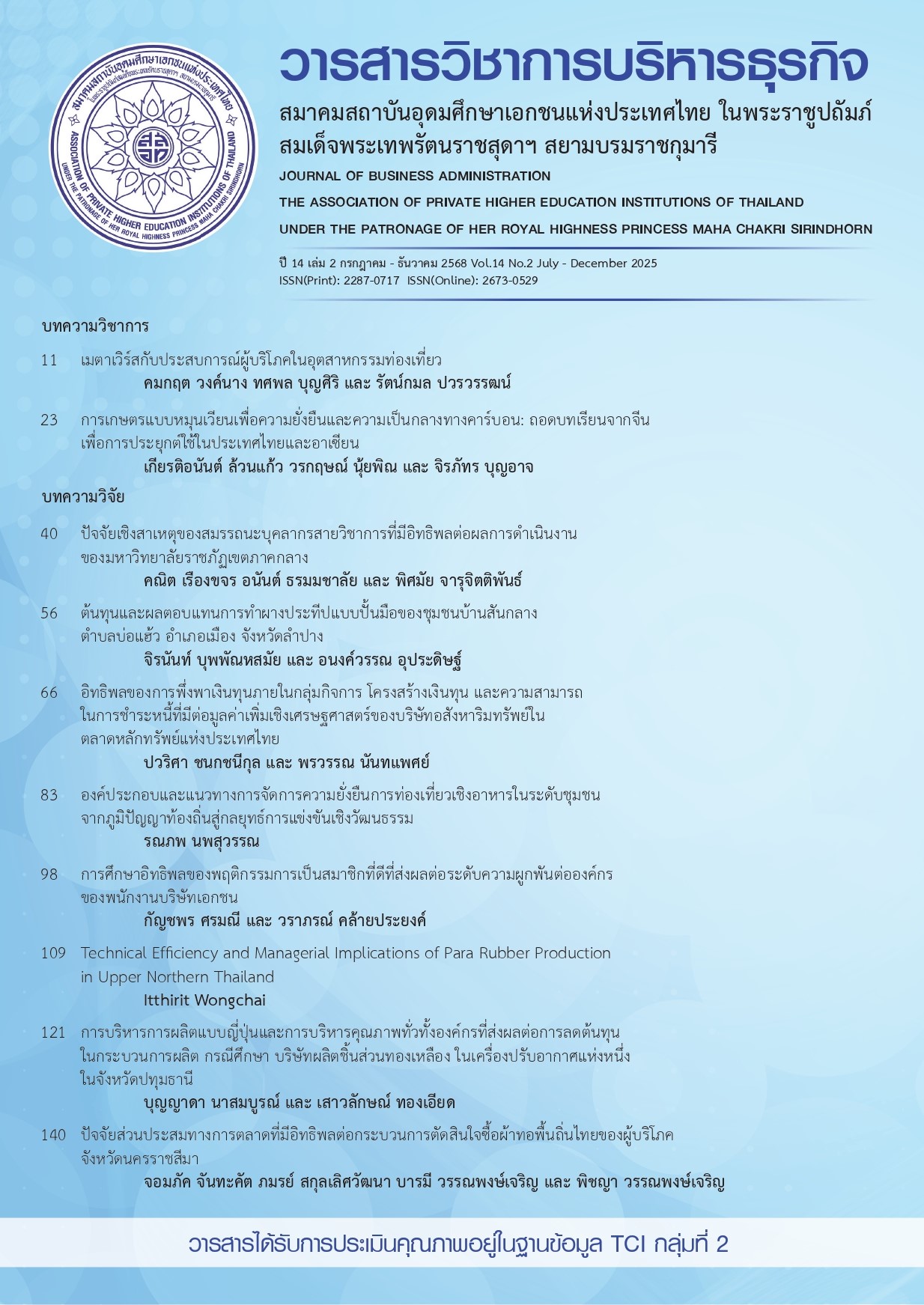
The Effect of Japanese Production Management and total Quality Management on Reducing Production cost: a Case Study of a brass Component Manufacturing Company for air Conditioners in Pathum Thani Province.
Keywords:
Japanese production management, Total quality management, Cost reductionAbstract
This research aimed to study: 1) the levels of Japanese manufacturing management, total quality management, and production cost reduction; 2) the aspects of Japanese manufacturing management that affect production cost reduction; and 3) the aspects of total quality management that affect production cost reduction. Data were collected through an online questionnaire administered to 110 production employees of an air conditioner brass parts manufacturing company in Pathum Thani Province. The data were analyzed using descriptive statistics, Pearson’s product–moment correlation coefficient, and multiple regression analysis. The results showed that: 1) the levels of Japanese manufacturing management, total quality management, and production cost reduction were all high, with mean scores of 3.50, 3.81, and 4.07, respectively; 2) aspects of Japanese manufacturing management—specifically operating standards and continuous improvement activities—jointly and significantly predicted production cost reduction at the 0.01 level, with a coefficient of determination of 42.90%; and 3) aspects of total quality management—specifically quality and process improvement and employee participation—jointly and significantly predicted production cost reduction at the 0.01 and 0.05 levels, with an overall coefficient of determination of 52.90%. The findings can be used as guidelines for implementing Japanese manufacturing management and total quality management throughout the organization to reduce production costs and promote systematic operations that support organizational stability.
References
Al Zawamri, K. S. A., Ahmad, A., Tong, C. S., & Loh, K. S. (2025). The impact of total quality management on productivity in oil and gas manufacturing industries: A case study from SME of Oman. Journal of Information Systems Engineering and Management, 10(3), 388–406. https://doi.org/10.52783/jisem.v10i3.4934
Anwar, A., Kara, M. H., Abdullah, W., & Awaluddin, M. (2024). The Role of Islamic Values in Strengthening Effects of Kaizen, Employee Loyalty and Accounting Information System to Cost Reduction. Journal Ekonomi Islam, 13(1), 117-130. https://doi.org/10.54471/iqtishoduna.v13i1.2326
Cronbach, L. J. (1990). Essentials of psychological testing (5th ed.). Harper Collins Publishers.
Danthamrongkul, W. (2022). Business administration: Success and sustainability through value creation. Thammasat University Press. [in Thai]
Dimitrantzou, C., Psomas, E., Bouranta, N., & Kafetzopoulos, D. (2022). The role of organisational culture in total quality management adoption and cost of quality. Total Quality Management & Business Excellence, 33(15-16), 1718-1736. https://doi.org/10.1080/14783363.2021.1997143
Hair, J. F., Black, W. C., Babin, B. J., & Anderson, R. E. (2014) Multivariate Data Analysis (7th ed.). Pearson Education.
Krejcie, R. V., & Morgan, D. W. (1970). Determining sample size for research activities. Educational and Psychological Measurement, 30, 607-610.
Kunda, M., & Bupe, G. M. M. (2025). Assessing the Effect of Kaizen Practices on Operational Efficiency: A Case Study of a Steel Manufacturing Company in Zambia. African Journal of Commercial Studies, 6(1), 65-73.
Lertnaisat, R. (2007). Professional production management handbook (Vol. 3). Technology Promotion Association (Thailand–Japan). [in Thai]
Nasomboon, B. (2020). The mediating effect of Kaizen event between production management in Japanese style and cost reduction in Lat Krabang Industrial Estate. Journal of Business Administration and Languages, 8(1), 78–87. [in Thai]
Office of the National Economic and Social Development Council. (2023). NESDC economic report: Thailand’s economic situation in the third quarter of 2023 and outlook for 2023–2024. Office of the National Economic and Social Development Council. [in Thai]
Shrafat, F. D., & Ismail, M. (2019). Structural equation modeling of lean manufacturing practices in a developing country context. Journal of Manufacturing Technology Management, 30(1), 122-145.
Simachokdee, V. (2000). Quality is learning (2nd ed.). Technology Promotion Association (Thailand–Japan). [in Thai]
Simachokdee, V. (2007). TQM: A handbook for organizational excellence. Nation Books. [in Thai]
Sirikasemsuk, K. (2022). A study of industrial operations for lean production. Chulalongkorn University Press. [in Thai]
Suthikhajornkitkarn, S. (2004). Manufacturing KPI for TPM excellence. SE- EDUCATION. [in Thai]
Tangpaithoon, S. (2021). Productivity management techniques. Nai Nopphat Design and Print Ltd., Part. [in Thai]
The Federation of Thai Industries. (2024). Industry trends 2024: 46 industry groups and 5 regions. The Federation of Thai Industries. [in Thai]
Vanichbuncha, K. (2007). Statistical analysis: Statistics for administration and research (10th ed.). Chulalongkorn University Press. [in Thai]
Downloads
Published
How to Cite
Issue
Section
License
Copyright (c) 2025 Journal of Business Administration The Association of Private Higher Education Institutions of Thailand

This work is licensed under a Creative Commons Attribution-NonCommercial-NoDerivatives 4.0 International License.
บทความที่ลงตีพิมพ์ในวารสารวิชาการบริหารธุรกิจ สมาคมสถาบันอุดมศึกษาเอกชนแห่งประเทศไทยต้องเป็นบทความที่ไม่เคยได้รับการตีพิมพ์เผยแพร่ หรืออยู่ระหว่างการพิจารณาตีพิมพ์ในวารสารอื่นๆ การละเมิดลิขสิทธิ์เป็นความรับผิดชอบของผู้ส่งบทความโดยตรง

