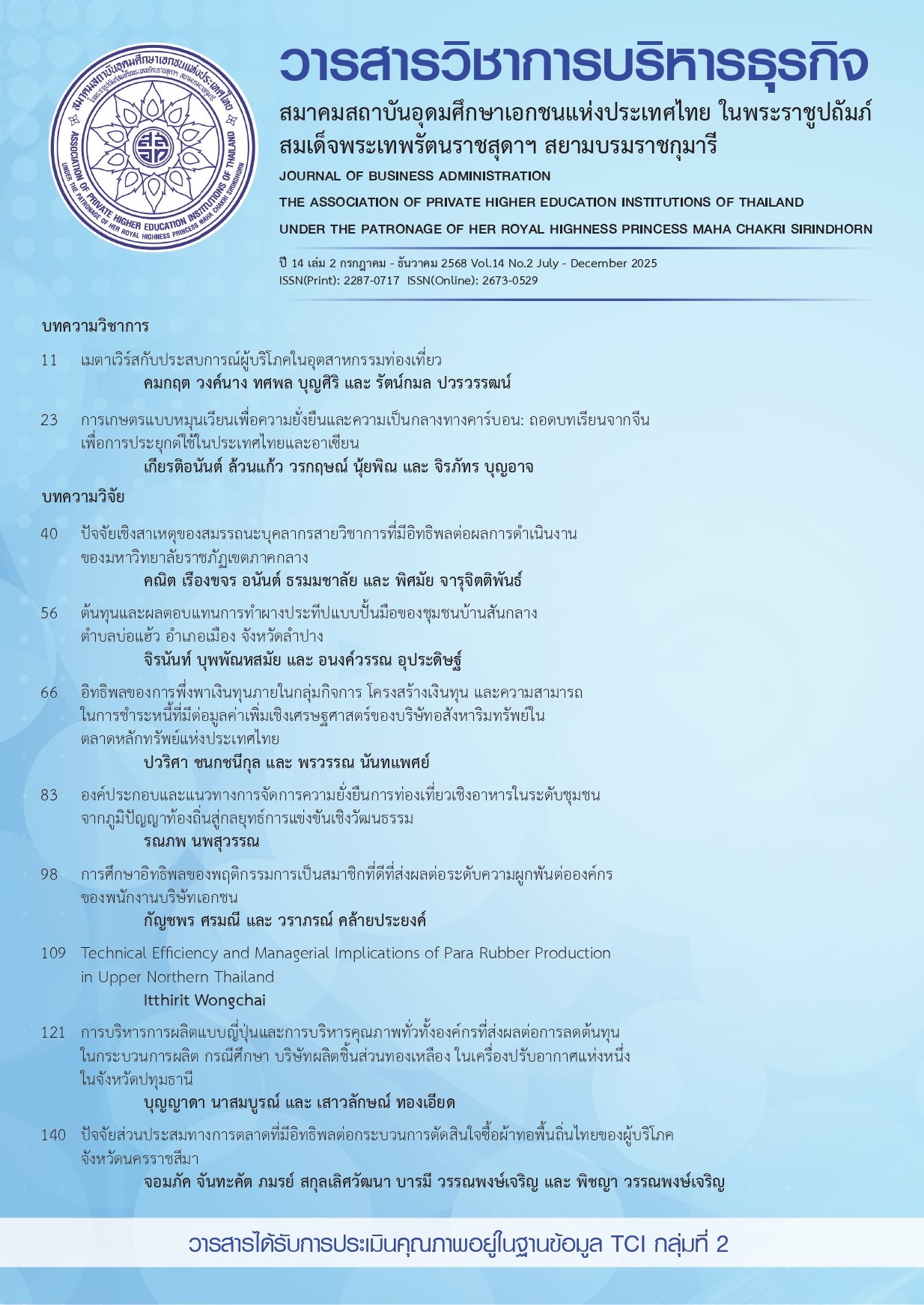
องค์ประกอบและแนวทางการจัดการความยั่งยืนการท่องเที่ยวเชิงอาหารในระดับชุมชน จากภูมิปัญญาท้องถิ่นสู่กลยุทธ์การแข่งขันเชิงวัฒนธรรม
คำสำคัญ:
การท่องเที่ยวเชิงอาหาร, ความยั่งยืน, ชุมชน, ภูมิปัญญาท้องถิ่น, กลยุทธ์การแข่งขันเชิงวัฒนธรรมบทคัดย่อ
การวิจัยครั้งนี้มีวัตถุประสงค์เพื่อ (1) ศึกษาองค์ประกอบของการท่องเที่ยวเชิงอาหารในระดับชุมชนที่เกื้อหนุนต่อความยั่งยืน (2) ศึกษาแนวทางการจัดการการท่องเที่ยวเชิงอาหารในระดับชุมชนบนฐานภูมิปัญญาท้องถิ่น และ (3) เสนอแนวทางเชิงกลยุทธ์ด้านการแข่งขันเชิงวัฒนธรรมของพื้นที่ศึกษา การวิจัยใช้ระเบียบวิธีเชิงคุณภาพ เก็บรวบรวมข้อมูลจากผู้ให้ข้อมูลหลักจำนวน 43 คน ใน 6 จังหวัดที่มีศักยภาพด้านการท่องเที่ยวเชิงอาหาร ได้แก่ เพชรบุรี ภูเก็ต สงขลา ยะลา ปัตตานี และนราธิวาส ผ่านการสัมภาษณ์เชิงลึกแบบกึ่งโครงสร้าง และการรวบรวมเอกสารและบันทึกภาคสนาม จากนั้นวิเคราะห์ข้อมูลด้วยการวิเคราะห์เชิงประเด็นเชิงสาระสำคัญหลักตามแนวทางของ Braun and Clarke (2006) โดยเน้นการสกัดประเด็นจากประสบการณ์และมุมมองของผู้มีส่วนได้ส่วนเสียในชุมชน ผลการวิจัยพบว่า องค์ประกอบและแนวทางการจัดการความยั่งยืนของการท่องเที่ยวเชิงอาหารในระดับชุมชนสามารถจำแนกออกเป็น 4 ประเด็นเชิงสาระสำคัญหลัก ได้แก่ (1) ความท้าทายด้านนโยบายและเศรษฐกิจ (2) การธำรงอัตลักษณ์อาหารและความภาคภูมิใจในท้องถิ่น (3) ความร่วมมือในระดับท้องถิ่นและเครือข่าย และ (4) การจัดการทรัพยากรและการส่งเสริม เมื่อสังเคราะห์ภาพรวมพบว่า การท่องเที่ยวเชิงอาหารในระดับชุมชนที่ยั่งยืนตั้งอยู่บนการบูรณาการสามมิติสำคัญ คือ อัตลักษณ์และภูมิปัญญาอาหารท้องถิ่น การจัดการและความยั่งยืนในระดับชุมชนและการสื่อสารการตลาดเชิงประสบการณ์และดิจิทัล ภายใต้การมีส่วนร่วมของผู้มีส่วนได้ส่วนเสียหลายฝ่าย ผลการวิจัยจึงเสนอให้ใช้กรอบคิดดังกล่าวเป็นฐานในการออกแบบนโยบายและแนวปฏิบัติที่ช่วยธำรงมรดกทางวัฒนธรรมอาหาร เสริมสร้างความมั่นคงทางเศรษฐกิจของชุมชน และยกระดับอาหารท้องถิ่นให้เป็นกลยุทธ์การแข่งขันเชิงวัฒนธรรมในเวทีการท่องเที่ยวทั้งในระดับชาติและนานาชาติ
เอกสารอ้างอิง
Apak, Ö. C., & Guerbuez, A. (2023). The effect of local food consumption of domestic tourists on sustainable tourism. Journal of Retailing and Consumer Services, 71(3), 103192. https://doi.org/10.1016/j.jretconser.2022.103192
Bhoophala, S., & Daengbuppha, J. (2022). The development of community-based culinary tourism in Thailand. Journal of Suvarnabhumi Institute of Technology (Humanities and Social Sciences), 8(1), 286-304.
Bramwell, B., & Lane, B. (2011). Critical research on the governance of tourism and sustainability. Journal of sustainable tourism, 19(4-5), 411-421. https://doi.org/10.1080/09669582.2011.580586
Braun, V., & Clarke, V. (2006). Using thematic analysis in psychology. Qualitative Research in Psychology, 3(2), 77–101. https://doi.org/10.1191/1478088706qp063oa
Cardoso, L., Araújo Vila, N., de Araújo, A. F., & Dias, F. (2020). Food tourism destinations’ imagery processing model. British Food Journal, 122(6), 1833–1847 https://doi.org/10.1108/BFJ-08-2018-0557
Chen, Q., & Huang, R. (2021). Understanding the role of local food in sustaining Chinese destinations. In C. M. Hall & C. Cooper (Eds.), Current issues in Asian tourism: Volume II (pp. 171-187). Routledge.
Chi, C. G., Deng, D. S., Chi, O. H., & Lin, H. (2024). Framing food tourism videos: what drives viewers’ attitudes and behaviors?. Journal of Hospitality & Tourism Research, 48(3), 533-548. https://doi.org/10.1177/10963480221123097
Choe, J. Y., Kim, J. H., & Cho, M. S. (2017). A comparison of food contents used by official tourism organizations' mobile applications. Gastronomy and Tourism, 2(3), 203-216. https://doi.org/10.3727/216929717X14870140201198
Chung, N., & Han, H. (2017). The relationship among tourists' persuasion, attachment and behavioral changes in social media. Technological Forecasting and Social Change, 123(10), 370-380. https://doi.org/10.1016/j.techfore.2016.09.005
Ellis, A., Park, E., Kim, S., & Yeoman, I. (2018). What is food tourism?. Tourism management, 68(10), 250-263. https://doi.org/10.1016/j.tourman.2018.03.025
Estrada, M., Moliner, M. Á., Monferrer, D., & Vidal, L. (2024). Sustainability and local food at tourist destinations: A study from the transformative perspective. Journal of Sustainable Tourism, 32(5), 1008-1026. https://doi.org/10.1080/09669582.2023.2195594
Freeman, R. E. (2010). Strategic management: A stakeholder approach. Cambridge university press.
Hall, C. M., & Gössling, S. (2016). From food tourism and regional development to food, tourism and regional development: themes and issues in contemporary foodscapes. In C. M. Hall & S. Gössling (Eds.), Food tourism and regional development: Networks, products and trajectories (pp. 3–57). Routledge
Hur, K., Kim, T. T., Karatepe, O. M., & Lee, G. (2017). An exploration of the factors influencing social media continuance usage and information sharing intentions among Korean travellers. Tourism management, 63(12), 170-178. https://doi.org/10.1016/j.tourman.2017.06.013
Mitchell, R. K., Agle, B. R., & Wood, D. J. (1997). Toward a theory of stakeholder identification and salience: Defining the principle of who and what really counts. Academy of Management Review, 22(4), 853–886. https://doi.org/10.5465/amr.1997.9711022105
Nopsuwan, R., Kheokao, J., & Plianrung, S. (2022). Identity of Langkasuka Food Culture from the Southernmost Region of Thailand. Journal of the Institute of Culture and the Arts, 24(1), 91-103. [in Thai]
Pretty, J. N. (1995). Participatory learning for sustainable agriculture. World development, 23(8), 1247-1263.
Pine, B. J., & Gilmore, J. H. (1999). The Experience Economy: Work is Theatre & Every Business a Stage. Harvard Business School Press.
Quan, S., & Wang, N. (2004). Towards a structural model of the tourist experience: an illustration from food experiences in tourism. Tourism management, 25(3), 297-305.
Richards, G. (2012). Food and the tourism experience: Major findings and policy orientations. In D. Dodd (Ed.), Food and the tourism experience (pp. 13–46). OECD Publishing.
Sidali, K. L., Kastenholz, E., & Bianchi, R. (2013). Food tourism, niche markets and products in rural tourism: combining the intimacy model and the experience economy as a rural development strategy. Journal of Sustainable Tourism, 23(8–9), 1179–1197. https://doi.org/10.1080/09669582.2013.836210
Sims, R. (2009). Food, place and authenticity: local food and the sustainable tourism experience. Journal of Sustainable Tourism, 17(3), 321–336. https://doi.org/10.1080/09669580802359293
Tsai, F. M., & Bui, T. D. (2020). Impact of word of mouth via social media on consumer intention to purchase cruise travel products. Maritime Policy & Management, 48(2), 167–183. https://doi.org/10.1080/03088839.2020.1735655
ดาวน์โหลด
เผยแพร่แล้ว
รูปแบบการอ้างอิง
ฉบับ
ประเภทบทความ
สัญญาอนุญาต
ลิขสิทธิ์ (c) 2025 วารสารวิชาการบริหารธุรกิจ สมาคมสถาบันอุดมศึกษาเอกชนแห่งประเทศไทย

อนุญาตภายใต้เงื่อนไข Creative Commons Attribution-NonCommercial-NoDerivatives 4.0 International License.
บทความที่ลงตีพิมพ์ในวารสารวิชาการบริหารธุรกิจ สมาคมสถาบันอุดมศึกษาเอกชนแห่งประเทศไทยต้องเป็นบทความที่ไม่เคยได้รับการตีพิมพ์เผยแพร่ หรืออยู่ระหว่างการพิจารณาตีพิมพ์ในวารสารอื่นๆ การละเมิดลิขสิทธิ์เป็นความรับผิดชอบของผู้ส่งบทความโดยตรง

