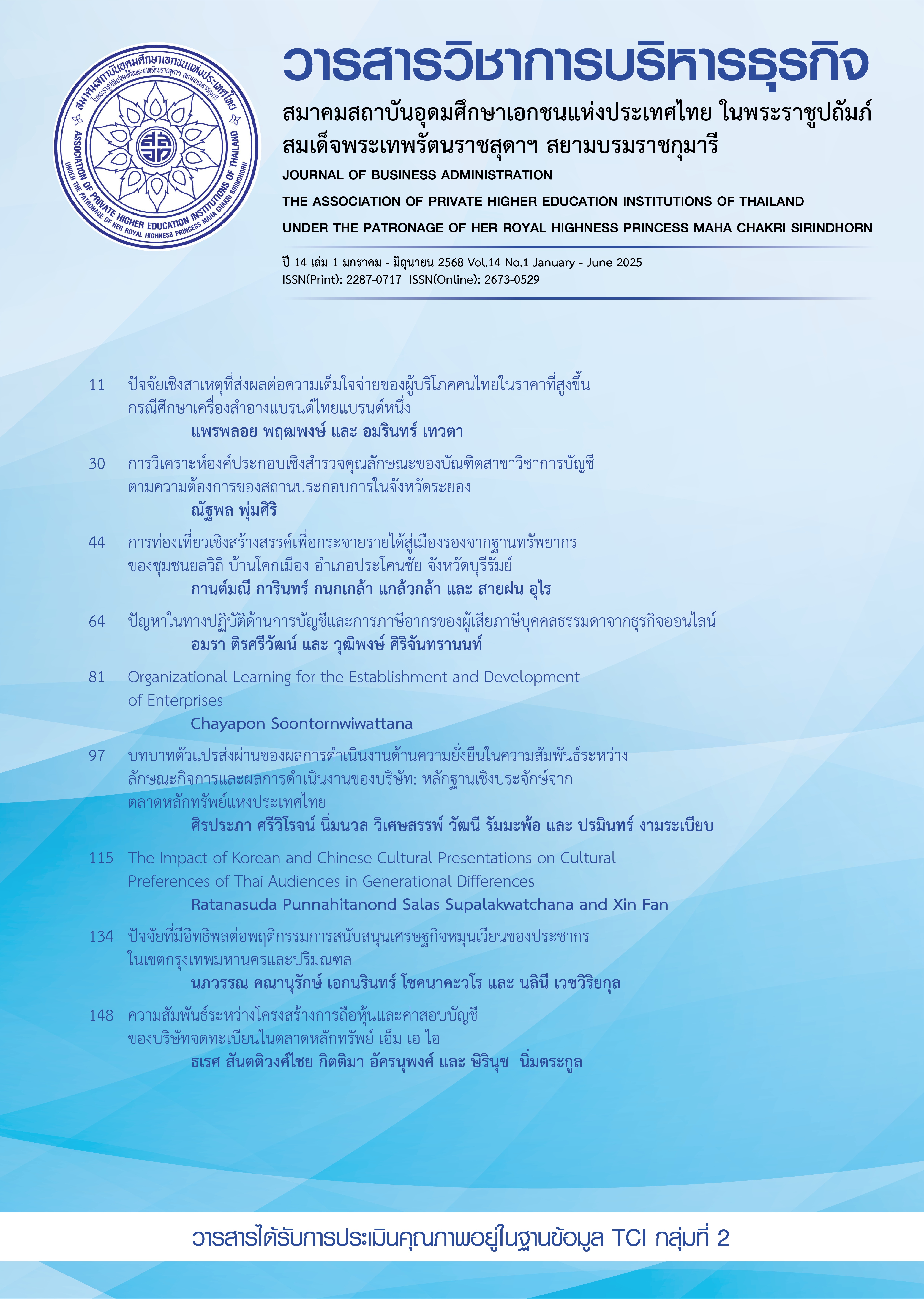
การวิเคราะห์องค์ประกอบเชิงสำรวจคุณลักษณะของบัณฑิตสาขาวิชาการบัญชี ตามความต้องการของสถานประกอบการในจังหวัดระยอง
คำสำคัญ:
การวิเคราะห์องค์ประกอบเชิงสำรวจ , คุณลักษณะของบัณฑิต , ความต้องการ , สถานประกอบการบทคัดย่อ
การวิจัยครั้งนี้มีวัตถุประสงค์ 1. เพื่อศึกษาคุณลักษณะของบัณฑิตสาขาวิชาการบัญชีตามความต้องการของสถานประกอบการในจังหวัดระยอง และ 2. เพื่อวิเคราะห์องค์ประกอบเชิงสำรวจคุณลักษณะของบัณฑิตสาขาวิชาการบัญชีตามความต้องการของสถานประกอบการในจังหวัดระยอง ประชากรที่ใช้ในการวิจัย คือ สถานประกอบการในจังหวัดระยอง จำนวน 2,542 โรงงาน สำหรับกลุ่มตัวอย่าง ผู้วิจัยกำหนดขนาดตามแนวคิดของ Comrey and Lee โดยเลือกจำนวน 500 โรงงาน และใช้วิธีการสุ่มแบบเจาะจง ทั้งนี้ ตัวแทนกลุ่มตัวอย่างที่ตอบแบบสอบถาม คือ หัวหน้าของบัณฑิตนักบัญชีที่ทำงานในสถานประกอบการ สถิติที่ใช้ในการวิเคราะห์ข้อมูล ประกอบด้วย ร้อยละ ค่าเฉลี่ย ส่วนเบี่ยงเบนมาตรฐาน และการวิเคราะห์องค์ประกอบเชิงสำรวจ ผลการวิจัยพบว่า 1. ระดับความสำคัญของคุณลักษณะของบัณฑิตสาขาวิชาการบัญชีตามความต้องการของสถานประกอบการในจังหวัดระยอง โดยภาพรวม มีความสำคัญอยู่ในระดับมาก 2. ค่าความเหมาะสมของเมทริกซ์สหสัมพันธ์ระหว่างตัวแปร (KMO) มีค่า = .979 ผลการวิเคราะห์องค์ประกอบเชิงสำรวจมี 4 องค์ประกอบ ได้แก่ (1) ด้านทักษะการวิเคราะห์และความสัมพันธ์ระหว่างบุคคล มีค่าน้ำหนัก = .699 (2) ด้านคุณธรรมและจริยธรรม มีค่าน้ำหนัก = .771 (3) ด้านความรู้ มีค่าน้ำหนัก = .730 และ (4) ด้านทักษะทางปัญญา มีค่าน้ำหนัก = .672 และแบบจำลองการวิเคราะห์องค์ประกอบคุณลักษณะของบัณฑิต ผ่านตามเกณฑ์การประเมินมีความสอดคล้องกลมกลืนกับข้อมูลเชิงประจักษ์ งานวิจัยนี้เป็นประโยชน์ต่อบัณฑิตที่จบการศึกษาในการเตรียมความพร้อมเข้าสู่การทำงานอย่างมีคุณภาพและมีประสิทธิภาพ
เอกสารอ้างอิง
Alderfer, C. P. (1972). Existence, relatedness, and growth: Human needs in organizational settings. Free Press.
Ajzen, I. (1991). The theory of planned behavior. Organizational Behavior and Human Decision Processes, 50(2), 179–211.
Arbuckle, J. L. (2016). AMOS 20.0 users guide. Amos Development Corporation.
Chomphunuch, S., Saewuwan, T., Suanmadee, S., & Bodeerat, C. (2021). Context of the national economic and social development plan No.13 with local government organizations. Journal of Roi Kaensarn Academi, 7(3), 409–424. [in Thai]
Comrey, A. L., & Lee, H. B. (2013). A first course in factor analysis. Psychology Press.
Gunnrapong, N., Binyasen, R., Dodjun, J., & Polinhom, C. (2023). Entrepreneurs’ needs for the bachelor of accountancy program and characteristics of accountants desired by accounting and auditing firms. The Journal of Pacific Institute of Management science, 9(3), 174-182. [in Thai]
Gunton, L. (2022). Librarians as drivers of academic integrity for student success at university. Journal of the Australian Library and Information Association, 71(2), 156-170.https://doi.org/10.1080/24750158.2022.2063101
Hair, J. F., Hult, G. T. M., Ringle, C. M., & Sarsted, M. (2014). A primer on partial least squares structural equation modeling (PLS-SEM). SAGE Publications.
Judge, M., Warren-Myers, G., & Paladino, A. (2019). Using the theory of planned behaviour to predict intentions to purchase sustainable housing. Journal of Cleaner Production, 215, 259-267.
Komutputipong, N., & Vichitsarawong, T. (2024). Principles of Accounting (6th ed.). Chulalongkorn University Press. [in Thai]
Krongmee, W., Youngdee, P., & Ketmak, P. (2021). Impacts of digital accountant skills for successful work of accounting firms in Chiang Mai. Maejo Business Review, 2(1), 67–86. https://doi.org/10.14456/mjba.2020.5 [in Thai]
Lekkla, J., & Chansom, N. (2024). Learning Outcomes According to the National Higher Education Qualifications Framework for Undergraduate Students of the Faculty of Business Administration, Rangsit University. Dhonburi Rajabhat University Journal, 18(2), 207-227. [in Thai]
Lungnak, N., Manussanit, W., Keawpakdee, C., Punyakhem, U., & Chaichompoo, C. (2020). Factor affecting the decision making to employ accounting graduates of Chiang Rai enterprises. Kasalongkham Research Journal Chiangrai Rajabhat University, 14(1), 1–13. [in Thai]
Maslow, A. H. (1954). Motivation and Personality. Harper and Row.
McClelland, D. C. (1965). Toward a theory of motive acquisition. American Psychologist, 20(5), 321–333.
Murray, H. A. (1938). Explorations in personality. Oxford University Press.
Na Lamphun, V., Kamma, M., Silaprom, P., & Kaewsuwan, S. (2024). The qualifications of desirable tax accountants of accounting offices in Muang district Udon Thani province. Journal of Local Governance and Innovation, 8(1), 209-222. https://doi.org/10.14456/jlgisrru.2024.14 [in Thai]
Ngerndee, C., Gunpai, S., Khiewpakdee, N., & Sunet, C. (2022). Factors influencing accountant’s performance for company in industrial estate in Rayong province. Journal of Industrial Business Administration, 4(1), 1–14. [in Thai]
Rathore, S. (2008). International Accounting (2nd ed.). PHI Learning.
Samretphol, N., Buranapanich, S., & Yaemsamran, P. (2024). Guidelines for the development of graduate programs focus on outcome learning along with the standard criteria for graduate studies curriculum of 2022: in Curriculum and instruction western university. Buddhist Psychology Journal, 9(3), 355-369. [in Thai]
Silpcharu, T. (2024). Research and statistical analysis with SPSS and AMOS (20th ed.). SR Printing Mass Product. [in Thai]
Soeykrathoke, P. (2023). Qualifications of desirable accountant of enterprises in the digital era. SSRU Graduate Studies Journal, 16(2), 62-85. [in Thai]
Sriviroj, S., & Aiamchuen, K. (2019). Thai accountants in the 4.0 era. Eau Heritage Journal Social Science and Humanity, 9(1), 19-28. [in Thai]
Tanadka, I., Wannawan, P., Sriphai, S., & Charoensuk, P. (2019). Exploratory factor analysis in the necessary leadership characteristics of the basic education administrators under the jurisdiction of the secondary educational service area offices in the national education plans B.E.2017-2036. Academic Journal of Phetchaburi Rajabhat University, 9(2), 42-54. [in Thai]
Tavacıoğlu, L., Eski, Ö. Z. G. E., Demir, B. A. R. I. Ş., Gökmen, N. E. S. L. İ. H. A. N., & Algan, M. (2020). The non-technical skills of bridge officers on ship navigation: An assessment in terms of interpersonal skills. Indian journal of science and technology, 13(46), 4587-4594.
Vanichkitpisan, P., & Temiyasathit, C. (2017). Factors influencing attitude toward behavior in using mass transit system in Bangkok: A case study in car users. In 2017 IEEE International Conference on Industrial Engineering and Engineering Management (IEEM) (pp. 412–416). IEEE. https://doi.org/10.1109/IEEM.2017.8289923
Wongwaew, M., & Na Nan, A. (2023). Characteristics of accountants in the digital age that affect performance of accountants under local administrative organizations in Lampang province. Western University Research Journal of Humanities and Social Science, 9(1), 183-196. [in Thai]
ดาวน์โหลด
เผยแพร่แล้ว
รูปแบบการอ้างอิง
ฉบับ
ประเภทบทความ
สัญญาอนุญาต
ลิขสิทธิ์ (c) 2025 วารสารวิชาการบริหารธุรกิจ สมาคมสถาบันอุดมศึกษาเอกชนแห่งประเทศไทย

อนุญาตภายใต้เงื่อนไข Creative Commons Attribution-NonCommercial-NoDerivatives 4.0 International License.
บทความที่ลงตีพิมพ์ในวารสารวิชาการบริหารธุรกิจ สมาคมสถาบันอุดมศึกษาเอกชนแห่งประเทศไทยต้องเป็นบทความที่ไม่เคยได้รับการตีพิมพ์เผยแพร่ หรืออยู่ระหว่างการพิจารณาตีพิมพ์ในวารสารอื่นๆ การละเมิดลิขสิทธิ์เป็นความรับผิดชอบของผู้ส่งบทความโดยตรง

