FACTORS AFFECTING THE PARTICIPATION OF STUDENTS IN ATIVITIES, FACULTY OF EDUCATION, NAKHON SAWAN RAJABHAT UNIVERSITY
Article Sidebar
Main Article Content
Abstract
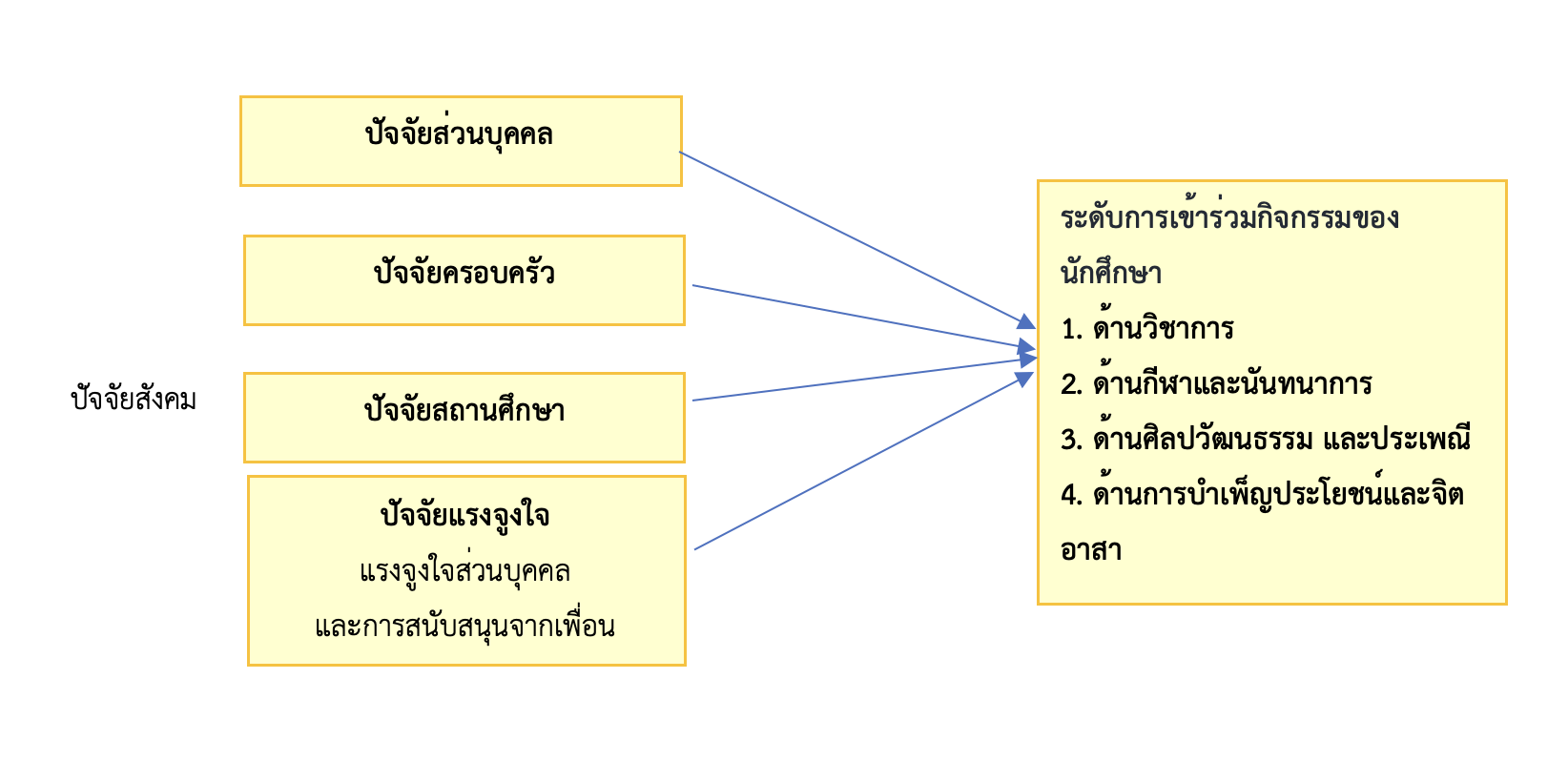
Introduction: Student activities are one of the factors in making the educational management process more complete. Therefore, this research has the following research Objectives: to study the level of factors affecting students’ participation in activities, to study the level of students’ participation in activities, to study the relationship between factors affecting students’ participation in activities, and to create a forecasting equation for students’ participation in activities. Method: The population and sample group are undergraduate students of the Faculty of Education, Nakhon Sawan Rajabhat University. The sample was randomly selected by opening a table by Krejcie & Morgan. The data were analyzed using descriptive statistics and inferential statistics, and statistics were used for testing reliability 0.87. The research instrument was a questionnaire. Results: the level of factors affecting overall activity participation was at a moderate level, with “personal motivation” being the highest-level factor, while “readiness of time and resources” was at the lowest level. The level of student activity participation was at a moderate level, with students usually participating in activities related to the curriculum, such as volunteer activities and orientation. In addition, it was found that motivation factors, institutional support, and friends had a positive relationship with activity participation behavior with statistical significance at a level of .01. The prediction equation could explain 54.3 percent of the variance in activity participation behavior. Conclusion: Emphasis should be placed on creating motivation and developing social support networks within the faculty, as well as designing activities that are consistent with students’ interests and aptitudes, so that student activities can be a mechanism that effectively helps to build desired graduate characteristics.
Downloads
Article Details

This work is licensed under a Creative Commons Attribution-NonCommercial-NoDerivatives 4.0 International License.
The author(s) is only responsible for data appearing in the submitted manuscript of Interdisciplinary social sciences and communication journal.Besides, this journal encourages and enables you to share data such as statements, contents, figures, etc. that support your research publication where appropriate, and enables you to interlink the data with proper citation.
References
Astin, A. W. (1991). Four critical years: Effects of college on beliefs, attitudes, and knowledge. Jossey-Bass.
Chebator, P. J. (1995). Involvement and student outcome: The student development effects of co-curricular programs [Unpublished doctoral dissertation]. Boston College.
Deci, E. L., & Ryan, R. M. (2020). Self-determination theory: Basic psychological needs in motivation, development, and wellness. Guilford Press.
Frederick, R. W. (1965). The third curriculum. Appleton-Century-Crofts.
Hanthongchai, B. (2012). Factors affecting participation in recreational activities of Pathum Thani University students [Unpublished Master’s thesis]. Srinakharinwirot University.
Kamolchanok, K. (2008). Self-potential development of Naresuan University students (Research report). Naresuan University.
Kittiwat, A. (2022). Student activities and the development of desirable graduate attributes in the digital era. Journal of Education, Chiang Mai University, 14(2), 45–59.
Manusawet, P. (2010). An effective student affairs administration model of private universities in Thailand [Unpublished doctoral dissertation]. Eastern Asia University.
Office of the Education Council. (2019). National Education Act B.E. 2542 and amendments (No. 4) B.E. 2562. Ministry of Education.
Office of the Permanent Secretary, Ministry of Education. (2021). National Education Plan (B.E. 2566–2580). https://www.ops.moe.go.th
Phuttan, S. (2019). Motivational factors influencing job application decisions at Rajamangala University of Technology Thanyaburi. Rajamangala University of Technology Thanyaburi.
Premwichit, W. (2021). Motivation for entering civil service at the Office of the Auditor General, Regional Office 11 (Nakhon Sawan Province). Ramkhamhaeng University.
Rani, I. H., Jalih, J. H., & Widyowati, L. A. (2022). Indonesian Generation Z work expectation and intention to apply for jobs: The role of social media. Quantitative Economics and Management Studies, 3(2), 12-23.
Silapasorn, W. (2018). Motivation and compensation management in cooperatives. Sukhothai Thammathirat Open University.
Sritanan, S. (2020). Factors influencing undergraduate students’ participation in student activities. Journal of Research and Development, Nakhon Pathom Rajabhat University, 8(2), 45–56.
Thaniyai, P. (2022). Factors affecting Generation Z’s decision to work in organizations. Naresuan University.
Thawiworadilok, S. (2010). Development of a student affairs administration model for higher education institutions based on the balanced management approach [Unpublished doctoral dissertation]. Burapha University.
Thongkap, M. (2016). Curricular and extracurricular activities of students in higher education institutions. National Youth Promotion and Coordination Commission.
Wichaiwong, A. (2008). Educational psychology. Phatthanasueksa Publishing House.
