
THE INFLUENCE OF FACTORS BASED ON THE THEORY OF PLANNED BEHAVIOR TO THAI CONSUMER’S PURCHASE INTENTION OF PLANT-BASED HEALTHY FOOD
Article Sidebar
Main Article Content
Abstract
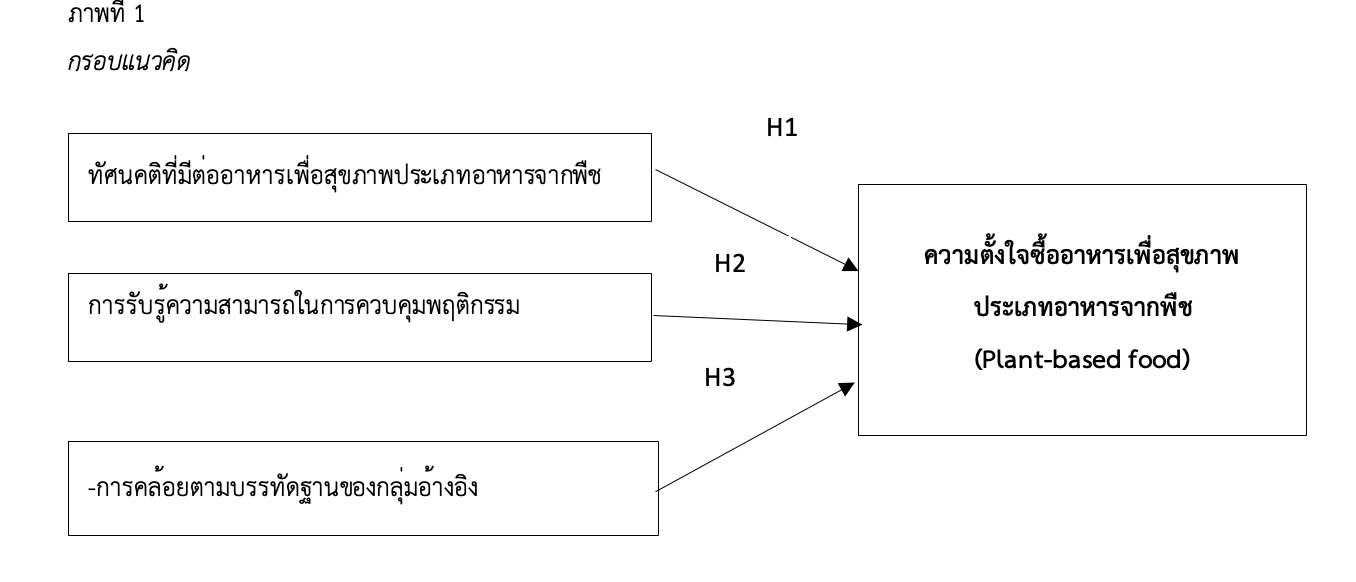
Introduction: In the present time, Thai consumers consume plant-based healthy food increasingly with healthy trend and green consumption trend. However, less papers have been tested the relationship with theory of planned behavior. Objective: This study aims to investigate the factors, which are attitude toward plant-based food, subjective norms and perceived behavior control, influencing to Thai consumer’s purchase intention of plant-based healthy food based on the theory of planned behavior (TPB), which includes attitude, subjective norm, and perceived behavioral control. Method: A quantitative method was employed using questionnaires collected from 400 Thai consumers. The convenience sampling is employed. Descriptive statistics and multiple regression analysis were used for data analysis. Results: The findings show that all three factors, which are attitude, subjective norms, and perceived behavioral control, positively and significantly influence to purchase intention. Conclusion: The findings confirms that the theory of planned behavior can explain the purchase intention for plant-based healthy food significantly. In addition, the findings provide guidance for promoting consumer behavior and developing effective marketing communication strategies.
Downloads
Article Details

This work is licensed under a Creative Commons Attribution-NonCommercial-NoDerivatives 4.0 International License.
The author(s) is only responsible for data appearing in the submitted manuscript of Interdisciplinary social sciences and communication journal.Besides, this journal encourages and enables you to share data such as statements, contents, figures, etc. that support your research publication where appropriate, and enables you to interlink the data with proper citation.
References
Ajzen, I. (1991). The theory of planned behavior. Organizational Behavior and Human Decision Processes, 50(2), 179-211. https://doi.org/10.1016/0749-5978(91)90020-T
Bang, H. K., Ellinger, A. E., Hadjimarcou, J., & Traichal, P. A. (2000). Consumer concern, knowledge, belief, and attitude toward renewable energy: An application of the reasoned action theory. Psychology & Marketing, 17(6), 449–468. https://doi.org/10.1002/(SICI)1520- 6793(200006)17:6<449:AID-MAR1>3.0.CO;2-8
Chuthathipat, A. (2023). Marketing mix and perceived value influencing plant-based food purchasing decisions among consumers in Bangkok and surrounding areas.Procedia of Multidisciplinary Research, 1(7), 79.
Cochran, W. G. (1953). Matching in analytical studies. American Journal of Public Health and the Nations Health, 43(6), 684-691. https://doi.org/10.2105/AJPH.43.6.684
Hair, J. F., Black, W. C., Babin, B. J., & Anderson, R. E. (2010). Multivariate data analysis (7th ed.). Pearson Prentice Hall.
Jansson, J., Marell, A., & Nordlund, A. (2010). Green consumer behavior: Determinants of curtailment and eco‐innovation adoption. Journal of Consumer Marketing, 27(4), 358-370. https://doi.org/10.1108/07363761011052396
Kalafatis, S. P., Pollard, M., East, R., & Tsogas, M. H. (1999). Green marketing and Ajzen’s theory of planned behaviour: A cross-market examination. Journal of Consumer Marketing, 16(5), 441-460. https://doi.org/10.1108/07363769910289550
Kotler, P. (2003). Marketing management (11th ed.). Prentice-Hall.
Kotler, P., Keller, K. L., Brady, M., Goodman, M., & Hansen, T. (2016). Marketing management (3rd European ed.). Pearson Higher Education.
Limsanguan, N., & Cheewaphruek, K. (2022). Plant-based protein products: Current trends in consumer behavior. Journal of Food Product Research and Development, 52(2), 5-15.
Liwjaroem, C., & Chokpitakkul, N., (2016). Knowledge, attitude and intention to purchase clean food: a guideline for health communication on clean food consumption promotion. Bu Academic Review, 15(2), 17-28.
Madden, T. J., Ellen, P. S., & Ajzen, I. (1992). A comparison of the theory of planned behavior and the theory of reasoned action. Personality and Social Psychology Bulletin, 18(1), 3-9.https://doi.org/10.1177/0146167292181001
Mathieson, K. (1991). Predicting user intentions: Comparing the technology acceptance model with the theory of planned behavior. Information Systems Research, 2(3), 173-191. https://doi.org/10.1287/isre.2.3.173
Nilthiam, W., & Lekmat, L. (2024). Factors affecting the decision to purchase plant-based food in Bangkok. Journal of Marketing and Management Rajamangala University of Technology Thanyaburi, 11(2), 40-57.
Phoyoy, P., Sasithanakornkaew, S., & Apisuphachok, W. (2022). The influence of online media and marketing factors on the purchase intention of plant-based meat among consumers in Bangkok. Journal of MCU Nakhondhat, 9(5), 146-160.
Piyapimonsit, C. (1998). Regression analysis. Walailak University.
Thabmuang, A., & KANANUKUL, C. (2021). Knowledge, Consumption Values, and Clean Food Consumption of Thai Consumers. [Unpublished doctoral dissertation]. Burapha University.
Thipmanee, C. (2016). The effect of marketing communications towards purchase intention of healthy food in Hatyai District, Songkhla Province. [Unpublished master’s thesis]. Prince of Songkla University.
Thitaporn, P., & Chumponsathian, A. (2023). Media exposure, knowledge, attitude, and behavior in consuming plant-based food among working-age people. Media and Communication Inquiry, 5(1), 126-142.
