SCENARIO FOR MANGEMENT OF NURSING COLLEGES OF PRABOROMARAJCHANOK INSTITUTE ACCORDING TO THE MISSION OF HIGHER EDUCATION IN THE NEXT DECADE
Article Sidebar
Main Article Content
Abstract
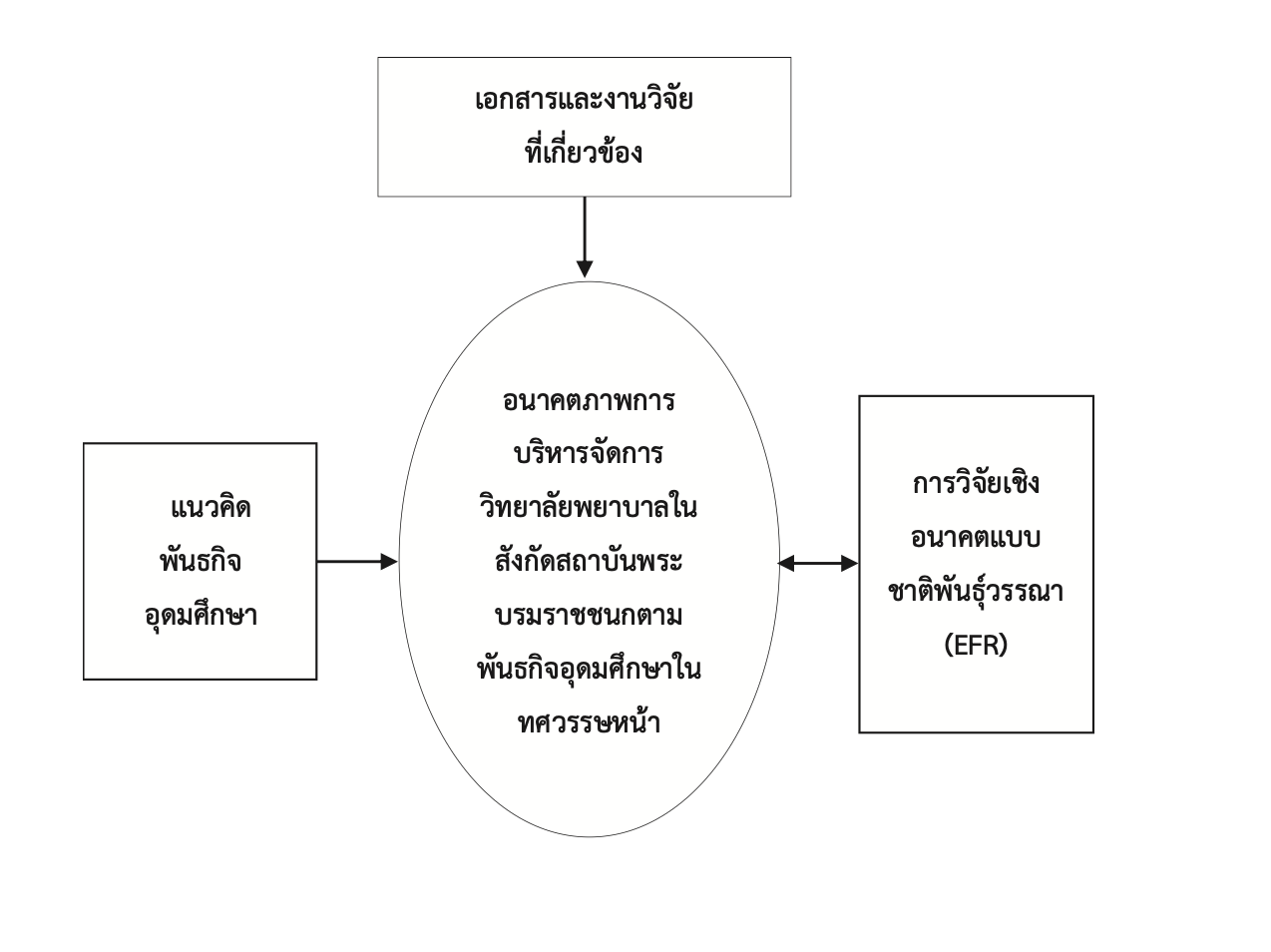
Introduction: The Nursing Colleges under the Praboromarajchanok Institute have been developed into higher education institutions recognized for their quality both nationally and internationally. Their primary mission is to produce high-caliber graduates who contribute significantly to public health advancement. In response to global economic and societal changes, these institutions must adopt forward-looking strategies to ensure sustainable and effective management. Objective: This study aimed to explore future management scenarios for the Nursing Colleges of the Praboromarajchanok Institute in alignment with the mission of higher education over the next decade. Methods: The research employed the Ethnographic Futures Research (EFR) methodology. A purposive sample of 16 experts was selected. Data were collected through unstructured interviews, and the findings were synthesized to identify key themes and construct future scenarios. Results: Three potential scenarios for the future management of the Nursing Colleges were identified. The most probable scenario was titled "Building Strength to Meet the Needs of the Primary Healthcare System." This scenario encompassed four key domains: 1. Curriculum management: Development of diverse curricula tailored to the needs of the primary healthcare system; establishment of national and local collaboration networks; implementation of flexible teaching formats; integration of technology to enhance instructional effectiveness; and alignment of curricula with international standards. 2. Research and Innovation: Formation of research networks based on areas of expertise; establishment of research teams focused on the primary healthcare system; development of national and international research collaborations; and application of technology to elevate research quality and innovation. 3. Academic Services: Design of academic service programs responsive to societal needs; creation of partnerships with government, private, and community stakeholders to promote community health; integration of teaching, research, and cultural preservation; and utilization of technology to deliver proactive, client-centered services. 4. Preservation of arts and culture: Integration of cultural preservation into the higher education mission to promote health and foster value through the conservation of local wisdom and cultural heritage.
Downloads
Article Details

This work is licensed under a Creative Commons Attribution-NonCommercial-NoDerivatives 4.0 International License.
The author(s) is only responsible for data appearing in the submitted manuscript of Interdisciplinary social sciences and communication journal.Besides, this journal encourages and enables you to share data such as statements, contents, figures, etc. that support your research publication where appropriate, and enables you to interlink the data with proper citation.
References
Atiya, S., Daravan, R., & Rungnapa, C. (2019). Nursing education in the 21st century: Competencies and roles of nursing instructors [In Thai]. Journal of Royal Thai Army Nurse, 20(1), 12–20.
Dias, J. (2013). The future of nursing education. Canadian Medical Education Journal, 4(1), 113–114.
Griffin, J. M. (2002). Are the Fama and French factors global or country specific?. The Review of Financial Studies, 15(3), 783–803.
Ministerial Regulation on Higher Education Management Standards. (2022). Royal Gazette, 139(20ก), 6–8. [In Thai]
Nisa, U., Chakrit, P., & Kanchana, P. (2019). The scenario of research management in higher education institution on the context of Thailand 4.0 [In Thai]. Journal of Educational Studies, 20(1), 42–56.
Nongnaphat, R., et al. (2022). Current situations, challenges, and proposed policy for developing toward high-performance organization among colleges of nursing, Praboromarajchanok Institute [In Thai].Journal of Nursing and Education, 15(2), 87–105.
Nongpayao, J. (2021). A study of factors analysis of promoting in academic services in colleges of Praboromarajchanok Institute, Ministry of Public Health [In Thai].
Thai Journal of Public Health and Health Sciences: TJPHS, 4(1), 147–160.
Phawich, T. (2023, June 24). The Council of Higher Education Institutions and higher education development. Academic Article [In Thai].
http://www.mua.go.th/users/bhes/catalog_h/StdEdu/FormCurr/PavitSpeak.pdf
Rattana, T. (2017). Nursing profession: Issues and trends (5th Ed) [In Thai]. Thanabannakanpim.
Sineenuch, S. (2020). N.A.V.Y. strategies for change in the new normal nursing education [In Thai].Royal Thai Navy Medical Journal, 47(3), 747–760.
Somkhwan, S. (2023, June 18). University management under the context of change. Academic Seminar. [In Thai]. https://somkuansub.files.wordpress.com
Sukit, T., Waiyawut, Y., & Boonjai, S. (2022). The scenario of the Bachelor of Nursing curriculum (during 2022–2026) from perspectives of nursing students studying in nursing college under the Faculty of Nursing Praboromarajchanok Institute Ministry of Public Health [In Thai]. Journal of Health and Nursing Research, 38(3), 201–212.
Sumitra, V., & Achara, C. (2014). Development of strategies for role development of higher education institutions in arts and cultural preservation. [In Thai]. Journal of Educational Studies, 42(3), 93–110.
Thailand Nursing and Midwifery Council. (2024, May 10). Educational institutions that teach the Bachelor of Nursing program are accredited by the Nursing Council. Graduates are eligible to apply for the examination to register and receive a license as a professional. [In Thai].https://www.tnmc.or.th/images/userfiles/files/1_web
Wakefield, M. K., Williams, D. R., Le Menestrel, S., & Flaubert, J. L. (Eds.). (2021). The future of nursing 2020–2030: Charting a path to achieve health equity. The National Academies Press. https://doi.org/10.17226/25982
