
SLOW TOURISM PREFERENCES AMONG MIDDLE-CLASS SENIOR CITIZENS
Article Sidebar
Main Article Content
Abstract
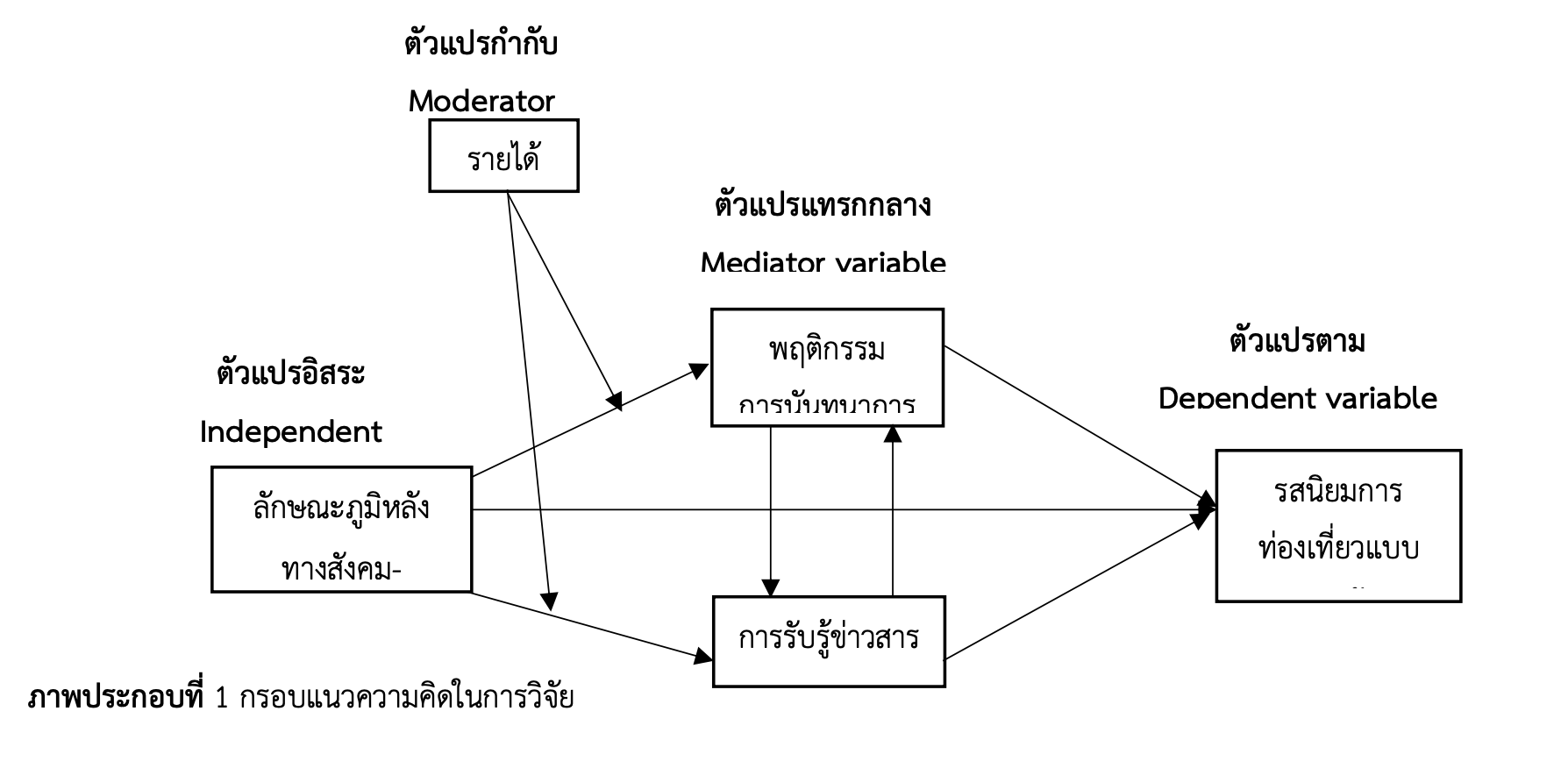
Objectives: 1) to describe and assess the taste for slow travel among middle-class senior citizens in Bangkok; Including economic, social and recreational characteristics as well as perception of news about tourism and 2) to analyze the relationship in direct effect and indirect effect or Mediation and Moderation, and the total effect between the variables of social and Social, economic characteristics, recreational behavior, news perception, and taste for slow tourism as well as inferring the results of the research into cause-effect relationships for formulating policies to promote slow tourism among senior citizens. Methods: The researcher used sample survey research and document research. The sample size was 200 subjects. Statistics in the data except for general data analysis with frequency and Percentage, checking for correlation with Chi-square test and analyzing the cause-effect relationship between the independent variable, the intervention and the dependent variable by Multiple Regression Analysis. Result: The majority of the sample was senior citizens with more females than males. Most of the sample subjects were people aged 60 years and over, and most were married. They had an average income of 59,653 baht per month, and most were in good health. The health variable was significantly related to the taste for slow travel people with good health were more likely to have a taste for slow travel than those with poor health. Middle-class senior citizens with good health and high incomes receive information about tourism for the elderly through social media, such as Facebook. They like to do recreational activities outside the home with their spouses. There is a significant trend towards a taste for slow travel. Conclusion: High-income, healthy middle-class senior citizens receive senior travel information via Facebook social media, enjoy outdoor leisure activities, and tend to have a tourism preferences
Downloads
Article Details

This work is licensed under a Creative Commons Attribution-NonCommercial-NoDerivatives 4.0 International License.
The author(s) is only responsible for data appearing in the submitted manuscript of Interdisciplinary social sciences and communication journal.Besides, this journal encourages and enables you to share data such as statements, contents, figures, etc. that support your research publication where appropriate, and enables you to interlink the data with proper citation.
References
Armstrong, J. A., (1991). Prediction of Consumer Behavior by Experts and Novices. Journal of Consumer Research. 18(2), 251–256
Bank of Thailand. (2562). Opportunities and ways to support the Thai industrial sector in the transition to an aging society. https://www.bot.or.th/Thai/MonetaryPolicy /ArticleAndResearch /Pages/FAQ194.aspx
Berlo, K. D. (1960). The Process of Communication: An Introduction to Theory and Practice. Holt, Rinehart and Winston.
Bourdieu, P. (1994). Distinction: A Social Critique of the Judgement of Taste. Routledge.
Chondarong Tongsong. (2557). A Concept for Developing Slow Tourism in Thailand. Research Methodology & Cognitive Science.12(2), 1-12.
Chubb, M. &, Chubb, H. R. (1981). One third of our time? : An introduction to recreation behavior and resources. Wiley.
Dražen Marić and et al. (2020). Slow tourism consumers’ recommendations. TEME journal for social science. 6(4), 1429−1440.
McQuail, D. (1987). Mass Communication Theory : An Introduction. Sage.
Nathabhol Khanthachai. (2557). “Article Review “Green, Samuel B.(1991). How Many Subjects Dose it Take to Do a Regression Analysis?” Multivariate Behavioral Research, 26(3): 499-510. Kasem Bundit Journal.15(1), 141-144.
Pansek Arthornturasook, Tienkaew Liemsuwan, Kanjana Boonyoung, & Shohei Ogawa. (2562). Models of Long stay Tourism at Thailand for the Japanese Elderly. Journal of Public Administration and Politics. 8(3), 71-93.
Royal Academy. (2565). Royal Institute Dictionary. https://dictionary.orst.go.th/.
