IMPACT OF TRAINING PROCESS ON EMPLOYEES’ PERFORMANCE OF HOTEL BUSINESS IN BANGKOK METROPOLITAN
Article Sidebar
Main Article Content
Abstract
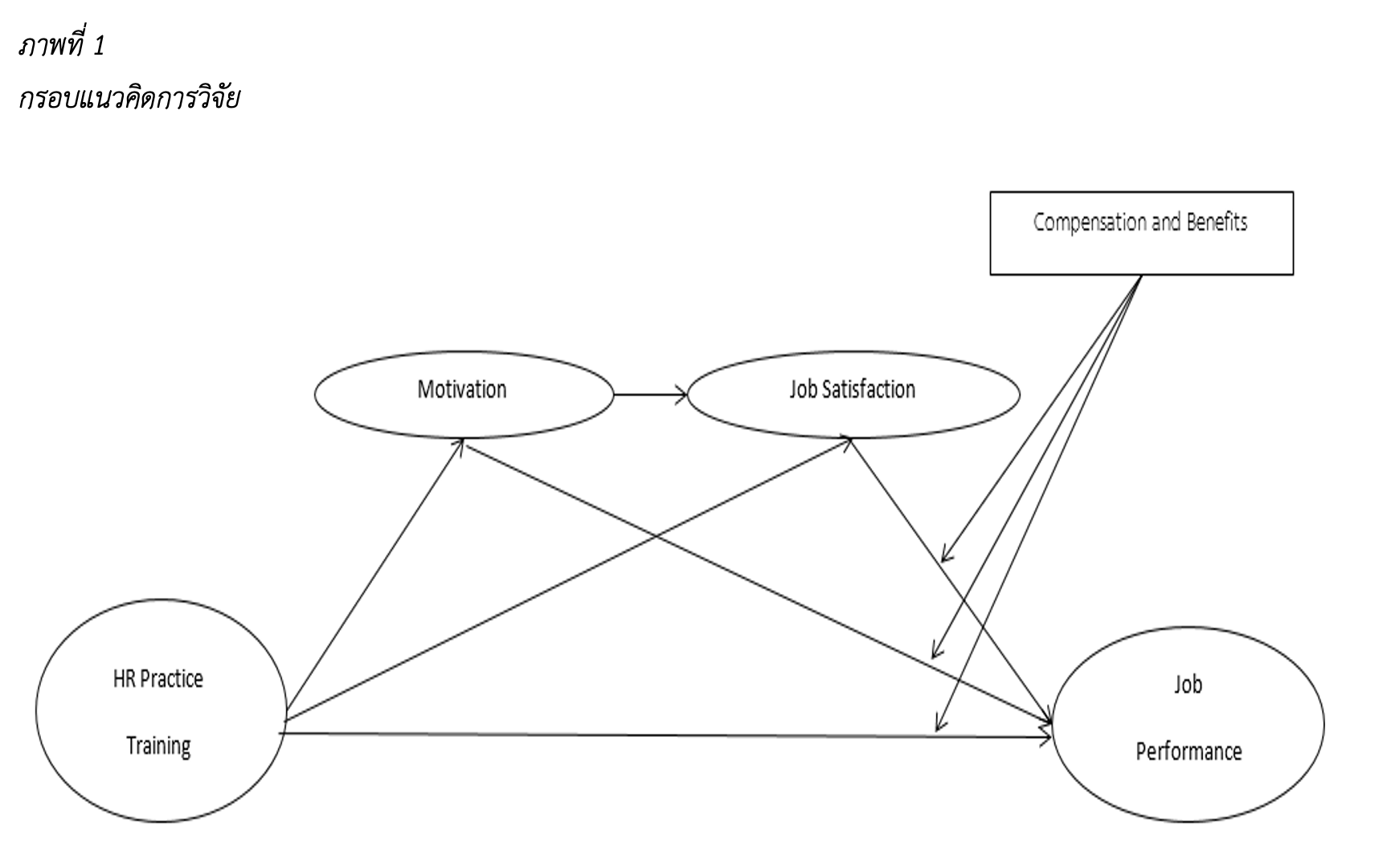
The objectives of this research are to study (1) to study the level training process Work motivation factors Job satisfaction factors Employee compensation factors and employee performance factors (2) to study the influence of compensation that directs the training link motivation to work job satisfaction Towards the performance of hotel business employees In Bangkok It is a mixed research method. Research sample There were 9,306 employees in 23 4-star hotels in Bangkok. The research sample included 384 employees working in the hotel business using simple random sampling. The research instrument was a questionnaire. Research statistics are frequency, percentage, mean, standard deviation. Dispersion coefficient and analyzed the structural equation model (SEM) using the Smart PLS 3.0 program.
The results of the research found that:
- Training process The overall average was at a high level with a mean of 4.24 for work motivation factors. The overall average is at a high level. with an average of 4.24. The work satisfaction factors had a total average of at a high level with an average of 4.29. The employee compensation factor has a high overall average. with an average value of 4.30 and the employee performance factors had an overall average level of high with an average of 4.29
- The results of the structural equation model analysis found that employee training and compensation There is a direct influence on employee performance with statistical significance at the .001 level and training. job satisfaction and motivation to work It has an indirect influence on the performance of employees.
Downloads
Article Details

This work is licensed under a Creative Commons Attribution-NonCommercial-NoDerivatives 4.0 International License.
The author(s) is only responsible for data appearing in the submitted manuscript of Interdisciplinary social sciences and communication journal.Besides, this journal encourages and enables you to share data such as statements, contents, figures, etc. that support your research publication where appropriate, and enables you to interlink the data with proper citation.
References
กัลยารัตน์ ธีระธนชัยกุล. (2562). ปัจจัยเหตุและผลของผลการปฏิบัติงานของพนักงานที่ปฏิบัตงิานในธุรกิจโรงแรมเขตภาคตะวันออกของประเทศไทย. มหาวิทยาลัยศรีปทุม.
ธัญชนก เลิศวิทยาทาน. ( 2564 ). ปัจจัยที่มีอิทธิพลต่อการคงอยู่ของพนักงานโรงแรมในเขตกรุงเทพมหานครที่ได้รับผลกระทบจากสถานการณ์โควิด-19
ภิญญดา ปีติวรรณ. (2564). แนวทางการพัฒนาทุนมนุษย์ในธุรกิจโรงแรมเครือข่ายนานาชาติหลังสถานการณ์การแพร่ระบาดของเชื้อไวรัสโควิด-19. มหาวิทยาลัยศิลปากร.
เยาวภา นียากร และ กนกกานต์ แก้วนุช. (2561). ระบบการให้ค่าตอบแทน ผลประโยชน์และรางวัลเพื่อก่อให้เกิดความผูกพันทุ่มเทในธุรกิจโรงแรมคณะการท่องเที่ยวและการโรงแรม. มหาวิทยาลัยมหาสารคาม
สมาคมโรงแรมไทย. (2564, 7 มกราคม). ระดับของธุรกิจโรงแรม. https://www.thaihotels.org/.
Agenda Isiaka K. Egbewole. (2021). Compensation Management and Employees’ Job Satisfaction Among Staff of Central Bank Of Nigeria, Lagos.. Department of Public Administration, Faculty of Management Sciences, Federal University Oye-Ekiti, Ekiti State, Nigeria. 95-109
Amjad Ali. (2016). The Impact of Motivation on the Employee Performance and Job Satisfaction in IT Park (Software House) Sector of Peshawar, Pakistan.
Aisha Sarwar and Lakhi Muhammad. (2020). Impact of organizational mistreatment on employeeperformance in the hotel industry. Department of Management and Social Sciences,Capital University of Science and Technology, Islamabad, Pakistan.
Asier Baquero. (2022). Customer and employee satisfaction in hotels during COVID-19, Universidad
Internacional de La Rioja, 69-83
Barry Gerhart George T. Milkovich. (2020). Pay, Performance, and Participation. Cornell University ILR School DigitalCommons. 1-44
David Isaac Ntimba. (2021). Job Satisfaction and Dissatisfaction as Outcomes of Psychological Contract: Evidence from the South African Workplace. Tshwane University of Technology, Pretoria, South Africa. 484-497
Eleonora Santos and Jacinta Moreira. (2022). Corporate Performance and Employment in High-Growth Hotels.
Centre of Applied Research in Management and Economics, Leiria, Portugal, 65-75
Emanuele Gabriel Margherita & Ilenia Bua. (2021). The Role of Human Resource Practices for the
Development of Operator 4.0 in Industry 4.0 Organizations : A Literature Review and a Research
Department of Economics Engineering Society and Business Organization—DEIM, University of Tuscia,
Via del Paradiso 47, 01100 Viterbo, Italy, 19 - 33
Ismail Azman et al. (2015). Effect of workplace stress on job performance Faculty of Economics &
Management. University Kebangsaan Malaysia.
Irum Shahzadi. (2014). Impact of Employee Motivation on Employee Performance. BBA (Hons) Department of
Management Sciences. The Islamia University of Bahawalpur.
Jonsen, K. and Jehn, K. A. (2009). Using triangulation to validate themes in qualitative studies. Qualitative research in organizations and management: an international journal, 4(2), 123-150.
Karen R. Johnsona and Kenneth R. Bartlett. (2013). The role of tourism in national human resource development: a Jamaican perspective. A Department of Educational Foundations and Leadership. College of Education, University of Akron, Akron.
Laxni Rezita Sulaxono. (2020). The Effect of Conflict Management, Work Environment and School Climate on Teacher Job Satisfaction at Madrasah Aliyah, Hulu Sungai Tengah District. [Unpublished master’s thesis]. Lambung Mangkurat University.
Malin Johansso. (2010). A method on how to improve employee job satisfaction: A case study, Linnaeus University. School of Engineering.
Milota Vetrakova and Ludmila Mazuchova. (2016). Draft of Management Model of Work Motivation in Hotels. Faculty of Economics. Matej Bel University.
Mohammed Saud Miraa, al. (2019). The effect of HRM practices and employees’ job satisfaction on employee performance. University of Multi Media, Cyberjaya, Malaysia.
Reshad Yazdani Fard. (2013). The impact of employee training and development on Employee Productivity. Centre of Postgraduate Studies Limkokwing University of Creative Technology. Cyberjaya, Malaysia,
Rodriguez, J., and Walters, K. (2017). The importance of training and development in employee performance and evaluation. Worldwide Journal of Multidisciplinary Research and Development, 3(10), 206-212.
Soodchai Ting Phonsanam. (2010 ). Total compensation practices and their relationship to hospitality
employee retention. University of Nevada, Las Vegas.
S.Prasanth. (2015). Training and Development in Hotel Industry. Shanlax International Journal of Management, 3(4), 23-45.
Svetozar Krstic. (2016). Human resources management in hotel industry: the analysis of current practices in Serbia. Belgrade Metropolitan University In Serbia
