CULTURAL NEGOTIATIONS OF KORAT’S ROCK SALT
Article Sidebar
Main Article Content
Abstract
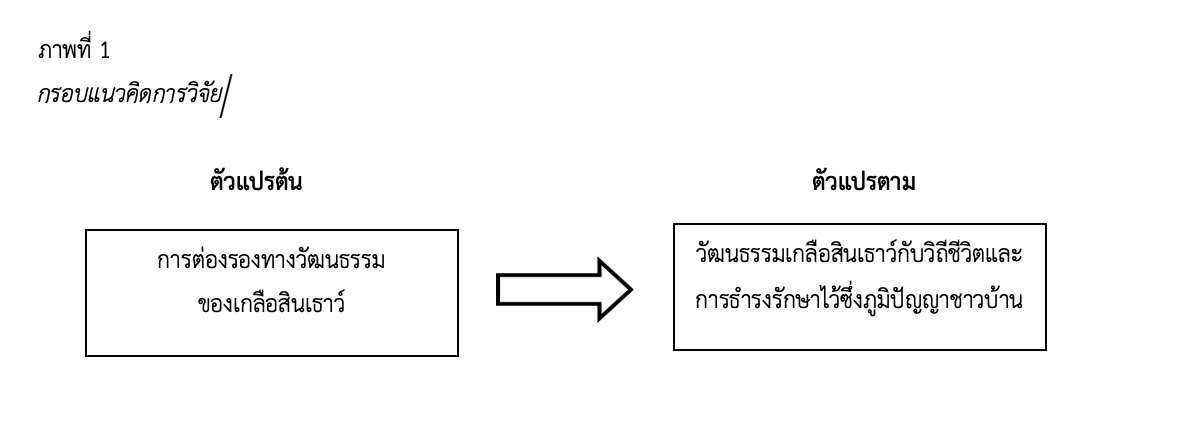
The purpose of this article is to study the cultural negotiation of rock salt in Nakhon Ratchasima Province. This research article is a part of a comprehensive study on adaptation and storytelling through cultural creations, with a specific focus on the preservation of rock salt in Nakhon Ratchasima Province. This study employs a qualitative research approach and collects data from four different community areas. The data is collected using the method of selecting specific sample groups, known as 'Purposive Sampling.' The data collection methods include participant observation and in-depth interviews with salt producers, community leaders, teachers, and villagers, totaling 10 people.
The research uncovered several key findings:
1) In the past, salt production involved the ancient methods of boiling or cooking salt in many households. However, today, these traditions have waned. Few households still practice these methods, and teenagers show little interest in them. As a result, people now use less salt in their cooking.
2) Salt production typically takes place during the dry season, falling between February and April each year. However, if there is rain, it promptly terminates salt production for that year.
3) The traditional method of cooking salt requires a significant amount of wood and water. Due to natural factors affecting the availability of wood and water, the amount of rock salt produced has gradually decreased. The study also identified that: 1) The new generation is still not interested in continuing the rock salt culture due to the challenging, tiring, and hot process of cooking salt, which demands patience. 2) The salt production process consumes substantial resources, including water and wood. As forests become scarcer, logging negatively impacts the environment. Moreover, during the farming season, rainwater washes away the salt, spreading it throughout the rice fields and causing poor yields. 3) Government support and promotion to encourage more people to cook salt may significantly affect most farmers.
4) Rock salt obtained through traditional methods, although lacking iodine, boasts numerous benefits. However, the production process does not meet contemporary standards, making rock salt less popular.
5) Rock salt has played a pivotal role in shaping the culture and way of life from the past to the present. Preserving the practice of cooking rock salt according to local wisdom is essential for future generations.
Downloads
Article Details

This work is licensed under a Creative Commons Attribution-NonCommercial-NoDerivatives 4.0 International License.
The author(s) is only responsible for data appearing in the submitted manuscript of Interdisciplinary social sciences and communication journal.Besides, this journal encourages and enables you to share data such as statements, contents, figures, etc. that support your research publication where appropriate, and enables you to interlink the data with proper citation.
References
กรมศิลปากร กระทรวงวัฒนธรรม. (2553, 11 มีนาคม). วิสัยทัศน์ พันธกิจ และยุทธศาสตร์. http://www.m-culture.go.th/about.php?sub_id=1037.
จักรมนตรี ชนะพันธ์. (2564, 11 มีนาคม). เกลือสินเธาว์อีสาน : ลมหายใจของอุตสาหกรรมครัวเรือน. https://www.silpa-mag.com/culture/article_6496.
จารุวรรณ พรมวัง. (2536). การเปลี่ยนแปลงทางวัฒนธรรมบางประการของชาวไทลื้อ: กรณีศึกษาบ้านทุ่งมอก อำเภอเชียงม่วน จังหวัดพะเยา. [วิทยานิพนธ์ปริญญามหาบัณฑิต ไม่ได้ตีพิมพ์]. จุฬาลงกรณ์มหาวิทยาลัย.
ณรงค์ เส็งประชา. (2538). มนุษย์กับสังคม. สำนักพิมพ์โอเดียนสโตร์.
ดำรงค์ ฐานดี. (ม.ป.ป., 11 มีนาคม). ความรู้เรื่องสังคมและวัฒนธรรม. http://www3.ru.ac.th/korea/article1/article11.pdf.
เนตรนภา รัตนโพธานันท์. (2557). ภูมิปัญญาการผลิตเกลือในแอ่งดินโคราช. วารสารชุมชนวิจัยมหาวิทยาลัยราชภัฏนครราชสีมา, 9(1), 13-20.
ผ่องพันธ์ มณีรัตน์. (2521). การเปลี่ยนแปลงทางสังคมและวัฒนธรรม. สำนักพิมพ์มหาวิทยาลัยธรรมศาสตร์.
สำนักงานคณะกรรมการอาหารและยา. (2563, 25 มกราคม). คู่มือ การผลิตและควบคุมคุณภาพ เกลือบริโภคเสริมไอโอดีน. https://food.fda.moph.go.th/media.php?id=462091027780608000&name=M_Salt.pdf.
สุภางค์ จันทวานิช. (2547). วิธีการวิจัยเชิงคุณภาพ (พิมพ์ครั้งที่ 12). สำนักพิมพ์แห่งจุฬาลงกรณ์มหาวิทยาลัย.
อานันท์ กาญจนพันธุ์. (2544). วิธีคิดท้องถิ่นว่าด้วยสิทธิอำนาจและการจัดการทรัพยากร. สำนักงานกองทุนสนับสนุนการวิจัย(สกว.)
อมฤต หมวดทอง. (2558). เกลือ และประวัติศาสตร์การตั้งถิ่นฐานชุมชนในอีสาน. วารสารวิชาการประจำคณะสถาปัตยกรรมศาสตร์มหาวิทยาลัยศิลปากร, 29(1), 165-176.
อมรา พงศาพิชญ์. (2540). ความหลากหลายทางวัฒนธรรมและการพัฒนา : มุมมองทางมานุษยวิทยา. สำนักงานกองทุนสนับสนุนการวิจัย (สกว.).
Arm Chaimala. (2559, 19 มีนาคม). ดินเค็มกับวิถีชีวิตคนอีสาน. http://a272-7.blogspot.com/2016/04/blog-post.html.
OKMD. (2558, 10 สิงหาคม). คู่มือประกอบนิทรรศการ “ข้าว เกลือ โลหะ” สถาบันพิพิธภัณฑ์การเรียนรู้แห่งชาติ สำนักนายกรัฐมนตรี. https://repository.museumsiam.org/bitstream/handle/6622252777/303/NDMI.
