A CAUSAL RELATIONSHIP MODEL LINKING CORPORATE SOCIAL RESPONSIBILITY, CORPORATE REPUTATION, QUALITY OF WORK LIFE, ORGANIZATIONAL COMMITMENT, AND ORGANIZATIONAL CITIZENSHIP BEHAVIOR IN THE PERSPECTIVES OF MODERN PHARMACEUTICAL INDUSTRY EMPLOYEES IN THE EASTERN ECONOMIC CORRIDOR OF THAILAND
Article Sidebar
Main Article Content
Abstract
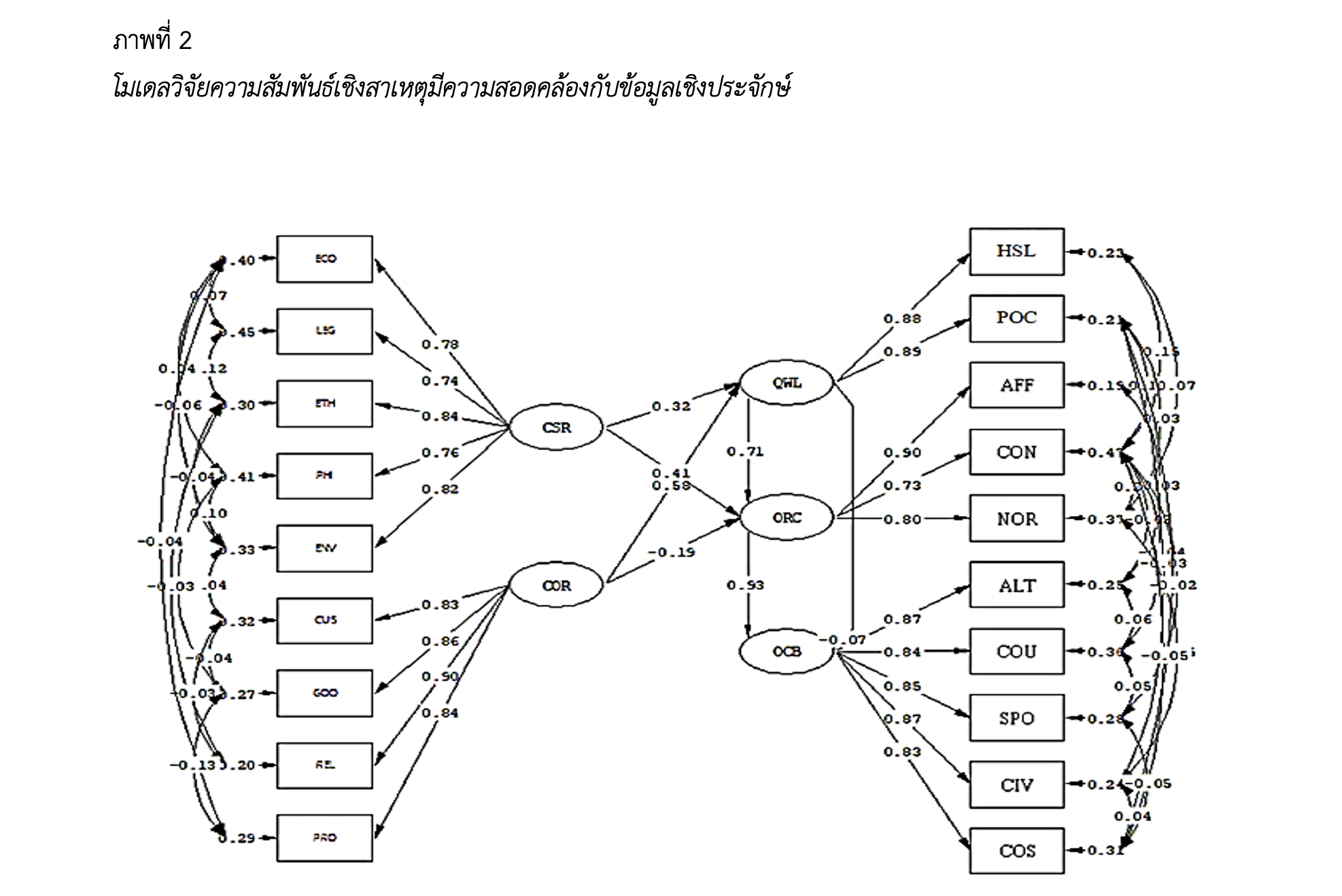
In this dissertation, the researcher investigates (1) the congruence of a causal relationship model linking corporate social responsibility, corporate reputation, quality of work life, organizational commitment, and organizational citizenship behavior in the perspectives of modern pharmaceutical industry employees in the Eastern Economic Corridor (EEC) of Thailand with the empirical data; and examines, and (2) the effects of direct, indirect, and total influence of the factors of corporate social responsibility and corporate reputation on employees’ organizational citizenship behavior through the quality of work life and organizational commitment from the perspectives of the employees under study.
The method of quantitative research was mainly employed and the technique of qualitative research was used to respond to the research objectives. Data were collected using a questionnaire with 542 subjects. In the qualitative research investigation, the technique of semi-structured interview was used with five executives of the modern pharmaceutical industry in the EEC. Descriptive statistics were used with the structural equation model (SEM) and path analysis.
Findings are as follows:
- The causal relationship model linking corporate social responsibility, corporate reputation, quality of work life, organizational commitment, and organizational citizenship behavior from the perspectives of modern pharmaceutical industry employees in the Eastern Economic Corridor of Thailand exhibited congruence with the empirical data.
- Corporate social responsibility exhibited a positive influence on the quality of work life and organizational commitment and a positive indirect influence on organizational citizenship behavior through the quality of work life and organizational commitment.
- Corporate reputation exhibited a positive influence on the quality of work life and organizational commitment and a positive indirect influence on organizational citizenship behavior through the quality of work life and organizational commitment
Downloads
Article Details

This work is licensed under a Creative Commons Attribution-NonCommercial-NoDerivatives 4.0 International License.
The author(s) is only responsible for data appearing in the submitted manuscript of Interdisciplinary social sciences and communication journal.Besides, this journal encourages and enables you to share data such as statements, contents, figures, etc. that support your research publication where appropriate, and enables you to interlink the data with proper citation.
References
สำนักงานคณะกรรมการอาหารและยา. (2561, 25 พฤษภาคม). รายนามสถานที่ผลิตยาแผนปัจจุบันที่ได้มาตรฐานวิธีการที่ดีในการผลิต. http://www.fda.moph.go.th/sites/drug/Post/Shared% 20Documents/Modern_GMP_THAI.pdf
Ahmad, R., Ahmad, S., Islam, T., & Kaleem, A. (2020). The nexus of corporate social responsibility (CSR), affective commitment and organisational citizenship behaviour in academia. Employee Relations: The International Journal, 42(1), 232-247.
Almeida, M. d. G. M. C., & Coelho, A. F. M. (2019). The Antecedents of Corporate Reputation and Image and Their Impacts on Employee Commitment and Performance: The Moderating Role of CSR. Corporate Reputation Review, 22(1), 10-25.
Barakat, S. R., Isabella, G., Boaventura, J. M. G., & Mazzon, J. A. (2016). The influence of corporate social responsibility on employee satisfaction. Management Decision, 54(9), 2325-2339.
Bateman, T. S., & Crant, J. M. (1993). The proactive component of organizational behavior: A measure and correlates. Journal of organizational behavior, 14(2), 103-118.
Beheshtifar, M., & Allahyary, M. H. (2013). Study the relationship among organizational reputation with organizational commitment and employees’ turnover intention. International Research Journal of Applied and Basic Sciences, 6(10), 1467-1478.
Bouraoui, K., Bensemmane, S., Ohana, M., & Russo, M. (2019). Corporate social responsibility and employees’ affective commitment. Management Decision, 57(1), 152-167.
Buchanan, B. (1974). Building Organizational Commitment: The Socialization of Managers in Work Organizations. Administrative science quarterly, 19(4), 533-546.
Carroll, A. B. (1991). The pyramid of corporate social responsibility: Toward the moral management of organizational stakeholders. Business Horizons, 34(4), 39-48.
Carroll, A. B. (1999). Corporate Social Responsibility: Evolution of a Definitional Construct. Business & Society, 38(3), 268-295.
Chaudhary, R., & Akhouri, A. (2019). CSR perceptions and employee creativity: examining serial mediation effects of meaningfulness and work engagement. Social Responsibility Journal, 15(1), 61-74.
Cheasakul, U., & Varma, P. (2016). The influence of passion and empowerment on organizational citizenship behavior of teachers mediated by organizational commitment. Contaduría y Administración, 61(3), 422-440.
Chun, R. (2005). Corporate reputation: Meaning and measurement. International Journal of Management Reviews, 7(2), 91-109.
Hair, J. F., Anderson, R. E., Babin, B. J., & Black, W. C. (2010). Multivariate data analysis: A global perspective (Vol. 7). Pearson Upper Saddle River, NJ.
Kim, H., Woo, E., Uysal, M., & Kwon, N. (2018). The effects of corporate social responsibility (CSR) on employee well-being in the hospitality industry. International Journal of Contemporary Hospitality Management, 30(3), 1584-1600.
Kim, H. L., Rhou, Y., Uysal, M., & Kwon, N. (2017). An examination of the links between corporate social responsibility (CSR) and its internal consequences. International Journal of Hospitality Management, 61(1), 26-34.
Lee, M., & Kim, W. (2013). The Effect of Perceived Corporate Social Responsibility on Hotel Employee’s Attitude and Behavior toward the Organization. International Journal of Tourism Sciences, 13(3), 51-74.
Lee, Y.-W., Dai, Y.-T., & McCreary, L. L. (2015). Quality of work life as a predictor of nurses' intention to leave units, organisations and the profession. Journal of Nursing Management, 23(4), 521-531.
Maslow, A. H. (2017). A Theory of human motivation. Dancing Unicorn Books.
Meyer, J. P., & Allen, N. J. (1991). A three-component conceptualization of organizational commitment. Human resource management review, 1(1), 61-89.
Organ, D. W. (1994). Personality and Organizational Citizenship Behavior. Journal of management, 20(2), 465-478.
Prasetio, A. P., Yuniarsih, T., & Ahman, E. (2017). Job satisfaction, organizational commitment, and organizational citizenship behaviour in state-owned banking. Universal Journal of Management, 5(1), 32-38.
Shanker, M. (2018). Organizational citizenship behavior in relation to employees’ intention to stay in Indian organizations. Business Process Management Journal, 24(6), 1355-1366.
Singhapakdi, A., Lee, D.-J., Sirgy, M. J., & Senasu, K. (2015). The impact of incongruity between an organization's CSR orientation and its employees' CSR orientation on employees' quality of work life. Journal of Business Research, 68(1), 60-66.
Sirgy, M. J., Efraty, D., Siegel, P., & Lee, D.-J. (2001). A New Measure of Quality of Work Life (QWL) Based on Need Satisfaction and Spillover Theories. Social indicators research, 55(3), 241-302.
United Nations Division for Sustainable Development. (1992, 21Decembe). United nations conference on environment & development.
https:// sustainabledevelopment.un.org/content/documents/Agenda21.pdf
Wang, Y. (2015). Examining organizational citizenship behavior of Japanese employees: a multidimensional analysis of the relationship to organizational commitment. The International Journal of Human Resource Management, 26(4), 425-444.
