การจัดการดิจิทัลและความยืดหยุ่นซัพพลายเชนที่มีอิทธิพลต่อผลการดำเนินธุรกิจของผู้ประกอบการธุรกิจยางพาราในเขตภาคใต้ของประเทศไทย
Article Sidebar
Main Article Content
บทคัดย่อ
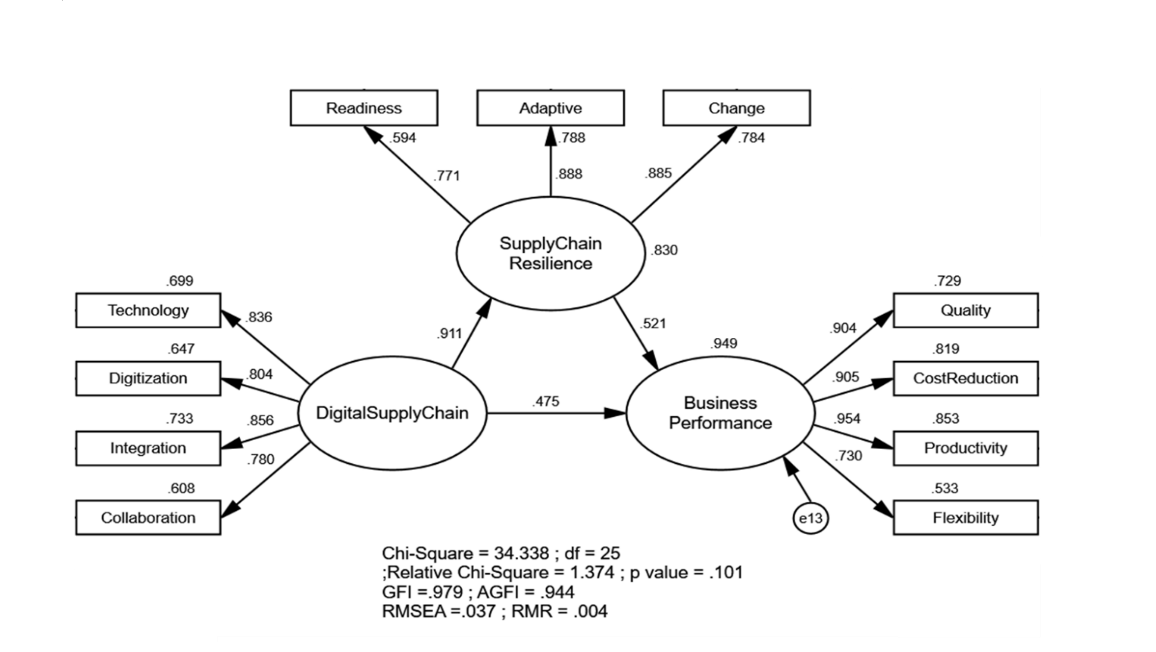
บทนำ: การจัดการดิจิทัลซัพพลายเชนและความยืดหยุ่นซัพพลายเชนเป็นหัวข้อที่มีความสำคัญและเป็นกุญแจสำคัญในการนำปประยุกต์ใช้อย่างชาญฉลาดในการปฏิบัติงานในการวางแผนเชิงรุกและเชิงรับได้อย่างมีประสิทธิภาพ วัตถุประสงค์ของการวิจัย: 1) ศึกษาระดับการจัดการดิจิทัลซัพพลายเชน ความยืดหยุ่นซัพพลายเชน ผลการดำเนินงานทางธุรกิจ 2) ศึกษาอิทธิพลของการจัดการดิจิทัลซัพพลายเชนที่มีต่อความยืดหยุ่นซัพพลายเชนและผลการดำเนินธุรกิจของผู้ประกอบการธุรกิจยางพาราในเขตภาคใต้ของประเทศไทย ระเบียบวิธีวิจัย: ผู้ประกอบการโรงงานแปรรูปยางพาราในเขตภาคใต้ กำหนดขนาดของกลุ่มตัวอย่าง 20 เท่าของค่าพารามิเตอร์และจำนวนตัวแปรสังเกตได้ จำนวน 280 บริษัท เก็บรวบรวมข้อมูลโดยใช้แบบสอบถามและการสัมภาษณ์ วิเคราะห์ข้อมูลโดยใช้แบบจำลองสมการโครงสร้าง ผลการวิจัยพบว่า: การจัดการดิจิทัลซัพพลายเชน ความยืดหยุ่นซัพพลายเชน และผลการดำเนินงานทางธุรกิจอยู่ในระดับสูง โดยโมเดลสมการโครงสร้างมีความสอดคล้องกับข้อมูลเชิงประจักษ์ ผลการวิจัยสะท้อนให้เห็นว่า การบูรณาการข้อมูลดิจิทัลทั้งภายในและภายนอกองค์กรช่วยให้การเชื่อมโยงข้อมูลเป็นไปอย่างต่อเนื่อง รวดเร็ว และถูกต้อง ลดความคลาดเคลื่อนในการสื่อสาร เพิ่มความสามารถในการตอบสนองต่อการเปลี่ยนแปลงผ่านการวิเคราะห์เชิงคาดการณ์และการเตรียมความพร้อมเชิงรุก ตลอดจนสนับสนุนการประยุกต์ใช้เทคโนโลยีดิจิทัลในการบริหารต้นทุน การพัฒนาศักยภาพบุคลากร และการยกระดับประสิทธิภาพการดำเนินงาน ซึ่งนำไปสู่การสร้างผลกำไร ความสามารถในการแข่งขัน และความได้เปรียบทางธุรกิจอย่างยั่งยืน สรุป: ข้อค้นพบข้างต้นยืนยันว่าแนวคิดการจัดการดิจิทัลซัพพลายเชนและความยืดหยุ่นซัพพลายเชนเป็นปัจจัยเชิงกลยุทธ์ที่สำคัญ ช่วยให้องค์กรสามารถวางแผน บริหารจัดการ ปรับตัวต่อการเปลี่ยนแปลง และยกระดับผลการดำเนินงานทางธุรกิจได้อย่างมีประสิทธิภาพ
Downloads
Article Details

อนุญาตภายใต้เงื่อนไข Creative Commons Attribution-NonCommercial-NoDerivatives 4.0 International License.
** ข้อความ ข้อคิดเห็น หรือข้อค้นพบ ในวารสารสหวิทยาการสังคมศาสตร์และการสื่อสารเป็นของผู้เขียน ซึ่งจะต้องรับผิดชอบต่อผลทางกฎหมายใด ๆ ที่อาจเกิดขึ้นจากบทความและงานวิจัยนั้น ๆ โดยมิใช่ความรับผิดชอบของคณะนิเทศศาสตร์ มหาวิทยาลัยราชภัฏรำไพพรรณี **
เอกสารอ้างอิง
Abeysekara, N., Wang, H., & Kuruppuarachchi, D. (2019). Effect of supply-chain resilience on firm performance and competitive advantage: A study of the Sri Lankan apparel industry. Business Process Management Journal, 25(7), 1673-1695.
Ab Hamid, M. R., Sami, W., & Mohmad Sidek, M. H. (2017). Discriminant validity assessment: Use of Fornell & Larcker criterion versus HTMT criterion. In Journal of physics: Conference series, 890,(1), 121-163.
Alkhatib, S. F., & Momani, R. A. (2023). Supply chain resilience and operational performance: The role of digital technologies in Jordanian manufacturing firms. Administrative Sciences,13(2), 40.
Bahrami, M., & Shokouhyar, S. (2022). The role of big data analytics capabilities in bolstering supply chain resilience and firm performance: a dynamic capability view. Information Technology & People, 35(5), 1621-1651.
Choi, T.-M., & Cheng, T.-C. E. (2020). Digital supply chain collaboration and its impact on business performance. International Journal of Production Economics, 220(2), 107474.
Cronbach, L. J. (1951). Coefficient alpha and the internal structure of tests. Psychometrika, 16(3), 297-334.
Daryanto, A. W., Prabowo, H., Hamsal, M., & Elidjen, E. (2023). Supply Chain Resilience Strategy to Generate Business Performance in Dynamic Environmental Change. International Journal of eBusiness and eGovernment Studies, 15(4), 191-211.
Davis, M. (2022). Digital transformation in crisis management: Adapting to change. Business Strategy Journal, 15(2), 89-105.
de Araujo, L. M., Priadana, S., Paramarta, V., & Sunarsi, D. (2021). Digital leadership in business organizations. International Journal of Educational Administration, Management, and Leadership, 3(3), 45-56.
Department of Industrial Works. (2023). Factory information https://www.diw.go.th/webdiw/search-factory
Elram, L., & Johnson, J. L. (2021). The impact of digital technologies on supply chain performance. Journal of Business Logistics, 42(3), 215-227.
Giannakis, M., & Papadopoulos, T. (2021). Digital supply chain resilience: Impact on business performance. International Journal of Production Economics, 23(2), 108023.
Hair, J. F., Black, W. C., Babin, B. J. & Anderson, R. E. (2010). Multivariate Data Analysis: A global perspectives. Pearson Education.
Huo, B., & Zhang, C. (2024). Technology advancements and supply chain resilience: Implications for business performance. Journal of Business Logistics, 45(1), 114-130.
Ivanov, D., Dolgui, A., Sokolov, B., & Ivanova, M. (2017). Literature review on disruption recovery in the supply chain. International Journal of Production Research, 55(20), 6158-6174.
Jantima, M., Wararatchai, P. & Phongthong, P. (2023). Improvement on Export Efficiency Through Resilient Supply Chain Management, Risk Management, and Innovation Management in The Jewelry Industry. Journal of Management Science Review, 25(3), 209-223.
Jones, A., & Clark, B. (2019). Enhancing business performance through digital technology. International Business Review, 18(3), 233-248.
Juan, S. J., Li, E. Y., & Hung, W. H. (2022). An integrated model of supply chain resilience and its impact on supply chain performance under disruption. The International Journal of Logistics Management, 33(1), 339-364.
Kline, T. J. (2005). Psychological testing: A practical approach to design and evaluation. Sage publications.
Lee, K. L., Teong, C. X., Alzoubi, H. M., Alshurideh, M. T., Khatib, M. E., & Al-Gharaibeh, S. M. (2024).Digital supply chain transformation: The role of smart technologies on operational performance in manufacturing industry. International Journal of Engineering Business Management, 16(4), 184-197.
MacCarthy, B. L., & Ivanov, D. (Eds.). (2022). The digital supply chain. Elsevier.
Nguyen, D., Nguyen, T., Nguyen, X., Do, T., & Ngo, H. (2022). The effect of supply chain finance on supply chain risk, supply chain risk resilience, and performance of Vietnam SMEs in global supply chain. Uncertain Supply Chain Management, 10(1), 225-238.
Office of the National Economic and Social Development Council. (2022). The Thirteenth National Economic and Social Development Plan (2023–2027). Office of the National Economic and Social Development Council, Office of the Prime Minister.
Office of the National Economic and Social Development Council. (2023). Action Plan for Thailand's Logistics System Development (2023–2027). Office of the Prime Minister.
Oubrahim, I., Sefiani, N., & Happonen, A. (2023). The influence of digital transformation and supply chain integration on overall sustainable supply chain performance: An empirical analysis from manufacturing companies in Morocco. Energies, 16(2), 1004.
Paksoy, T., Kochan, C. G., & Ali, S. S. (Eds.). (2020). Logistics 4.0: Digital transformation of supply chain management. CRC Press.
Phongthong, P., & Wararatchai, P. (2024). Logistics Capabilities & Supply Chain Agility and Collaboration are Affecting the Pallet Pooling Business Service Quality in Thailand.Journal of Logistics and Supply Chain Operations, 10(2), 1-17.
Rahayu, R., Santosa, W., & Triwulandari, T. (2023). The Effect of Technology Application in Digital Supply Chain on Company Operational Performance. Journal Ekonomi, 12(01), 1521-1525.
Rahimi, I., Gandomi, A. H., Fong, S. J., & Ülkü, M. A. (Eds.). (2020). Big data analytics in supply chain management: Theory and applications. CRC Press.
Rubber Authority of Thailand. (2017). The 20-Year Rubber Strategy (2017-2036). Ministry of Agriculture and Cooperatives.
Rovinelli, R. J., & Hambleton, R. K. (1976). On the use of content specialists in the assessment of criterion-referenced test item validity. (Report No. 24, 37 p.). ERIC Clearinghouse. Retrieved from https://files.eric.ed.gov/fulltext/ED121845.pdf
Teng, X., Wu, Z., & Yang, F. (2022). Research on the relationship between digital transformation and performance of SMEs. Sustainability, 14(10), 6012.
Uhlig, M., & Remané, G. (2022). A systematic literature review on digital business strategy.
Wang, H., Feng, J., Zhang, H., & Li, X. (2020). The effect of digital transformation strategy on performance: The moderating role of cognitive conflict. International Journal of Conflict Management, 31(3), 441-462.
