
DIGITAL SUPPLY CHAIN AND RESILIENCE MANAGEMENT INFLUENCING THE BUSINESS PERFORMANCE OF RUBBER ENTERPRISES IN SOUTHERN THAILAND
Article Sidebar
Main Article Content
Abstract
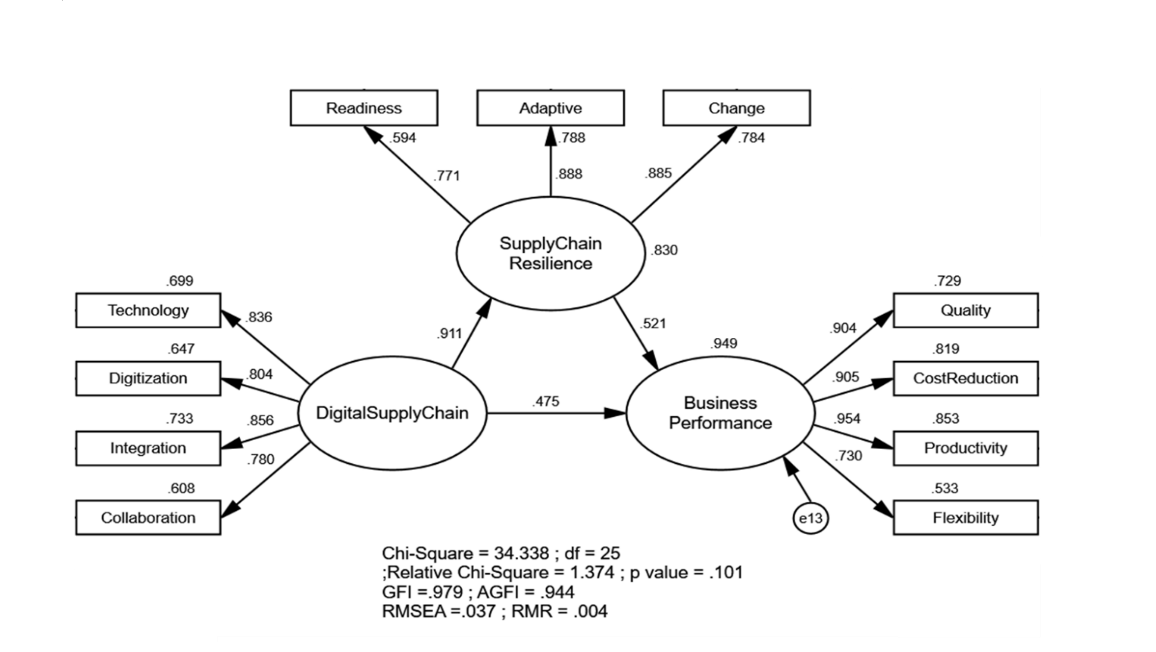
Introduction: Digital supply chain management and supply chain resilience are crucial topics for intelligent application in operational planning, both proactively and reactively. Objectives: 1) To study the level of digital supply chain management, supply chain resilience, and business performance, 2) To study the influence of digital supply chain management on supply chain resilience and business performance of rubber processing businesses in Southern Thailand. Method: The sample size was set at 20 times the parameter and the number of observable variables, totaling 280 companies. Data was collected using questionnaires and interviews. Data was analyzed using structural equation modeling. Result: Digital supply chain management, supply chain resilience, and business performance are at a high level, with structural equation modeling aligning with empirical data. The research findings reflect that the integration of internal and external digital data enables continuous, rapid, and accurate data flow, reducing communication errors and enhancing responsiveness to change through predictive analytics and proactive preparedness. Furthermore, it supports the application of digital technologies in cost management, human resource development, and operational efficiency enhancement, leading to sustainable profitability, competitiveness, and business advantage. Conclusion: The above findings confirm that digital supply chain management and supply chain resilience are crucial strategic factors, enabling organizations to plan, manage, adapt to change, and enhance business performance effectively.
Downloads
Article Details

This work is licensed under a Creative Commons Attribution-NonCommercial-NoDerivatives 4.0 International License.
The author(s) is only responsible for data appearing in the submitted manuscript of Interdisciplinary social sciences and communication journal.Besides, this journal encourages and enables you to share data such as statements, contents, figures, etc. that support your research publication where appropriate, and enables you to interlink the data with proper citation.
References
Abeysekara, N., Wang, H., & Kuruppuarachchi, D. (2019). Effect of supply-chain resilience on firm performance and competitive advantage: A study of the Sri Lankan apparel industry. Business Process Management Journal, 25(7), 1673-1695.
Ab Hamid, M. R., Sami, W., & Mohmad Sidek, M. H. (2017). Discriminant validity assessment: Use of Fornell & Larcker criterion versus HTMT criterion. In Journal of physics: Conference series, 890,(1), 121-163.
Alkhatib, S. F., & Momani, R. A. (2023). Supply chain resilience and operational performance: The role of digital technologies in Jordanian manufacturing firms. Administrative Sciences,13(2), 40.
Bahrami, M., & Shokouhyar, S. (2022). The role of big data analytics capabilities in bolstering supply chain resilience and firm performance: a dynamic capability view. Information Technology & People, 35(5), 1621-1651.
Choi, T.-M., & Cheng, T.-C. E. (2020). Digital supply chain collaboration and its impact on business performance. International Journal of Production Economics, 220(2), 107474.
Cronbach, L. J. (1951). Coefficient alpha and the internal structure of tests. Psychometrika, 16(3), 297-334.
Daryanto, A. W., Prabowo, H., Hamsal, M., & Elidjen, E. (2023). Supply Chain Resilience Strategy to Generate Business Performance in Dynamic Environmental Change. International Journal of eBusiness and eGovernment Studies, 15(4), 191-211.
Davis, M. (2022). Digital transformation in crisis management: Adapting to change. Business Strategy Journal, 15(2), 89-105.
de Araujo, L. M., Priadana, S., Paramarta, V., & Sunarsi, D. (2021). Digital leadership in business organizations. International Journal of Educational Administration, Management, and Leadership, 3(3), 45-56.
Department of Industrial Works. (2023). Factory information https://www.diw.go.th/webdiw/search-factory
Elram, L., & Johnson, J. L. (2021). The impact of digital technologies on supply chain performance. Journal of Business Logistics, 42(3), 215-227.
Giannakis, M., & Papadopoulos, T. (2021). Digital supply chain resilience: Impact on business performance. International Journal of Production Economics, 23(2), 108023.
Hair, J. F., Black, W. C., Babin, B. J. & Anderson, R. E. (2010). Multivariate Data Analysis: A global perspectives. Pearson Education.
Huo, B., & Zhang, C. (2024). Technology advancements and supply chain resilience: Implications for business performance. Journal of Business Logistics, 45(1), 114-130.
Ivanov, D., Dolgui, A., Sokolov, B., & Ivanova, M. (2017). Literature review on disruption recovery in the supply chain. International Journal of Production Research, 55(20), 6158-6174.
Jantima, M., Wararatchai, P. & Phongthong, P. (2023). Improvement on Export Efficiency Through Resilient Supply Chain Management, Risk Management, and Innovation Management in The Jewelry Industry. Journal of Management Science Review, 25(3), 209-223.
Jones, A., & Clark, B. (2019). Enhancing business performance through digital technology. International Business Review, 18(3), 233-248.
Juan, S. J., Li, E. Y., & Hung, W. H. (2022). An integrated model of supply chain resilience and its impact on supply chain performance under disruption. The International Journal of Logistics Management, 33(1), 339-364.
Kline, T. J. (2005). Psychological testing: A practical approach to design and evaluation. Sage publications.
Lee, K. L., Teong, C. X., Alzoubi, H. M., Alshurideh, M. T., Khatib, M. E., & Al-Gharaibeh, S. M. (2024).Digital supply chain transformation: The role of smart technologies on operational performance in manufacturing industry. International Journal of Engineering Business Management, 16(4), 184-197.
MacCarthy, B. L., & Ivanov, D. (Eds.). (2022). The digital supply chain. Elsevier.
Nguyen, D., Nguyen, T., Nguyen, X., Do, T., & Ngo, H. (2022). The effect of supply chain finance on supply chain risk, supply chain risk resilience, and performance of Vietnam SMEs in global supply chain. Uncertain Supply Chain Management, 10(1), 225-238.
Office of the National Economic and Social Development Council. (2022). The Thirteenth National Economic and Social Development Plan (2023–2027). Office of the National Economic and Social Development Council, Office of the Prime Minister.
Office of the National Economic and Social Development Council. (2023). Action Plan for Thailand's Logistics System Development (2023–2027). Office of the Prime Minister.
Oubrahim, I., Sefiani, N., & Happonen, A. (2023). The influence of digital transformation and supply chain integration on overall sustainable supply chain performance: An empirical analysis from manufacturing companies in Morocco. Energies, 16(2), 1004.
Paksoy, T., Kochan, C. G., & Ali, S. S. (Eds.). (2020). Logistics 4.0: Digital transformation of supply chain management. CRC Press.
Phongthong, P., & Wararatchai, P. (2024). Logistics Capabilities & Supply Chain Agility and Collaboration are Affecting the Pallet Pooling Business Service Quality in Thailand.Journal of Logistics and Supply Chain Operations, 10(2), 1-17.
Rahayu, R., Santosa, W., & Triwulandari, T. (2023). The Effect of Technology Application in Digital Supply Chain on Company Operational Performance. Journal Ekonomi, 12(01), 1521-1525.
Rahimi, I., Gandomi, A. H., Fong, S. J., & Ülkü, M. A. (Eds.). (2020). Big data analytics in supply chain management: Theory and applications. CRC Press.
Rubber Authority of Thailand. (2017). The 20-Year Rubber Strategy (2017-2036). Ministry of Agriculture and Cooperatives.
Rovinelli, R. J., & Hambleton, R. K. (1976). On the use of content specialists in the assessment of criterion-referenced test item validity. (Report No. 24, 37 p.). ERIC Clearinghouse. Retrieved from https://files.eric.ed.gov/fulltext/ED121845.pdf
Teng, X., Wu, Z., & Yang, F. (2022). Research on the relationship between digital transformation and performance of SMEs. Sustainability, 14(10), 6012.
Uhlig, M., & Remané, G. (2022). A systematic literature review on digital business strategy.
Wang, H., Feng, J., Zhang, H., & Li, X. (2020). The effect of digital transformation strategy on performance: The moderating role of cognitive conflict. International Journal of Conflict Management, 31(3), 441-462.
