SOCIAL MEDIA AS ENVIRONMENTAL STIMULUS: HOW eWOM, SOCIAL MEDIA INFLUENCE, AND REVIEWS SHAPE THAI TOURISTS' MEMORABLE EXPERIENCES, DESTINATION TRUST, SUBJECTIVE WELL-BEING, AND VISIT INTENTIONS TO ECOTOURISM DESTINATIONS
Article Sidebar
Main Article Content
บทคัดย่อ
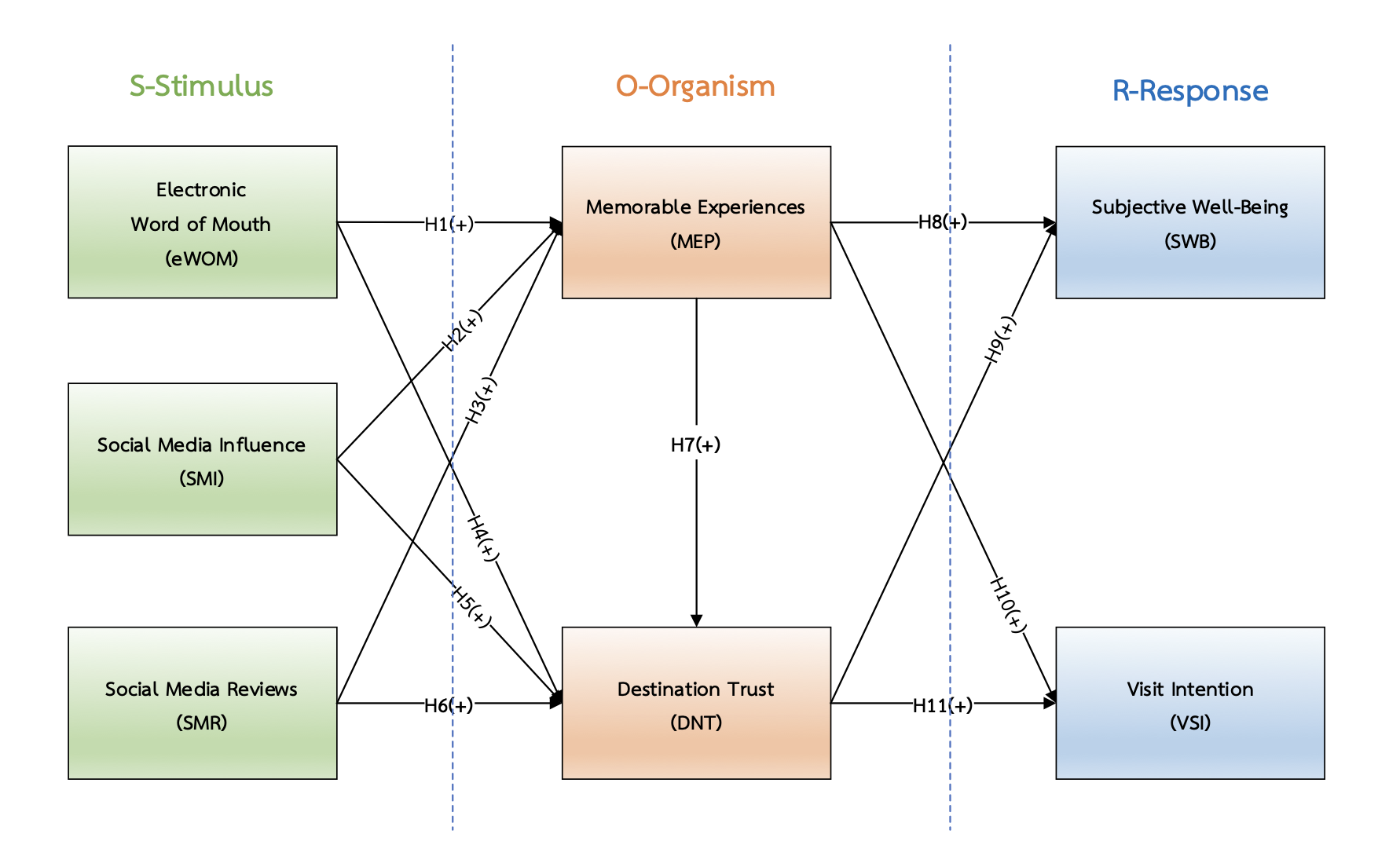
Introduction: This study examines the factors that influence memorable experiences, destination trust, subjective well-being, and visit intention among tourists at ecotourism destinations in Thailand. Digital communication channels increasingly influence tourist decision-making and experience formation in contemporary tourism contexts. Objective: To examine how electronic word-of-mouth (eWOM), social media influence, and social media reviews affect memorable tourism experiences; how these factors influence destination trust; and the impact of memorable experiences and destination trust on subjective well-being and visit intention. Methods: A quantitative approach was employed, collecting data through electronic and traditional questionnaires from 499 tourists using quota sampling. Structural equation modeling was utilized to test the hypothesized relationships between variables. Results: eWOM, social media influence, and social media reviews demonstrated positive impacts on memorable experiences. These factors, together with memorable experiences, significantly enhanced destination trust. Both memorable experiences and destination trust positively influenced tourists' subjective well-being and visit intention, confirming the proposed relationships. Conclusion: Digital communication channels significantly shape tourist experiences, trust formation, and subsequent well-being and visit intentions in ecotourism contexts. These findings provide valuable insights for destination management and marketing strategies in the digital age.
Downloads
Article Details

อนุญาตภายใต้เงื่อนไข Creative Commons Attribution-NonCommercial-NoDerivatives 4.0 International License.
** ข้อความ ข้อคิดเห็น หรือข้อค้นพบ ในวารสารสหวิทยาการสังคมศาสตร์และการสื่อสารเป็นของผู้เขียน ซึ่งจะต้องรับผิดชอบต่อผลทางกฎหมายใด ๆ ที่อาจเกิดขึ้นจากบทความและงานวิจัยนั้น ๆ โดยมิใช่ความรับผิดชอบของคณะนิเทศศาสตร์ มหาวิทยาลัยราชภัฏรำไพพรรณี **
เอกสารอ้างอิง
Albores, A. B., la Cruz, S. D., & Reyes-Mercado, P. (2024). The interplay of nostalgia and memorable experiences: A study on apparel. Journal of Management and Entrepreneurship, 26(2), 79-87. https://doi.org/https://doi.org/10.9744/jmk.26.2.79-87
Aldulaimi, S., Soni, S., Kampoowale, I., Krishnan, G., Ab Yajid, M. S., Khatibi, A., Minhas, D., & Khurana, M. (2025). Customer perceived ethicality and electronic word of mouth approach to customer loyalty: The mediating role of customer trust. International Journal of Ethics and Systems, 41(1), 258-278. https://doi.org/10.1108/IJOES-03-2024-0088
Amali, M. T., Tunggal, I. D. A., & Rohima, A. (2024). The impact of e-WOM, accessibility, and attractiveness on revisit intention to Wediombo Beach Yogyakarta: The mediating role of tourist experience. Tourism Journal: Destinations, Hospitality and Travel, 8(1), 87-98. https://doi.org/10.34013/jk.v8i1.1463
Amloy, A., Wonglangka, W., Ounchanum, P., Ruangwitthayanusorn, S., Siriphon, A., & Oranratmanee, R. (2024). Agroecology, tourism, and community adaptability under Unesco Biosphere Reserve: A case study of smallholders in Northern Thailand. Sustainable Development, 32(5), 4428-4439. https://doi.org/10.1002/sd.2919
Bangperng, K. (2024, 12/29). Guidelines to promote sustainable Bru ethnic tourism. Journal of Liberal Arts, Thammasat University, 24(3), 179-205. https://doi.org/https://so03.tci-thaijo.org/index.php/liberalarts/article/view/277021/186778
Bhandari, H., Mittal, A., & Arora, M. (2024). Influence of memorable tourism experience on attitude towards pilgrimage: A moderated-mediation model with memorable religious experience and religiosity. Journal of Hospitality and Tourism Insights, 7(2), 1111-1129. https://doi.org/10.1108/jhti-11-2023-0848
Credence Research. (2025). Thailand Sustainable Tourism Market. Retrieved 6 June from https://www.credenceresearch.com/report/thailand-sustainable-tourism-market
Falter, M. (2024). The role of rural tourism lifestyle entrepreneurs in rethinking current tourism development. Journal of Tourism Futures, ahead-of-print(ahead-of-print). https://doi.org/10.1108/JTF-09-2023-0205
FMI Future Market Insight. (2024). Thailand Sustainable Tourism Market Size and Share Forecast Outlook (2024 to 2034). Retrieved 6 June from https://www.futuremarketinsights.com/reports/thailand-sustainable-tourism-market
Hair, J. F., Babin, B. J., Anderson, R. E., & Black, W. C. (2019). Multivariate data analysis (8th ed.). Cengage.
Handiman, U. T., Rachbini, D. J., Chan, S., & Riyanto, S. (2024). How to increase sustainable rural tourism performance? An empirical study in Indonesia. Geojournal of Tourism and Geosites, 52(1), 150-164. https://doi.org/10.30892/gtg.52114-1191
Hussain, A., Li, M., Kanwel, S., Asif, M., Jameel, A., & Hwang, J. (2023). Impact of tourism satisfaction and service quality on destination loyalty: A structural equation modeling approach concerning China resort hotels. Sustainability, 15(9), 7713. https://doi.org/10.3390/su15097713
Iqbal, M., Abdillah, Y., & Mawardi, M. K. (2025). The influence of social media marketing on decision to visit mediated by fear of missing out (FOMO) and trust. Profit: Journal of Business Administration, 19(1), 32-49. https://doi.org/https://doi.org/10.21776/ub.profit.2025.019.01.3
Jin, Z., & Gao, M. (2025). Global trends in research related to ecotourism: A bibliometric analysis from 2012 to 2022. SAGE Open, 15(1), 21582440251316718. https://doi.org/10.1177/21582440251316718
Khoshroo, M., & Soltani, M. (2025). Digital transformation of tourism: Towards a model of technology acceptance by tourists in the Industry 5.0. European Journal of Innovation Management, ahead-of-print(ahead-of-print). https://doi.org/10.1108/EJIM-11-2023-1018
Kumpiw, W., Damrongsak, D., Jaitiang, T., Wongsapai, W., Sangkakorn, K., Daroon, S., Khiaolek, K., Srichai, P., Auttarat, S., Krajangchom, S., & Chinachan, T. (2025). Performance tracking of sustainable tourism goal (stg) criteria for achieving Thailand’s greenhouse gas mitigation targets in the service sector: A case study of large Thai hotels. Sustainability, 17(4), 1635. https://doi.org/10.3390/su17041635
Kuqi, B., & Vishaj, B. (2024). Sustainable tourism as potential development in the region of Peja. International Journal of Sustainable Development and Planning, 19(10), 3871-3877. https://doi.org/10.18280/ijsdp.191015
Lam, T., Heales, J., & Hartley, N. (2025). The role of positive online reviews in risk-based consumer behaviours: An information processing perspective. Aslib Journal of Information Management, 77(2), 282-305. https://doi.org/10.1108/AJIM-03-2023-0102
Li, X., Yuan, Y., & Zhang, J. (2024). The influence of tourists' emotional experiences on destination loyalty from the perspective of community economy. International Journal of Tourism Research, 26(1), e2630. https://doi.org/10.1002/jtr.2630
Liu, C., Jiang, M., & Muhammad, Z. A. (2024). The impact of TikTok short video factors on tourists' behavioral intention among Generation Z and millennials: The role of flow experience. PLoS One, 19(12), e0315140. https://doi.org/10.1371/journal.pone.0315140
Liu, J., Wang, C., & Zhang, T. (2024). Exploring social media affordances in tourist destination image formation: A study on China's rural tourism destination. Tourism Management, 101, 104843. https://doi.org/10.1016/j.tourman.2023.104843
Liu, M., & Chamaratana, T. (2024). Sustainable ecotourism development model in the areas of the Greater Mekong Subregion: A systematic review. Cuadernos de Economía, 47(134), 27-37. https://doi.org/https://doi.org/10.32826/cude.v47i134.1404
Luekveerawattana, R. (2024). A study of factors affecting attitudes after visiting eco-tourism destination Don Hoi Lot, Samut Songkhram. Cogent Social Sciences, 10(1), 2423858. https://doi.org/10.1080/23311886.2024.2423858
Mittal, A., Bhandari, H., & Chand, P. K. (2022). Anticipated positive evaluation of social media posts: social return, revisit intention, recommend intention and mediating role of memorable tourism experience. International Journal of Culture, Tourism and Hospitality Research, 16(1), 193-206. https://doi.org/10.1108/IJCTHR-12-2020-0287
Nguyen, T. V. H., Hằng, N. T., & Tai, L. K. (2024). Sustainable tourism and the intention of generation Z to choose sustainable tourism. International Journal of Scientific Research and Management, 12(06), 1871-1880. https://doi.org/10.18535/ijsrm/v12i06.sh03
Pratama, I. W. A., Diwyarthi, N. D. M. S., Jata, I. W., Pinaria, N. W. C., Citrawati, L. P., & Kusumarini, I. (2024). Analysis of sustainable tourism management, tourist education, and environmental awareness on visit intention in Ubud, Bali. 2(07), 1155-1165. https://doi.org/10.58812/wsshs.v2i07.1126
Rafdinal, W., Wibisono, N., Setiawati, L., & Juniarti, C. (2025). Virtual reality (VR) meets religiosity: introducing the Q-R CAT model to predict visit intention to religious destinations. Journal of Hospitality and Tourism Insights, ahead-of-print(ahead-of-print). https://doi.org/10.1108/JHTI-08-2024-0796
Rungchavalnont, P. (2022). Community-Based Tourism: Empowering Local Champions for Sustainable Tourism in Thailand. Retrieved 6 June from https://www.undp.org/thailand/blog/community-based-tourism-empowering-local-champions-sustainable-tourism-thailand
Russell, J. A. (1974). An approach to environmental psychology. MIT Press.
Scheyvens, R., Movono, A., Auckram, J., & Faaiuaso, L. (2024). Spiritual and environmental well‐being: Factors supporting adaptation of Pacific peoples during pandemic times. Asia Pacific Viewpoint, 65(3), 380-397. https://doi.org/10.1111/apv.12423
Statista. (2025). Thailand: Top ten national parks in Thailand by number of tourists 2023 Retrieved 6 June from https://www.statista.com/statistics/1040668/thailand-top-ten-national-parks-by-number-of-tourists/
Sundari, L., Pasaribu, R. D., & Sugiat, M. (2024). The influence of brand experience and brand image on brand loyalty with brand trust as a mediation variable (Case study of FCL Modest in Pekanbaru City). International Journal of Science, Technology & Management, 5(6), 1331-1339. https://doi.org/https://doi.org/10.46729/ijstm.v5i6.1160
Supun, J., Prasongthan, S., & Silpsrikul, R. (2025). Narratives and experiences of community potential development under the U2T project for enhancing competitiveness in creative economy. Journal of Multidisciplinary in Humanities and Social Sciences, 8(1-2), 222-243. https://doi.org/https://so04.tci-thaijo.org/index.php/jmhs1_s/article/view/277939
The Nation. (2025). Thailand sets target of 40m foreign tourists, 2.8 trn baht in 2025. Retrieved 6 June from https://www.nationthailand.com/news/tourism/40044451
Tourism Authority of Thailand. (2025). TAT Celebrating 65 Years of Leading Thailand’s Sustainable Tourism Future. Retrieved 6 June from https://www.tatnews.org/2025/03/tat-celebrating-65-years-of-leading-thailands-sustainable-tourism-future/
Tripadvisor. (2025). Ecotourism in Thailand. Retrieved 30 March from https://th.tripadvisor.com/Attractions-g293915-Activities-c61-t216-Thailand.html
Wang, L., Zhang, Q., Ye, M.-J., Wong, P. P. W., & Gong, Y. (2024). Green hotels visit intention among young adults: Integrating the familiarity, novelty, trust, perceived risk, and theory of planned behaviour. Humanities and Social Sciences Communications, 11(1), 1390. https://doi.org/10.1057/s41599-024-03935-0
Wee, H., & Thomas, A. (2024). Exploring educational tourists' destination selection behavior using the extended S-O-R model. International Journal of Academic Research in Progressive Education and Development, 13(3), 566-579. https://doi.org/10.6007/ijarped/v13-i3/21676
Wilopo, W., & and Nuralam, I. P. (2025, 2025/12/12). An investigating the influence of social media marketing activities on revisit intention among Indonesian international tourists. Cogent Business & Management, 12(1), 2440626. https://doi.org/10.1080/23311975.2024.2440626
Yabo, Z., Wee, H., & Gani, A. A. (2024). Destination image and memorable tourism experiences: Literature gaps and conceptual exploration. International Journal of Academic Research in Business and Social Sciences, 14(3), 58-71. https://doi.org/10.6007/ijarbss/v14-i3/20753
Yang, K. (2022). The Effect of Destination Trust on Tourists’ Travel Intention After the Covid-19. Proceedings of the International Conference on Hospitality and Tourism Management,
Yang, S., Liu, Y., & Li-ping, X. U. (2024). The effect of food tourism experiences on tourists' subjective well-being. Heliyon, 10(3), e25482. https://doi.org/10.1016/j.heliyon.2024.e25482
Yen, C.-H., Tsaur, S.-H., & Yen, H.-H. (2024). Tourist engagement and subjective well-being in film tourism: Mediator of memorable tourism experience. tourism and Hospitality Research, 0(0), 14673584241238576. https://doi.org/10.1177/14673584241238576
Yu, Q., Pickering, S., Geng, R., & Yen, D. (2021). Thanks for the memories: Exploring city tourism experiences via social media reviews. Tourism Management Perspectives, 40, 100851. https://doi.org/10.1016/j.tmp.2021.100851
Zaky, D. I., & Mafruhah, I. (2024). The role of social media review intensity in mediating the influence of perceived usefulness and trust on tourists' intention to visit beaches in Yogyakarta. Journal of Business and Management Studies, 6(4), 112-120. https://doi.org/10.32996/jbms.2024.6.4.10
Zhao, M., Li, Y., Lin, J., Fang, Y., Yang, Y., Li, B., & Dong, Y. (2024). The relationship between trust and well-being: A meta-analysis. Journal of Happiness Studies, 25(5), 56. https://doi.org/10.1007/s10902-024-00737-8
Zheng, W. (2024). Analyse subjective wellbeing- based on definition, measurement, and limitations. Advances in Economics Management and Political Sciences, 75(1), 205-209. https://doi.org/10.54254/2754-1169/75/20241668
