การวิเคราะห์พฤติกรรมของผู้บริโภคที่มีต่อผลิตภัณฑ์แปรรูป เพื่อเพิ่มมูลค่าจากมะม่วงหิมพานต์เหลือทิ้ง
Article Sidebar
Main Article Content
บทคัดย่อ
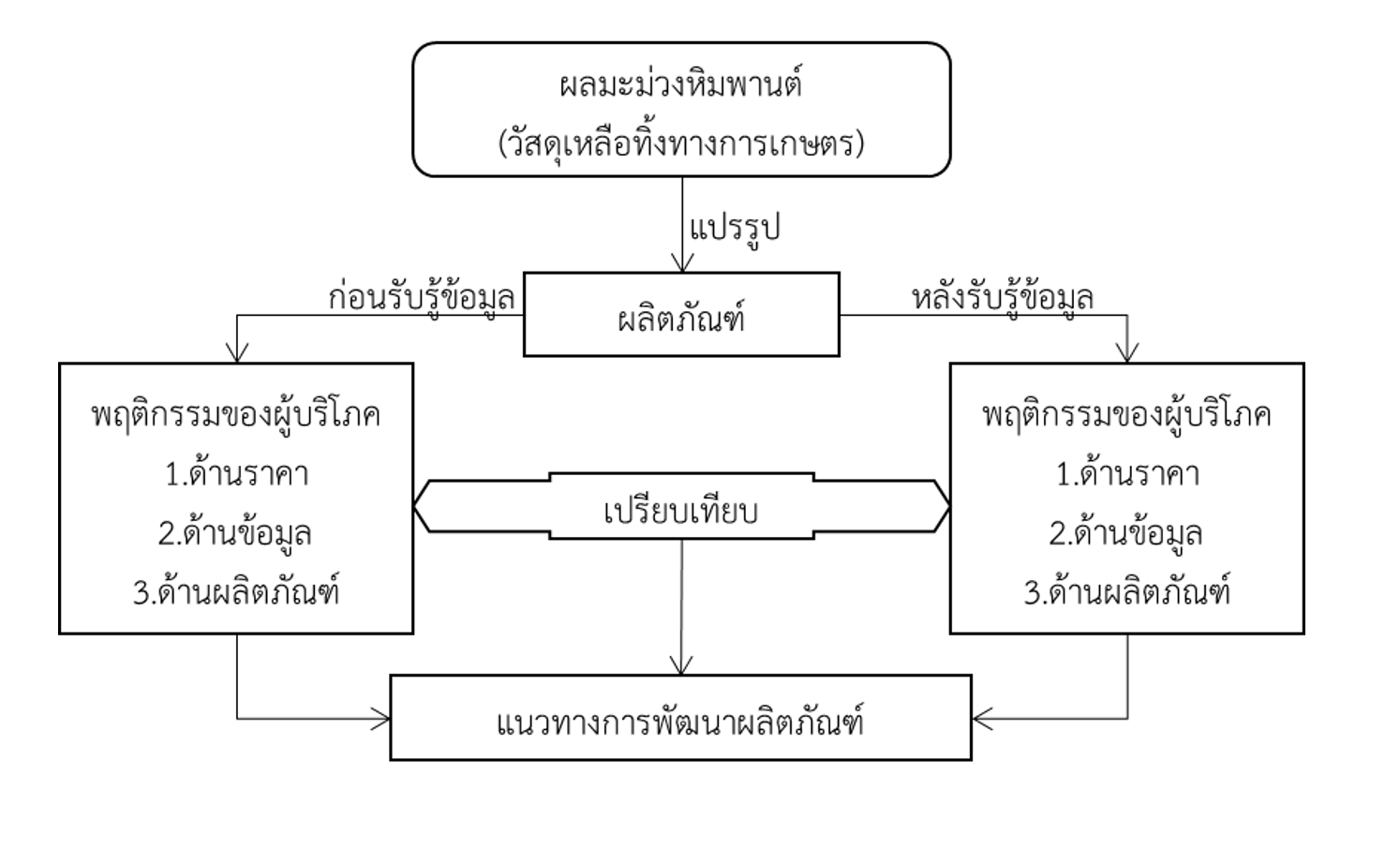
บทนำ: การที่ผู้บริโภคชาวไทยส่วนใหญ่ไม่คุ้นเคยกับการบริโภคผลมะม่วงหิมพานต์ส่งผลให้เกิดการสูญเสียทางเศรษฐกิจและปัญหาขยะจากการทิ้งผลไม้ส่วนนี้หากนำผลมะม่วงหิมพานต์มาเพิ่มมูลค่าและสร้างคุณค่าให้เป็นที่ยอมรับ ย่อมสามารถสร้างรายได้ให้กับเกษตรกรผู้เพาะปลูก และสามารถสร้างทางเลือกให้กับผู้บริโภคได้เพิ่มมากขึ้น วัตถุประสงค์ของการวิจัย: (1) ศึกษาพฤติกรรมของผู้บริโภคที่มีต่อการรับรู้ข้อมูลการเพิ่มมูลค่าผลมะม่วงหิมพานต์ และ (2) สร้างแนวทางการเพิ่มมูลค่าผลิตภัณฑ์แปรรูปจากผลมะม่วงหิมพานต์ ระเบียบวิธีวิจัย: การวิจัยนี้เป็นการวิจัยแบบสำรวจ โดยเก็บข้อมูลด้วยแบบสอบถามจากกลุ่มตัวอย่างจำนวน 100 ตัวอย่าง ด้วยวิธีแบบสะดวกในการสุ่มตัวอย่าง โดยศึกษาความแตกต่างของพฤติกรรมผู้บริโภคก่อนและหลังการรับรู้ข้อมูลผ่านการชมวิดิทัศน์เกี่ยวกับคุณค่าของผลิตภัณฑ์ และใช้การวิเคราะห์ข้อมูลทางสถิติ Paired sample t-test ในการทดสอบพฤติกรรมของผู้บริโภคก่อนและหลังรับข้อมูลเกี่ยวกับผลิตภัณฑ์ และใช้การวิเคราะห์โดยเปรียบเทียบเหตุการณ์ (Constant Comparison) ในการวิเคราะห์แนวทางการเพิ่มมูลค่าผลมะม่วงหิมพานต์เหลือทิ้ง ผลการวิจัย: พบว่า ผู้บริโภคมีพฤติกรรมแตกต่างอย่างมีนัยสำคัญทางสถิติทั้งในทุกด้าน ได้แก่ ด้านราคา ด้านข้อมูล และด้านผลิตภัณฑ์ ซึ่งหลังการรับรู้ข้อมูลผู้บริโภคมีความเต็มใจซื้อมากขึ้น และพบว่าการสื่อสารการตลาดเกี่ยวกับคุณค่าของผลิตภัณฑ์สามารถเพิ่มมูลค่าให้ผลิตภัณฑ์แปรรูปจากมะม่วงหิมพานต์เหลือทิ้ง สรุป: การสื่อสารข้อมูลเกี่ยวกับผลิตภัณฑ์แปรรูปมะม่วงหิมพานต์ที่ทำให้ผู้บริโภครู้สึกดี รับรู้ถึงคุณค่าที่มากกว่าของผลิตภัณฑ์ และรับรู้ถึงคุณค่าที่มากกว่าต้นทุนที่จ่าย ทำให้รับรู้ถึงมูลค่าเพิ่มของผลิตภัณฑ์ ส่งผลต่อการเปลี่ยนแปลงของทัศนคติ และความเต็มใจซื้อของผู้บริโภค
Downloads
Article Details

อนุญาตภายใต้เงื่อนไข Creative Commons Attribution-NonCommercial-NoDerivatives 4.0 International License.
** ข้อความ ข้อคิดเห็น หรือข้อค้นพบ ในวารสารสหวิทยาการสังคมศาสตร์และการสื่อสารเป็นของผู้เขียน ซึ่งจะต้องรับผิดชอบต่อผลทางกฎหมายใด ๆ ที่อาจเกิดขึ้นจากบทความและงานวิจัยนั้น ๆ โดยมิใช่ความรับผิดชอบของคณะนิเทศศาสตร์ มหาวิทยาลัยราชภัฏรำไพพรรณี **
เอกสารอ้างอิง
Adaval, R., & Wyer, R. S. (1998). The role of narratives in consumer information processing. Journal of Consumer Psychology, 7(3), 207–245.
Ajzen, I., & Fishbein, M. (2000). Attitudes and the attitude–behavior relation: Reasoned and automatic processes. In W. Stroebe & M. Hewstone (Eds.), European Review of Social Psychology (Vol. 11, pp. 1–33). John Wiley & Sons.https://people.umass.edu/aizen/pubs/ersp.pdf
Almquist, E., Senior, J., & Bloch, N. (2016). The elements of value. Harvard Business Review.https://hbr.org/2016/09/the-elements-of-value
Bindeoué, T. (2021). The concept of consumer behavior: Definitions in a contemporary marketing perspective. International Journal of Management & Entrepreneurship Research, 3(8), 303–307.
David, C., & Prasad, S. (2015). Value-added products from cashew apple. In I International Symposium on Cashew Nut (ISHS Acta Horticulturae, No. 1080).https://doi.org/10.17660/ActaHortic.2015.1080.51
Dimoso, N., Aluko, A., Makule, E., & Kassim, N. (2021). Challenges and opportunities toward sustainable consumption and value addition of cashew apples in Tanzania. Outlook on Agriculture, 50,(2), 169–177.
Fehrenbach, D., & Herrando, C. (2021). The effect of customer-perceived value when paying for a product with personal data: A real-life experimental study. Journal of Business Research, 222–232.
Ferguson, C., Halloran, J., & Nakamoto, S. (1991). What is value added? CTAHR Economic Fact Sheet (No. 14). https://scholarspace.manoa.hawaii.edu
Fishbein, M., & Ajzen, I. (1975). Belief, attitude, intention, and behavior: An introduction to theory and research.https://people.umass.edu/aizen/f&a1975.html
Hye-Jin Kim, Park, S.-Y., & Park, H.-Y. (2016). A study on the effect of storytelling marketing on brand image and brand attitude. Journal of Economics, Marketing, and Management, 6(4), 1–16.
Kumar, V., & Reinartz, W. (2016). Creating enduring customer value. Journal of Marketing, 80(6), 36–68.
https://doi.org/10.1509/jm.15.0414
Kurnia, P. R. (2020). Examining the reasons behind the successes and failures of new products. Journal of Management and Marketing Review, 5(3), 129–140.
Lebaka, V., Jung Wee, Y., Narala, V., & Joshi, V. (2018). Development of new probiotic foods: A case study on probiotic juices. In Advances in Probiotic Technology (pp. 55–78). Academic Press.https://doi.org/10.1016/B978-0-12-814625-5.00004-4
Mason, M., Oduro, S., Umar, R., & Zamparo, G. (2023). Effect of consumption values on consumer behavior: A meta-analysis. Marketing Intelligence & Planning, 41(7), 923–944.
Office of Chanthaburi Provincial Statistics. (2023). Chanthaburi provincial statistical report.
Perner, L. (2010). Consumer behavior: The psychology of marketing.https://www.consumerpsychologist.com
Poornakala, S., Indumathi, V., & Shanthi, K. (2020). Value addition in cashew apple: A review. International Journal of Chemical Studies, 8(6), 819–825.
Preethi, P., et al. (2021). Cashew apple pomace powder enriched cereal-based extrudates. LWT – Food Science and Technology, 139, 110539. https://doi.org/10.1016/j.lwt.2020.110539
Runjala, S., & Kella, L. (2017). Cashew apple (Anacardium occidentale L.): Therapeutic benefits, processing, and product development. The Pharma Innovation Journal, 6(7), 260–264.
Smith, J., & Colgate, M. (2007). Customer value creation: A practical framework. Journal of Marketing Theory and Practice, 15, 17–23.
Steptoe, A., Pollard, T. M., & Wardle, J. (1995). Development of a measure of the motives underlying food choice. Appetite, 25(3), 267–284.https://doi.org/10.1006/appe.1995.0061
Tanrikulu, C. (2021). Theory of consumption values in consumer behaviour research. International Journal of Consumer Studies, 45(6), 1179–1197.https://doi.org/10.1111/ijcs.12687
Walten, L., & Wiedmann, K.-P. (2023). How product information and source credibility affect consumer attitudes. Journal of Marketing Communications, 29(7), 637–653.
Wang, Q., Dacko, S., & Gad, M. (2008). Factors influencing consumers’ evaluation and adoption intention of really-new services. Advances in Consumer Research, 35, 416–423.
