
ANALYSIS OF CONSUMER BEHAVIOR TOWARD CASHEW APPLE VALUE ADDITION
Article Sidebar
Main Article Content
Abstract
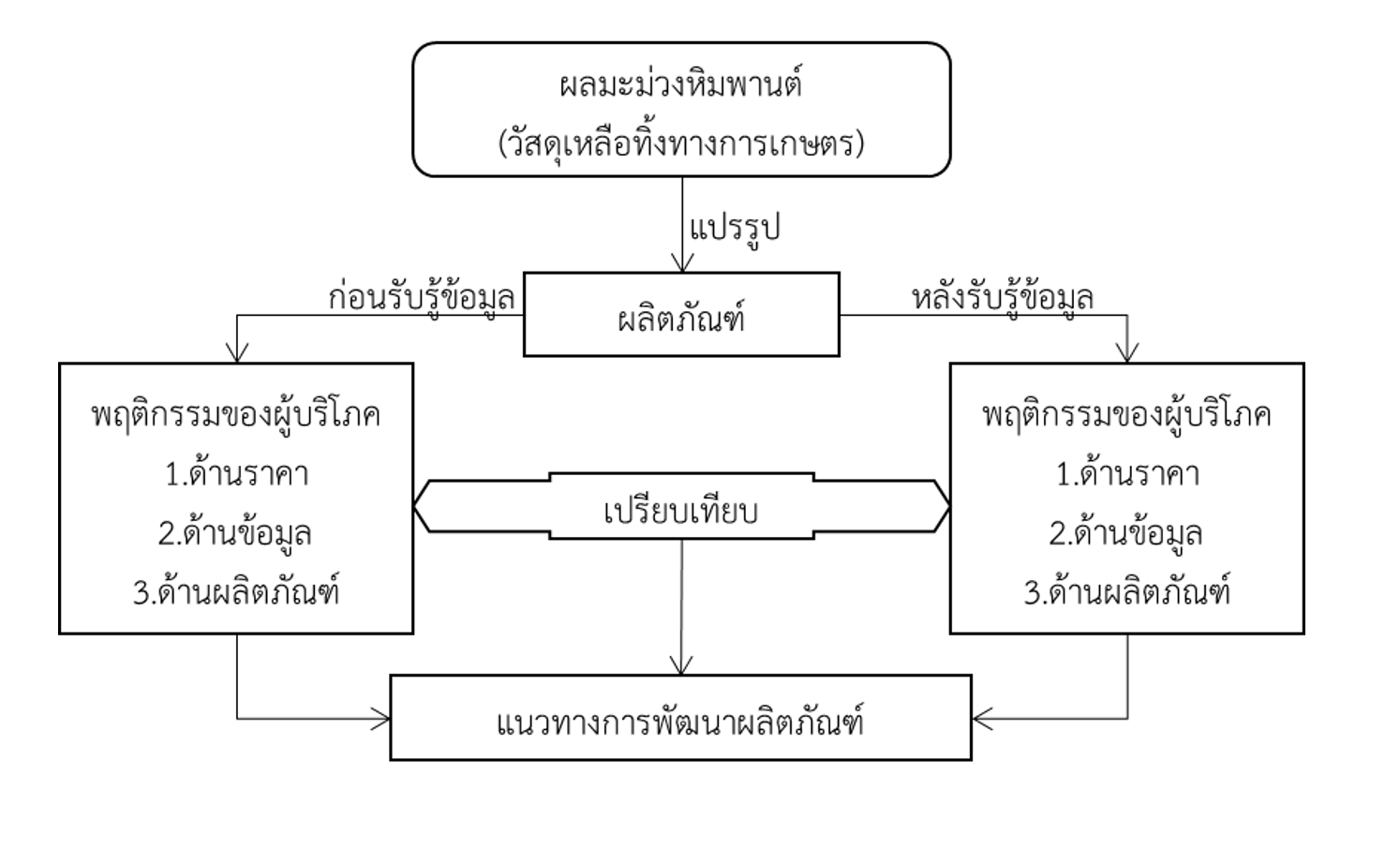
Introduction: Lack of familiarity with the cashew apple among most Thai consumers results in economic losses and waste from discarded fruit. However, adding value to and creating a favorable perception of the cashew apple could generate income for farmers and expand choices for consumers. Objectives: (1) analyze consumer behavior regarding the perception of information on added-value cashew apple products and (2) propose guidelines for adding value to processed cashew apple products. Methodology: This survey research collected data via questionnaires from a convenience sample of 100 participants. The study examined the difference in consumer behavior before and after exposure to a video on the value of the product. The data were analyzed using a Paired Sample t-test to compare behavior before and after receiving product information, and a Constant Comparison method to analyze value-adding guidelines for the discarded cashew apple.Result: The study found statistically significant differences in all aspects of consumer behavior—namely, price, information, and product after they were exposed to the information. Following this exposure, consumers demonstrated a greater willingness to purchase the product. The study also concluded that marketing communication about the product's value can successfully add value to processed cashew apple products. Conclusion: Communicating information about processed cashew apple products that elicits positive consumer affect, conveys a perception of product value and perceives value exceeding the price paid fosters the recognition of added value. This process subsequently influences consumer attitudes and purchase intentions
Downloads
Article Details

This work is licensed under a Creative Commons Attribution-NonCommercial-NoDerivatives 4.0 International License.
The author(s) is only responsible for data appearing in the submitted manuscript of Interdisciplinary social sciences and communication journal.Besides, this journal encourages and enables you to share data such as statements, contents, figures, etc. that support your research publication where appropriate, and enables you to interlink the data with proper citation.
References
Adaval, R., & Wyer, R. S. (1998). The role of narratives in consumer information processing. Journal of Consumer Psychology, 7(3), 207–245.
Ajzen, I., & Fishbein, M. (2000). Attitudes and the attitude–behavior relation: Reasoned and automatic processes. In W. Stroebe & M. Hewstone (Eds.), European Review of Social Psychology (Vol. 11, pp. 1–33). John Wiley & Sons.https://people.umass.edu/aizen/pubs/ersp.pdf
Almquist, E., Senior, J., & Bloch, N. (2016). The elements of value. Harvard Business Review.https://hbr.org/2016/09/the-elements-of-value
Bindeoué, T. (2021). The concept of consumer behavior: Definitions in a contemporary marketing perspective. International Journal of Management & Entrepreneurship Research, 3(8), 303–307.
David, C., & Prasad, S. (2015). Value-added products from cashew apple. In I International Symposium on Cashew Nut (ISHS Acta Horticulturae, No. 1080).https://doi.org/10.17660/ActaHortic.2015.1080.51
Dimoso, N., Aluko, A., Makule, E., & Kassim, N. (2021). Challenges and opportunities toward sustainable consumption and value addition of cashew apples in Tanzania. Outlook on Agriculture, 50,(2), 169–177.
Fehrenbach, D., & Herrando, C. (2021). The effect of customer-perceived value when paying for a product with personal data: A real-life experimental study. Journal of Business Research, 222–232.
Ferguson, C., Halloran, J., & Nakamoto, S. (1991). What is value added? CTAHR Economic Fact Sheet (No. 14). https://scholarspace.manoa.hawaii.edu
Fishbein, M., & Ajzen, I. (1975). Belief, attitude, intention, and behavior: An introduction to theory and research.https://people.umass.edu/aizen/f&a1975.html
Hye-Jin Kim, Park, S.-Y., & Park, H.-Y. (2016). A study on the effect of storytelling marketing on brand image and brand attitude. Journal of Economics, Marketing, and Management, 6(4), 1–16.
Kumar, V., & Reinartz, W. (2016). Creating enduring customer value. Journal of Marketing, 80(6), 36–68.
https://doi.org/10.1509/jm.15.0414
Kurnia, P. R. (2020). Examining the reasons behind the successes and failures of new products. Journal of Management and Marketing Review, 5(3), 129–140.
Lebaka, V., Jung Wee, Y., Narala, V., & Joshi, V. (2018). Development of new probiotic foods: A case study on probiotic juices. In Advances in Probiotic Technology (pp. 55–78). Academic Press.https://doi.org/10.1016/B978-0-12-814625-5.00004-4
Mason, M., Oduro, S., Umar, R., & Zamparo, G. (2023). Effect of consumption values on consumer behavior: A meta-analysis. Marketing Intelligence & Planning, 41(7), 923–944.
Office of Chanthaburi Provincial Statistics. (2023). Chanthaburi provincial statistical report.
Perner, L. (2010). Consumer behavior: The psychology of marketing.https://www.consumerpsychologist.com
Poornakala, S., Indumathi, V., & Shanthi, K. (2020). Value addition in cashew apple: A review. International Journal of Chemical Studies, 8(6), 819–825.
Preethi, P., et al. (2021). Cashew apple pomace powder enriched cereal-based extrudates. LWT – Food Science and Technology, 139, 110539. https://doi.org/10.1016/j.lwt.2020.110539
Runjala, S., & Kella, L. (2017). Cashew apple (Anacardium occidentale L.): Therapeutic benefits, processing, and product development. The Pharma Innovation Journal, 6(7), 260–264.
Smith, J., & Colgate, M. (2007). Customer value creation: A practical framework. Journal of Marketing Theory and Practice, 15, 17–23.
Steptoe, A., Pollard, T. M., & Wardle, J. (1995). Development of a measure of the motives underlying food choice. Appetite, 25(3), 267–284.https://doi.org/10.1006/appe.1995.0061
Tanrikulu, C. (2021). Theory of consumption values in consumer behaviour research. International Journal of Consumer Studies, 45(6), 1179–1197.https://doi.org/10.1111/ijcs.12687
Walten, L., & Wiedmann, K.-P. (2023). How product information and source credibility affect consumer attitudes. Journal of Marketing Communications, 29(7), 637–653.
Wang, Q., Dacko, S., & Gad, M. (2008). Factors influencing consumers’ evaluation and adoption intention of really-new services. Advances in Consumer Research, 35, 416–423.
