EXPLORING INFLUENCING FACTORS AND IMPLEMENTING EFFECTIVE COUNTERMEASURES ON TEACHER MOBILITY IN HIGHER EDUCATION IN CHINA
Article Sidebar
Main Article Content
บทคัดย่อ
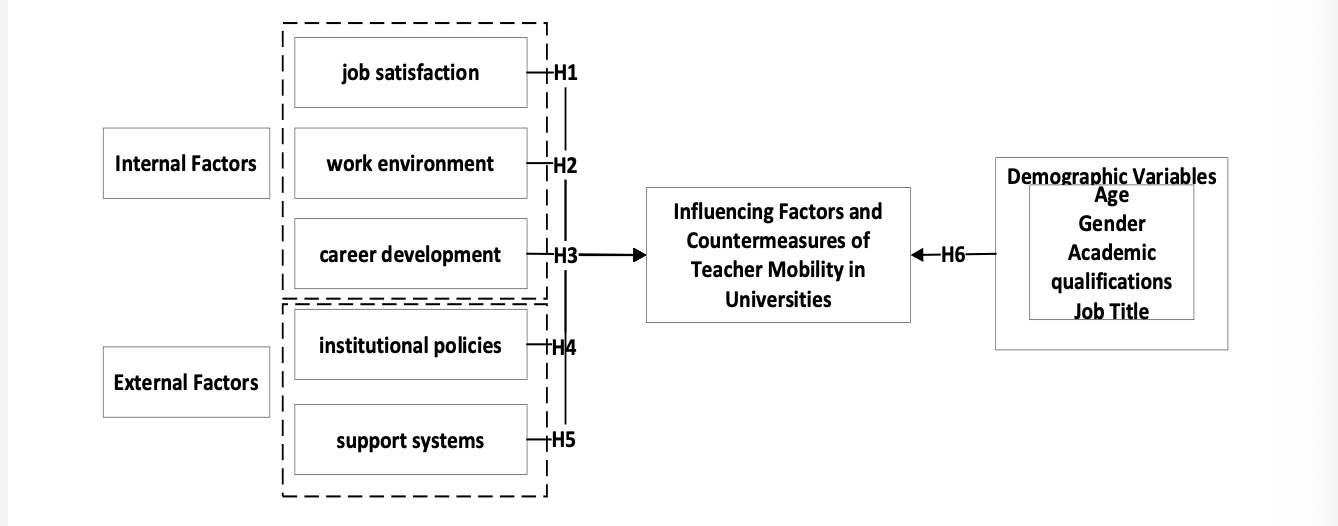
Introduction Here are some ideas and tips on exploring influencing factors and implementing effective countermeasures for teacher mobility in higher education in China:Influencing Factors: Career advancement opportunities: Objectives of the StudyThis study investigated the factors influencing and effective countermeasures for teacher turnover in higher education in China. Methodology A survey was conducted with 463 university teachers using an online questionnaire survey. showed that job satisfaction, the working environment, career development, institutional policies, and support systems significantly affected teacher turnover. However, there were no significant differences in teacher turnover according to gender, age, academic qualifications or job title. This study suggests that the government should play a macro-level regulatory role in the housing market.Results Universities should control the autonomy of teacher turnover and establish compensation mechanisms for losses. Teachers should improve their self-discipline to ensure honest turnover. To promote rational teacher turnover, institutions should focus on teachers' career development, improve teachers' treatment, and build a good organizational culture. It is important to meet the resource conditions for teachers' professional development.Conclusion Management interventions should be reduced, and office procedures should be simplified to achieve efficiency. The results provide insights into the factors influencing teacher turnover in China's higher education and suggest ways to promote teacher turnover scientifically and systematically
Downloads
Article Details

อนุญาตภายใต้เงื่อนไข Creative Commons Attribution-NonCommercial-NoDerivatives 4.0 International License.
** ข้อความ ข้อคิดเห็น หรือข้อค้นพบ ในวารสารสหวิทยาการสังคมศาสตร์และการสื่อสารเป็นของผู้เขียน ซึ่งจะต้องรับผิดชอบต่อผลทางกฎหมายใด ๆ ที่อาจเกิดขึ้นจากบทความและงานวิจัยนั้น ๆ โดยมิใช่ความรับผิดชอบของคณะนิเทศศาสตร์ มหาวิทยาลัยราชภัฏรำไพพรรณี **
เอกสารอ้างอิง
Ehrenberg, R.,Kasper, H.,& Rees, D. (1991). Faculty turnover at American colleges and universities: analyses of AAUP data. Economics of Education Review, 10(2), 99-110.
Fayol, H. (1949). General and industrial management. Sir Isaac Pitman & Sons, Ltd.
Feng, L., & Sass, T. R. (2012). Teacher quality and teacher mobility. Education Finance & Policy, 42.
Freeman, R.E. (1984). Strategic management: a stakholder approach. Journal of Management Studies, 29(2), 131-154.
Greenwood, M. (2007). Stakeholder engagement: beyond the myth of corporate responsibility. Journal of Business Ethics, 74(4), 315-327.
Gulosino, C. , & Ni, Y. . (2018). Teacher Mobility in Charter Schools and Traditional Public Schools: A Test of Segmented Labor Market.Panel Session: Teachers' Choices and Experiences in the Charter Sector. AERA 2018
Hair, J. F., Black, W. C., Babin, B. J., &Anderson,R.E. (2010). Multivariat Data Analysis:A Global Perspective, (7th Ed). Pearson Educational Inc.
Hinsz V.B., & Nelson, L. C . (1990). Testing models of turnover intentions with university faculty1. Journal of Applied Social Psychology,20(1), 68-84.
Hoppock, R. (1935). Job satisfaction. Haper & Row, (3), 62.67.
Hu, Shiji. (2018). Research on the Difference of Teacher Mobility in Colleges and Universities Based on Push-Pull Theory. Master's thesis, Wuhan University of Technology.
Jili, Jingya Li, & Taotao Lai. (2014). Teacher brain drain in local universities under the perspective of hierarchy of needs theory. Journal of Guangxi Institute of Education, (1), 35-38.
Knight, P. (2002). Being a teacher in higher education. Open University Press.
Lai, Q. H., & Li, D. H.. (2021). Talent mobility dilemma and its governance path in universities under the perspective of push-pull theory. Jiangsu Higher Education, 248(10), 46-52.
Lamont, M., Beljean, S., & Clair, M. (2014). What is missing? Cultural processes and causal pathways to inequality. Socio-Economic Review, 12(3), 573-608.
Lange, D. E. (1990). Blueprint for Teacher Development, Jack C. Richards and David Nunan (Eds.), Second Language Teacher Education. Cambridge University Press.
Lee, E. S. (1966). A theory of migration. Demgraphy, (1), 47- 57.
Li, Irene. (2013). An analysis of the four forces model of private college teachers' motivation. Contemporary Economy, (9), 82-84.
Lin, Songyue, Liu, Jin, & Xu, Li. (2020). What makes university teachers mobile -The introduction of a non-contact research method. Research on Teacher Education, 32(01), 78-84
Lipset, S. M. & R. Bendix. (1959). Social Mobility in I ndustrial Society. University of California Press.
Liu J. (2019). Academic career mobility: a comparative study between China and Japan-an empirical analysis of faculty mobility between University M in China and University N in Japan. China Higher Education Research, 308(04), 55-63.
Liu L. (2023). Can overseas study promote university teachers' career development - the mediating effect of research output and the masking effect of local academic networks. Exploration of Higher Education, (05), 35-43.
Mrope, G. (2023). Job Satisfaction and Teachers’ Mobility in Momba District, Tanzania.
Qin, Jian, & Zhou, Hongli. (2022). Analysis on the influencing factors and governance of high- level talent mobility in central region under the perspective of push-pull theory -The case of zz city. Decision Sciences, (2), 46-53.
Qing Sulan. (2021). Examination of the current situation of faculty mobility and countermeasure suggestions in colleges and universities in central and western China--an analysis based on the key construction universities in central and western China "one province, one school. Journal of Southwest University (Social Science Edition), 47(06), 93-100.
Racké, C. (2013). Staff mobility in higher education: national policies and programmes. European Commission.
Rausch, D. (1989). The Academic Revolving Door: Why Do Women Get Caught?. CUPA Journal, 40, 1-16.
Romer, P. (1986). Increasing Returns and Long-Run Growth. Journal of Political Economy, 94, 1002 - 1037.
Sims, S. (2020). Modelling the relationships between teacher working conditions, job satisfaction and workplace mobility. British Educational Research Journal, 46(2), 301-320.
Su, Yang. (2023). Does international academic mobility promote academic entrepreneurship among college teachers? - An empirical analysis based on the mechanical engineering disciplines of five top universities in China. Fudan Education Forum, 21(02), 80-87.
Sullivan, K. , Barkowski, E. , Lindsay, J. , Lazarev, V. , & Lin, L. (2017). Trends in teacher mobility in Texas and associations with teacher, student, and school characteristics.
Yu, Wei-Ye, & Wang, Z.-G. (2010). Literature review of job satisfaction theory research. Industry and Technology Forum, 2010, 9(10), 125-126.
