Confirmatory of Composite Analysis
Keywords:
Confirmatory composite analysis, Confirmatory factor analysis, Partial least square structural equation modelAbstract
Abstract
The advantage of the variance-based structural equation model is that simple convergence, limited sample size and non-normal distribution data are especially in comparison to the covariance-based structural equation model, such as the confirmatory factor analysis. In addition, the variance-based approach was developed in 2015 using factor variable influence less bias and the scholar proposed a confirmatory composite analysis. As a result, variance-based can operate both confirmatories, while covariance-based only performs a confirmatory factor analysis. This study is investigating the results of confirmatory composite analysis to use a variance-based or partial least square model of structural equation using Jhantasana data (2020). The outcome demonstrates flexible composite confirmation analysis. However, the significance of this method is multicollinearity, including model-fit criteria, which by solving it can increase the quality of a model. Confirmatory composite analysis can focus more on many fields as many organizations create a composite index for many indicators than a latent variable used only for behavioral studies.
Downloads
References
ฉันธะ จันทะเสนา. (2563). Methods of reporting research-results of the second-order construct of pls-sem. Chulalongkorn Business Review, 42(165), 39 - 67.
Aaker, D.A. (1991). Managing Brand Equity. New York, NY : The Free Press.
Antonakis, J., Bendahan, S., Jacquart, P., & Lalive, R. (2010). On making causal claims: A review and recommendations. The Leadership Quarterly, 21(6), 1086-1120.
Becker, J. M., Klein, K., & Wetzels, M. (2012). Hierarchical latent variable models in PLS-SEM: Guidelines for using reflective-formative type models. Long Range Planning, 45(5-6), 359-394.
Benítez-Ávila, C., Hartmann, A., Dewulf, G., & Henseler, J. (2018). Interplay of relational and contractual governance in public-private partnerships: The mediating role of relational norms, trust and partners' contribution. International journal of project management, 36(3), 429-443.
Braojos, J., Benitez, J., & Llorens, J. (2019). How do social commerce-IT capabilities influence firm performance? Theory and empirical evidence. Information & Management, 56(2), 155-171.
Bollen, K. A., & Bauldry, S. (2011). Three Cs in measurement models: Causal indicators, composite indicators, and covariates. Psychological Methods, 16(3), 265.
Bollen, K. A., & Diamantopoulos, A. (2015). In defense of causal-formative indicators: A minority report. Psychological Methods, 22(3), 581-596.
Cavicchia, C., & Vichi, M. (2020). Statistical model based composite indicators for tracking coherent policy conclusions. Social Indicators Research, 156, 449-479.
Cegarra-Navarro, J. G., Ruiz, F. J. A., Martínez-Caro, E., & Garcia-Perez, A. (2019). Turning heterogeneity into improved research outputs in international R&D teams. Journal of Business Research, 128, 770-778.
Cohen, J. (1988). Set correlation and contingency tables. Applied Psychological Measurement, 12(4), 425-434.
Cronbach, L. J., & Meehl, P. E. (1955). Construct validity in psychological tests. Psychological Bulletin, 52(4), 281-302.
Dijkstra,T. K. (2013). A note on how to make PLS consistent. Working Paper. Retrieved on August 12, 2020, from http://www.rug.nl/staff/t.k.dijkstra/how-to-make-pls-consist.
Dijkstra, T. K., & Henseler, J. (2015a). Consistent and asymptotically normal PLS estimators for linear structural equations. Computational Statistics & Data Analysis, 81, 10-23.
Dijkstra, T. K., & Henseler, J. (2015b). Consistent partial least squares path modeling. MIS Quarterly, 39(2), 1-20.
Edwards, J. R., & Bagozzi, R. P. (2000). On the nature and direction of relationships between constructs and measures. Psychological Methods, 5(2), 155-174.
Felipe, C. M., Roldán, J. L., & Leal-Rodríguez, A. L. (2016). An explanatory and predictive model for organizational agility. Journal of Business Research, 69(10), 4624-4631.
Foltean, F. S., Trif, S. M., & Tuleu, D. L. (2019). Customer relationship management capabilities and social media technology use: Consequences on firm performance. Journal of Business Research, 104, 563-575.
Hair, J. F., Ringle, C. M., & Sarstedt, M. (2011). PLS-SEM: Indeed a silver bullet. Journal of Marketing theory and Practice, 19(2), 139-152.
Hair Jr, J. F., Howard, M. C., & Nitzl, C. (2020). Assessing measurement model quality in PLS-SEM using confirmatory composite analysis. Journal of Business Research, 109, 101-110.
Henseler, J., & Schuberth, F. (2020). Using confirmatory composite analysis to assess emergent variables in business research. Journal of Business Research, 120, 147-156.
Henseler, J., Dijkstra, T. K., Sarstedt, M., Ringle, C. M., Diamantopoulos, A., Straub, D. W., Ketchen, D., Hair, J. F., Hult, T. M., & Calantone, R. J. (2014). Common beliefs and reality about PLS: Comments on Ronkko and Evermann (2013). Organizational Research Methods, 17(2), 182-209.
Henseler, J., Hubona, G., & Ray, P. A. (2016). Using PLS path modeling in new technology research: Updated guidelines. Industrial Management & Data Systems, 116(1), 2-20
Henseler, J. (2017a). ADANCO 2.0. 1. In 9th International Conference on PLS and Related Methods, PLS.
Henseler, J. (2017b). Bridging design and behavioral research with variance-based structural equation modeling. Journal of Advertising, 46(1), 178-192.
Hu, L. T., & Bentler, P. M. (1998). Fit indices in covariance structure modeling: Sensitivity to underparameterized model misspecification. Psychological Methods, 3(4), 424-453.
Hubona, G. S., Schuberth, F., & Henseler, J. (2021). A clarification of confirmatory composite analysis (CCA). International Journal of Information Management, 61, 1-8.
Hult, G. T. M., Hair Jr, J. F., Proksch, D., Sarstedt, M., Pinkwart, A., & Ringle, C. M. (2018). Addressing endogeneity in international marketing applications of partial least squares structural equation modeling. Journal of International Marketing, 26(3), 1-21.
Kettenring, J. R. (1971). Canonical analysis of several sets of variables, Biometrika, 58(3), 433–451.
Jhantasana, C. (2020). Methods of reporting research-results of the second-order construct of pls-sem. Chulalongkorn Business Review, 42(3), 39 - 67.
Jöreskog, K.G. (1969). A general approach to confirmatory maximum likelihood factor analysis. Psychometrika, 34, 183-202.
Marcoulides, G. A., & Chin, W. W. (2013). You write, but others read: Common methodological misunderstandings in PLS and related methods. In New perspectives in Partial Least Squares and Related Methods (pp. 31-64). New York, NY : Springer.
Martelo-Landroguez, S., Navarro, J. G. C., & Cepeda-Carrión, G. (2019). Uncontrolled counter-knowledge: its effects on knowledge management corridors. Knowledge Management Research & Practice, 17(2), 203-212.
Menisera,M. (2007). Scoring ordinal variables for constructing composite indicators. Statistica, 63(3), 309-324.
Motamarri, S., Akter, S., & Yanamandram, V. (2020). Frontline employee empowerment: Scale development and validation using confirmatory composite analysis. International Journal of Information Management, 54, 102-177.
Nardo,M., Saisana, M., Saltelli, A., Tarantola, S., Hoffma, A. & Giovannini, E. (2005). Handbook on constructing composite indicators: Methodology and user guide, OECD Statistics Working Paper.
OECD (2006). Handbook on constructing composite indicators. Retrieved on August 20, 2020, from https://www.oecd.org/sdd/42495745.pdf
Rasoolimanesh, S. M., Md Noor, S., Schuberth, F., & Jaafar, M. (2019). Investigating the effects of tourist engagement on satisfaction and loyalty. The Service Industries Journal, 39(7-8), 559-574.
Ringle, C. M., Sarstedt, M., & Straub, D. W. (2012). Editor's Comments: A Critical Look at the Use of PLS-SEM in “MIS Quarterly”. MIS Quarterly, 36(1), 3-14.
Rönkkö, M., & Evermann, J. (2013). A critical examination of common beliefs about partial least squares path modeling. Organizational Research Methods, 16(3), 425-448.
Rönkkö, M., McIntosh, C. N., Antonakis, J., & Edwards, J. R. (2016). Partial least squares path modeling: Time for some serious second thoughts. Journal of Operations Management, 47, 9-27.
Rueda, L., Benitez, J., & Braojos, J. (2017). From traditional education technologies to student satisfaction in Management education: A theory of the role of social media applications. Information & Management, 54(8), 1059-1071.
Ruiz-Palomo D, Diéguez-Soto J, Duréndez A, Santos JAC. (2019). Family management and firm performance in family SMEs: The mediating roles of management control systems and technological innovation. Sustainability, 11(14), 1-22.
Sarstedt, M., Hair, J. F., Ringle, C. M., Thiele, K. O., & Gudergan, S. P. (2016). Estimation issues with PLS and CB-SEM: Where the bias lies! Journal of Business Research, 69(10), 3998-4010.
Schuberth, F. (2020). Confirmatory composite analysis using partial least squares: Setting the record straight. Review of Managerial Science, 15, 1-35.
Schuberth, F., Rademaker, M. E., & Henseler, J. (2020). Estimating and assessing second-order constructs using PLS-PM: the case of composites of composites. Industrial Management & Data Systems.
Schuberth, F., Henseler, J., & Dijkstra, T. K. (2018). Confirmatory composite analysis. Frontiers in Psychology, 9, 1-14.
Schumacker., R. E., & Lomax, R.G. (2016). A beginner's Guide to Structural Equation Modeling: 4th Edition, New York, NY : Routledge.
Van Riel, A. C., Henseler, J., Kemény, I., & Sasovova, Z. (2017). Estimating hierarchical constructs using consistent partial least squares: The case of second-order composites of common factors. Industrial management & data systems, 117(3), 459-477.
Yiu, H. L., Ngai, E. W., & Lei, C. F. (2020). Impact of service‐dominant orientation on the innovation performance of technology firms: Roles of knowledge sharing and relationship learning. Decision Sciences, 51(3), 620-654.
Zhou, P., Ang, B. W., & Poh, K. L. (2007). A mathematical programming approach to constructing composite indicators. Ecological economics, 62(2), 291-297.
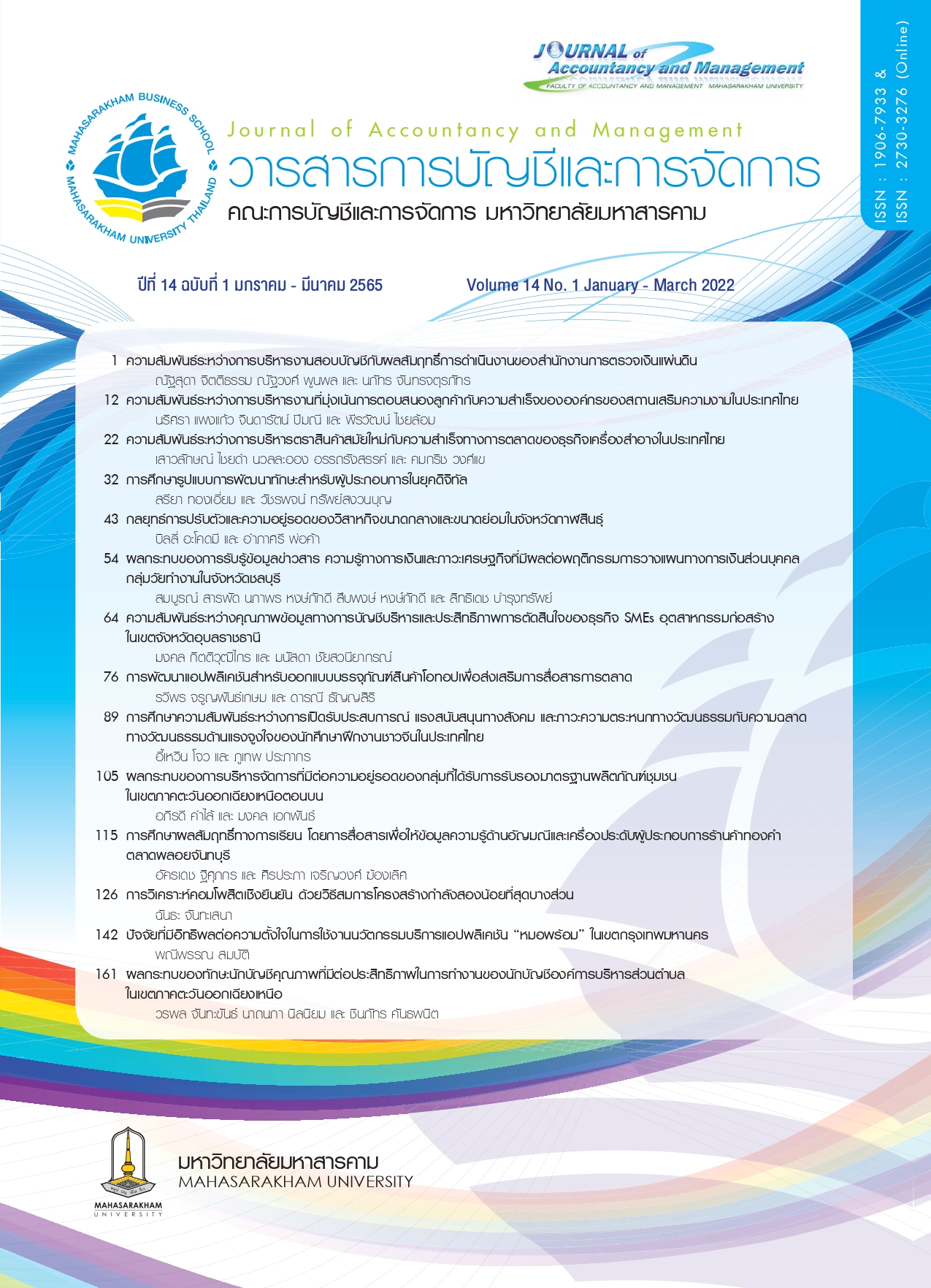
Downloads
Published
How to Cite
Issue
Section
License
Copyright (c) 2021 Journal of Accountancy and Management

This work is licensed under a Creative Commons Attribution-NonCommercial-NoDerivatives 4.0 International License.
บทความที่ได้รับการตีพิมพ์เป็นลิขสิทธิ์ของวารสารการบัญชีและการจัดการ
ข้อความที่ปรากฏในบทความแต่ละเรื่องในวารสารวิชาการเล่มนี้เป็นความคิดเห็นส่วนตัวของผู้เขียนแต่ละท่านไม่เกี่ยวข้องกับมหาวิทยาลัยมหาสารคาม และคณาจารย์ท่านอื่นๆในมหาวิทยาลัยฯ แต่อย่างใด ความรับผิดชอบองค์ประกอบทั้งหมดของบทความแต่ละเรื่องเป็นของผู้เขียนแต่ละท่าน หากมีความผิดพลาดใดๆ ผู้เขียนแต่ละท่านจะรับผิดชอบบทความของตนเองแต่ผู้เดียว