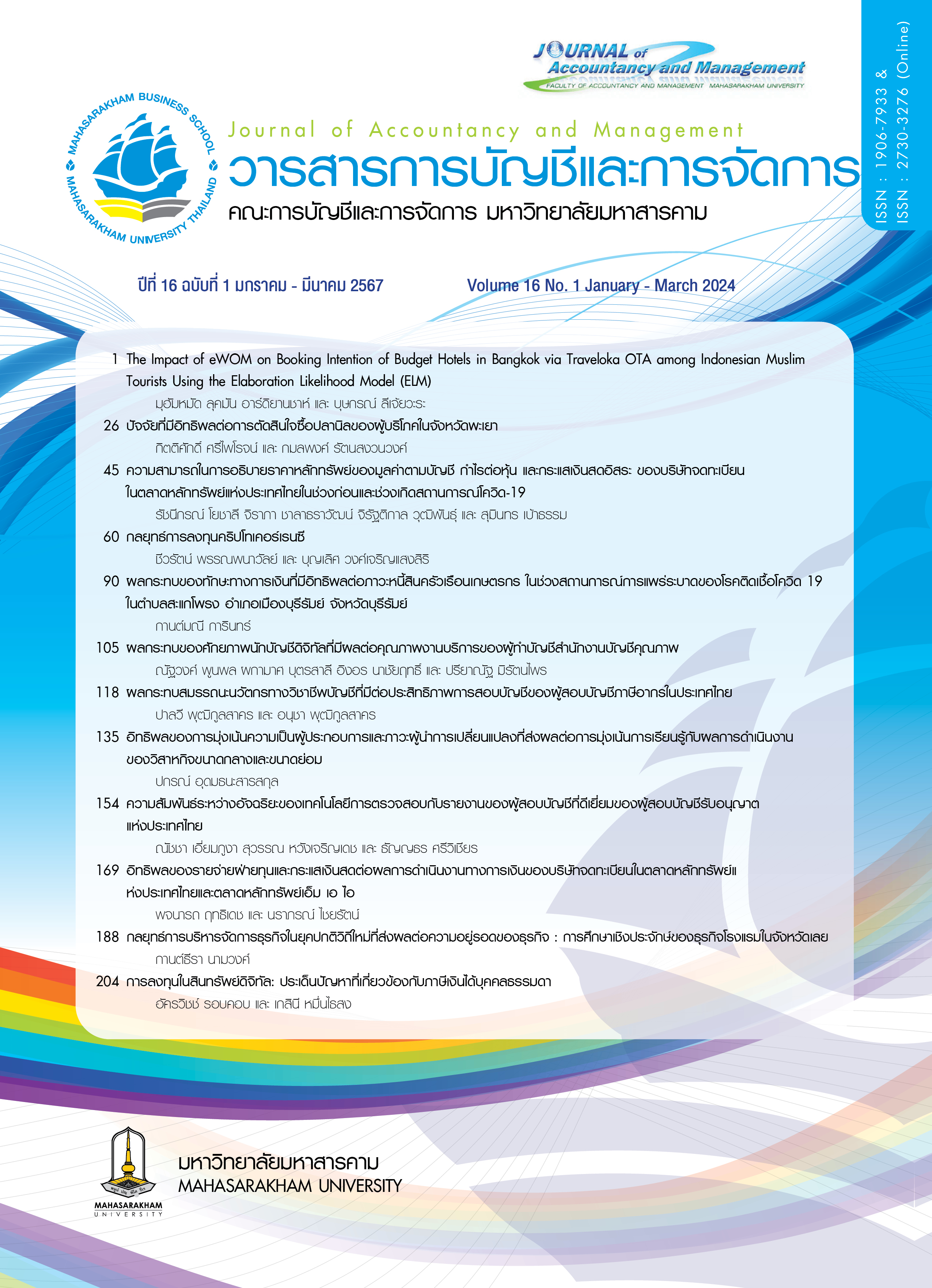
อิทธิพลของการมุ่งเน้นความเป็นผู้ประกอบการและภาวะผู้นำการเปลี่ยนแปลง ที่ส่งผลต่อการมุ่งเน้นการเรียนรู้กับผลการดำเนินงานของวิสาหกิจ ขนาดกลางและขนาดย่อม
คำสำคัญ:
การมุ่งเน้นความเป็นผู้ประกอบการ, ภาวะผู้นำการเปลี่ยนแปลง, การมุ่งเน้นการเรียนรู้, ผลการดำเนินงานขององค์กร, วิสาหกิจขนาดกลางและขนาดย่อมบทคัดย่อ
การวิจัยนี้มีวัตถุประสงค์เพื่อศึกษาอิทธิพลปัจจัยการมุ่งเน้นความเป็นผู้ประกอบการและภาวะผู้นำการเปลี่ยนแปลงที่มีผลต่อการมุ่งเน้นการเรียนรู้และผลการดำเนินงานของธุรกิจขนาดกลางและขนาดย่อม (SMEs) และศึกษาความสอดคล้องของโมเดลเชิงสาเหตุ การมุ่งเน้นความเป็นผู้ประกอบการและภาวะผู้นำการเปลี่ยนแปลงที่มีผลต่อการมุ่งเน้นการเรียนรู้และผลการดำเนินงานของ SMEs กับข้อมูลเชิงประจักษ์ การศึกษาใช้แบบสอบถามเป็นเครื่องมือในการเก็บรวบรวมข้อมูลจากกลุ่มตัวอย่างผู้ประกอบการ SMEs ภาคการผลิต ในกรุงเทพมหานครและเขตปริมณฑล จำนวน 386 ราย วิเคราะห์ข้อมูลด้วยสถิติพรรณนา คือ ค่าร้อยละ ค่าเฉลี่ย และส่วนเบี่ยงเบนมาตรฐาน และสถิติอนุมาน คือ การวิเคราะห์สมการโครงสร้าง ผลการศึกษาพบว่า โมเดลมีความสอดคล้องกับข้อมูลเชิงประจักษ์โดยมีค่าดัชนีตรวจสอบความกลมกลืนได้แก่ ค่าไค-สแควร์สัมพัทธ์ (CMIN/df) = 1.832, ค่าดัชนี CFI = 0.978, ค่า TLI = 0.974 , ค่า RMSEA = 0.043, ค่า SRMR = 0.038 และการมุ่งเน้นความเป็นผู้ประกอบการและภาวะผู้นำการเปลี่ยนแปลงมีอิทธิพลทางตรงเชิงบวกต่อการมุ่งเน้นการเรียนรู้และมีอิทธิพลทางตรงและทางอ้อมเชิงบวกต่อการดำเนินงานของ SMEs อย่างมีนัยสำคัญทางสถิติที่ระดับ 0.05
Downloads
เอกสารอ้างอิง
สำนักงานส่งเสริมวิสาหกิจขนาดกลางและขนาดย่อม. (2565). ข้อมูลจำนวนผู้ประกอบการ. ค้นเมื่อ 14 สิงหาคม 2565 จาก https://sme.go.th/th/page.php?modulekey=348
สำนักงานส่งเสริมวิสาหกิจขนาดกลางและขนาดย่อม. (2565). แผนการส่งเสริมวิสาหกิจขนาดกลางและขนาดย่อม ฉบับที่ 5. ค้นเมื่อ 10 ธันวาคม 2565 จาก https://sme.go.th/upload/mod_download/download-20230202150703.pdf
Aftab, J., Veneziani, M., Sarwar, H., & Ishaq, M. I. (2022), Entrepreneurial orientation and firm performance in SMEs: the mediating role of entrepreneurial competencies and moderating role of environmental dynamism, International Journal of Emerging Markets, Vol. ahead-of-print No. ahead-of-print. https://doi.org/10.1108/IJOEM-07-2021-1151
Allameh, S. M., & Khalilakbar, R. (2018). Exploring the antecedents of innovation erformance: the roles of entrepreneurial orientation, learning orientation and organizational learning. International Journal of Business Excellence, 14(4), 470-485.
Amin, M. (2015). The effect of entrepreneurship orientation and learning orientation on SMEs' performance: an SEM-PLS approach. Journal for International Business and ntrepreneurship Development, 8(3), 215-230.
Baker, W.E., Mukherjee, D., & Perin, M. (2022). Learning orientation and competitive advantage: A critical synthesis and future directions. Journal of Business Research, 144, 863-873.
Bass, B. M. (1985). Leadership and performance beyond expectations. New York : Free Press.
Bass, B. M., & Avolio, B. J. (1994). Improving organizational effectiveness through transformational leadership. sage
Bature, S. W., Sallehuddin, R. M., & Hin, C. W. (2018). Learning orientation, access to debt finance, organizational capability and performance of small and medium enterprises: A proposed model. Academy of Accounting & Financial Studies Journal, 22(3), 1–11.
Calantone R. J., Cavusgil S. T., & Zhao, Y. (2002). Learning orientation, firm innovation, and firm performance. Industrial Marketing Management, 31(6), 515-524.
Covin, J. G., & Lumpkin G. T. (2011). Entrepreneurial orientation theory and research: Reflections on a needed construct. Entrepreneurship Theory and Practice, 35(5), 855–872.
Fornell, C., & Larcker, D. F. (1981). Evaluating structural equation models with unobservable variables and measurement error. Journal of Marketing Research, 18(1), 39-50.
Gomes, G., Seman, L. O., Berndt, A. C., & Bogoni, N. (2022). The role of entrepreneurial orientation, organizational learning capability and service innovation in organizational performance. Revista de Gestao, 29(1), 39–54.
Gong, Y., Huang, J. C., & Farh, J. L. (2009). Employee learning orientation, transformational leadership, and employee creativity: The mediating role of employee creative self-efficacy. Academy of management Journal, 52(4), 765-778.
Hair, J. F., Jr., Black, W. C., Babin, B. J., & Anderson, R. E. (2010). Multivariate data analysis: A global perspective (7th edition). New Jersey : Prentice Hall.
Hakim, N. I., & Wijaya, A. (2021). The Influence of market and learning orientation on MSME business performance mediated by innovation. Proceedings of the tenth International Conference on Entrepreneurship and Business Management 2021, 653, 36-41.
Hossain, M. R., Akhter, F., & Sultana, M. M. (2022). SMEs in covid-19 crisis and combating strategies: a systematic literature review (SLR) and A case from emerging economy. Operations Research Perspectives, 100222.
Huang, S. K., & Wang, Y. L. (2011). Entrepreneurial orientation, learning orientation and innovation in small and medium enterprises. Procedia-Social and Behavioral Sciences, 24, 563-570.
Ikhram W, M. A. D., & Fuadiputra, I. R. (2021). The impact of transformational leadership style and culture on the performance of MSME employee through mediation of organizational learning. Business and Accounting Research (IJEBAR), 5(3), 865–873.
Jensen, M., Potocnik, K., & Chaudhry, S. (2020). A Mixed-methods study of CEO transformational leadership and firm performance. European Management Journal, 38(6), 836-845.
Jyoti, J., & Bhau, S. (2015). Impact of Transformational leadership on job performance: Mediating role of leader–member exchange and relational identification. SAGE Open, 5(4), 1-10.
Kiyabo, K., & Isaga, N. (2019). Strategic entrepreneurship, competitive advantage, and SMEs’ performance in the welding industry in Tanzania. Journal of Global Entrepreneurship Research, 9(1), 1-23.
Ključnikov, A., Civelek, M., Čech, P., & Kloudová, J. (2019). Entrepreneurial orientation of SMEs? executives in the comparative perspective for Czechia and Turkey. Oeconomia Copernicana, 10(4), 773–795.
Kraus, S., Rigtering, J.P.C., & Hughes, M. (2012). Entrepreneurial orientation and the business performance of SMEs: a quantitative study from the Netherlands. Review of Managerial Science, 6, 161–182.
Lomberg, C., Urbig, D., Stöckmann, C., Marino, L. D., & Dickson, P. H. (2017). Entrepreneurial orientation: The dimensions’ shared effects in explaining firm performance. Entrepreneurship: Theory and Practice, 41(6), 973-998.
Lumpkin, G. T., & Dess, G. G. (1996). Clarifying the Entrepreneurial Orientation Construct and Linking It to Performance. The Academy of Management Review, 21(1), 135–172.
Mahto, R. V., McDowell, W. C., Kudlats, J., & Dunne, T. C. (2018), Learning orientation and performance satisfaction as predictors of small firm innovation: the moderating role of gender, Group Decision and Negotiation, 27(3), 375-391.
Miller, D. (1983). The correlates of entrepreneurship in three types of firms. Management Science, 29(7), 770-791.
Nasir, W., Al Mamun, A., & Breen, J. (2017). Strategic orientation and performance of SMEs in Malaysia. SAGE Open, 7(2), 139-152.
Nulkar, G. (2014). SMEs and environmental performance–A framework for green business strategies. Procedia-Social and Behavioral Sciences, 133, 130-140.
Podsakoff P. M., MacKenzie S. B., Moorman R. H., & Fetter R. (1990). Transformational leader behaviors and their effects on followers’ trust in leader, satisfaction, and organizational citizenship behaviors. Leadership Quarterly, 1, 107-142.
Pokharel, M. P., & Choi, S. O. (2015). Exploring the relationships between the learning organization and organizational performance. Management research review, 38(2), 126-148.
Purushothaman, A. (2015). Organizational learning: a road map to evaluate learning outcomes in knowledge intensive firms. Development and learning in organizations. An International Journal, 29(3), 11-14.
Rauch, A., Wiklund, J., Lumpkin, G. T., & Frese, M. (2009). Entrepreneurial orientation and business performance: An assessment of past research and suggestions for the future. Entrepreneurship theory and practice, 33(3), 761-787.
Rostini,R., Souisa, W., Masmarulan,R., & Yasin, N. (2021). Competitiveness development, learning orientation, entrepreneurial commitment and business performance in the silk industry. Management Science Letters, 11(3), 903-908.
Sawaean, F., & Ali, K. (2020). The impact of entrepreneurial leadership and learning orientation on organizational performance of SMEs: The mediating role of innovation capacity. Management Science Letters, 10(2), 369-380.
Semrau, T., Ambos, T., & Kraus, S. (2016). Entrepreneurial orientation and SME performance across societal cultures: An international study. Journal of Business Research, 69(5), 1928-1932.
Sinkula, J. M., Baker, W. E., & Noordewier, T. (1997). A framework for market-based organizational learning: Linking values, knowledge, and behavior. Journal of the Academy of Marketing Science, 25(4), 305–318.
Soares, M. D. C., & Perin, M. G. (2020). Entrepreneurial orientation and firm performance: An updated meta-analysis. RAUSP Management Journal, 55(2), 143–159.
Song, W., Ma, X., & Yu, H. (2019). Entrepreneurial orientation, interaction orientation, and innovation performance: A model of moderated mediation. SAGE Open, 9(4), 1–13.
Tajasom, A., Hung, D. K. M., Nikbin, D., & Hyun, S. S. (2015). The role of transformational leadership in innovation performance of Malaysian SMEs. Asian Journal of Technology Innovation, 23(2), 172-188.
Tehseen, S., & Ramayah, T. (2015). Entrepreneurial competencies and SMEs business success: the contingent role of external integration. Mediterranean Journal of Social Sciences, 6(1), 50-61.
Tho, N. D. (2019). Strategic orientations and firm innovativeness: a necessary condition analysis. Baltic Journal of Management, 14(3), 427-442.
Uddin, M., Rahman, M., & Howladar, M. (2018). Deviant workplace behavior and job performance: The moderating effect of transformational leadership. Iranian Journal of Management Studies, 11(1), 147-183.
Vij, S., & Farooq, R. (2015). The relationship between learning orientation and business performance: Do smaller firms gain more from learning orientation? Journal of Knowledge Management, 13(4), 7–28.
Voelker, K. E., Rakich, J. S., & Richard, F. G. (2001). The balanced scorecard in healthcare organizations: A performance measurement and strategic planning methodology. Hospital Topics, 79(3), 13-24.
Wang, C. L. (2008). Entrepreneurial orientation, learning orientation, and firm performance. Entrepreneur ship: Theory and Practice, 32(4), 635–657.
Wang, G., Oh, I. S., Courtright, S. H., & Colbert, A. E. (2011). Transformational leadership and performance across criteria and levels: A meta-analytic review of 25 years of research. Group & Organization Management, 36(2), 223-270.
Wibowo, A., & Sumiati, S. (2022). Strategies to improve learning orientation through intrinsic motivation transformational leadership and growth mindset. International Journal of Business and Economy, 4(1), 164-176.
Widianto, S., & Harsanto, B. (2017). The impact of transformational leadership and organizational culture on firm performance in Indonesia SMEs. The Palgrave Handbook of Leadership in Transforming Asia, 503-517.
Wiklund, J., & Shepherd, D. (2005). Entrepreneurial orientation and small business performance: A configurational approach. Journal of Business Venturing, 20(1), 71–91.
Yang, L., & Aumeboonsuke, V. (2022). The impact of entrepreneurial orientation on firm performance: the multiple mediating roles of competitive strategy and knowledge creation process. Mobile Information Systems, 2022, 1-10. Article ID 2339845. https://doi.org/10.1155/2022/2339845
Yizhong, X., Baranchenko, Y., Lin, Z., Lau, C. K., & Ma, J. (2019). The influences of transformational leadership on employee employability: evidence from China. Employee Relations, 41(1), 101-118.
ดาวน์โหลด
เผยแพร่แล้ว
รูปแบบการอ้างอิง
ฉบับ
ประเภทบทความ
สัญญาอนุญาต
ลิขสิทธิ์ (c) 2023 วารสารการบัญชีและการจัดการ

อนุญาตภายใต้เงื่อนไข Creative Commons Attribution-NonCommercial-NoDerivatives 4.0 International License.
บทความที่ได้รับการตีพิมพ์เป็นลิขสิทธิ์ของวารสารการบัญชีและการจัดการ
ข้อความที่ปรากฏในบทความแต่ละเรื่องในวารสารวิชาการเล่มนี้เป็นความคิดเห็นส่วนตัวของผู้เขียนแต่ละท่านไม่เกี่ยวข้องกับมหาวิทยาลัยมหาสารคาม และคณาจารย์ท่านอื่นๆในมหาวิทยาลัยฯ แต่อย่างใด ความรับผิดชอบองค์ประกอบทั้งหมดของบทความแต่ละเรื่องเป็นของผู้เขียนแต่ละท่าน หากมีความผิดพลาดใดๆ ผู้เขียนแต่ละท่านจะรับผิดชอบบทความของตนเองแต่ผู้เดียว