
Guidelines for attributes of tourism destination management to create a tourism experience for revisit to Phuket Airport Safety Management that influencing Service Decision-Making of Thai Elderly Passenger: A case study of Khon Kaen International Airport
Article Sidebar
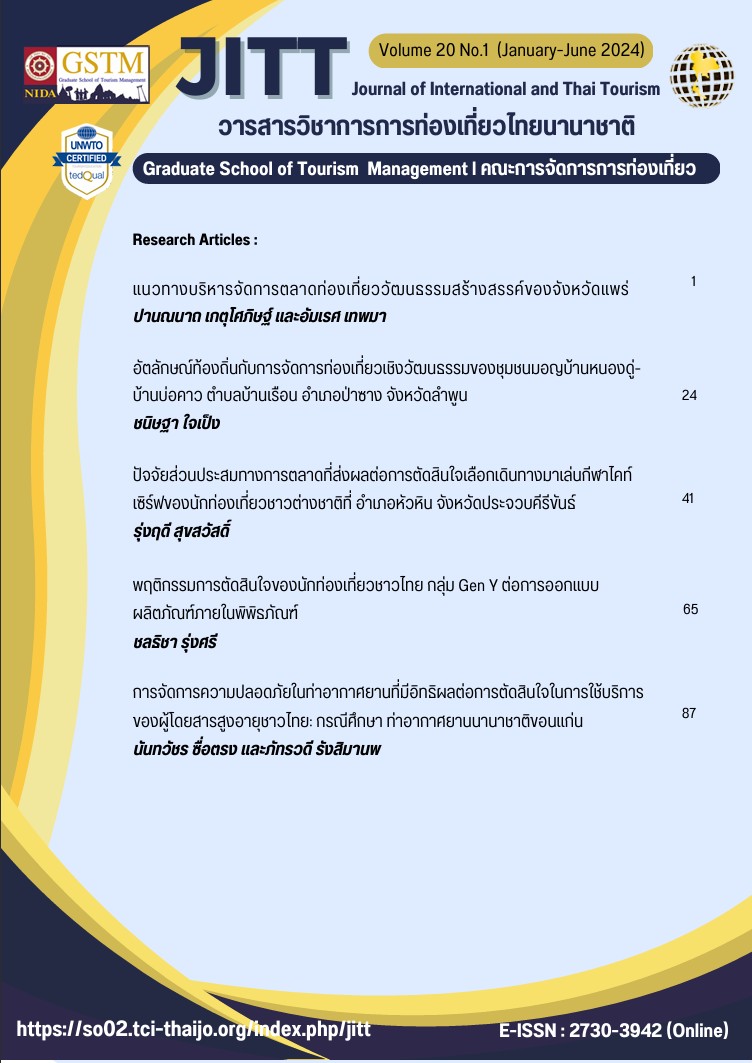
Main Article Content
Abstract
The purpose of this research was to explore the attributes of tourism destinations that create tourism experiences in additional, to study the influence of factor attributes of tourism destinations on revisits in Phuket with quantitative research methods by using a questionnaire which has a group of Thai tourists who pervious travel in Phuket with a sample of 250 people and the statistical study of exploratory factors using Promax axis rotation method, it was found that all 6 components of travel destination attributes could be classified and explained. (Consisting of Factor 1 Quality and service delivery of tourist attractions in the area Factor 2 Availability of facilities in the area Factor 3 Image of Phuket Factor 4 Accessibility within the area Factor 5 Public utilities and infrastructure in the area and factor 6, uniqueness of Phuket). Then, the results of multiple regression analysis further investigate showed that Phuket’s image factor is the only factor that affects the revisit of Phuket. Lastly, propose guidelines for managing the tourism destinations of Phuket.
Article Details

This work is licensed under a Creative Commons Attribution-NonCommercial-NoDerivatives 4.0 International License.
1. Any article contents published here are original work written, researched, analyzed, synthesized, compiled, and referenced by their own authorship. The editorial board does not entertain liability for article contents published here.
2. Manuscript articles published by our journal should not have been published before by any print or electronic media and should not be considered for publication by other journals at the moment. On duplicate publication, author shall be held solely responsible for violating copyright act.
3. Any published work for this journal belongs to the journal as its copyright. It is illegal to republish a portion, a partial portion, or all of it without a written approval from the editorial board of the journal
References
Bazerman, M. (1998). Judgement in Managerial Decision Making, New York, John Wiley.
Taherdoost, H., & Madanchian, M. (2023). Decision Making: Models, Processes, Techniques.
Cloud Computing and Data Science. 5(1), 1-14.
Ploch, J., & Zihla, Z. (2016). Security and Hindrance at Airports. Journal of Security and
Sustainability Issues. 5(4), 481-488.
Tosun, C., Dedeoğlu, B. B., & Fyall, A. (2015). Destination service quality, affective image and
revisit intention: The moderating role of past experience. Journal of Destination
Marketing & Management, 4(4), 222-234.
Saha, G. C., & Theingi. (2009). Service Quality, Satisfaction, and Behavioral Intensions: A study
of Low-cost Airline Carriers in Thailand. Managing Service Quality, 19(3), 350-372.
Poowapatchaiyakit, W. (2018). Service Quality Factors Affecting Satisfaction of Thai Customers
at Suvarnabhumi International Airport. Graduate School, Bangkok University
Seetanah, B., Teeroovengadum, V. & Nunkoo, R. (2018). Destination Satisfaction and Revisit
Intention of Tourists: Does the Quality of Airport Services Matter?. Journal of Hospitality
and Tourism Research, 2020(44), 134-148.
Monuz, C., Cordoba, J. & Sarmiento, I. (2016). Airport Choice Model in Multiple Region. Journal
of Airline and Airport Management, 7(1), 1-12.
Chilembwe, J.M. (2014). Evaluation of Service Quality, Value and Satisfaction of Air
Transportation in Malawi: Case study of Malawi. International Journal of Social Sciences
and Entrepreneurship, 1(11), 236-266.
Saleem, M. (2017). Impact of service quality and trust on repurchase intentions –the case of
Pakistan airline industry. Journal of Marketing and Logistics.29(5), 1136-1159.
Cochran, W.G. (1977). Sampling Techniques. 3rd ed. New York: John Wiley & Sons.
