
The Impact of Virtual Dental Clinic Color and Image Modifications on Anxiety Reduction in Undergraduate Dental Students
Article Sidebar
Main Article Content
Abstract
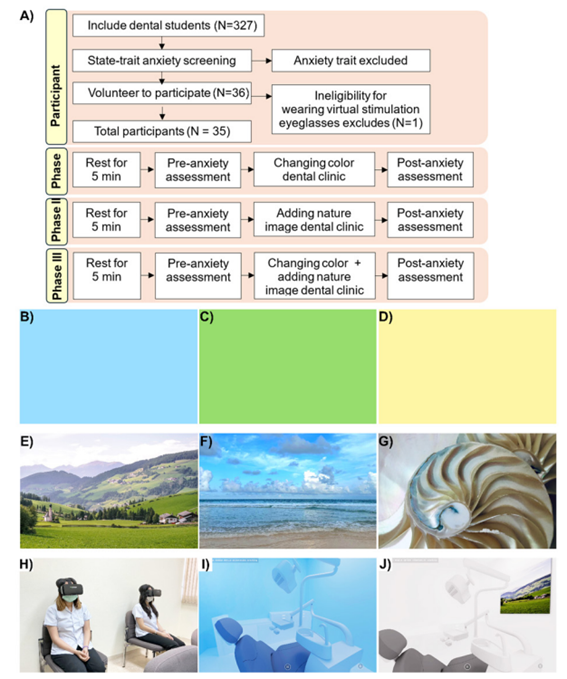
Dental students often experience stress due to the curriculum’s theoretical and practical demands, which can negatively affect their well-being. Previous research suggests that room colors and images can reduce anxiety in certain populations. However, no studies have examined this effect among dental students. Therefore, this study investigated how color and visual imagery in dental clinics affect anxiety levels in dental students. Participants were dental students experiencing state anxiety. They completed a modified version of the State-Trait Anxiety Inventory (STAI) Form Y-1 before and after entering a virtual reality (VR) dental clinic with altered environmental features. Three types of visual interventions were tested: 1) changing wall colors to blue, green, or yellow; 2) adding images of mountain, sea, or nautilus shell; and 3) combining the most preferred color and image. Paired t-tests were used to analyze changes in anxiety scores, and intergroup differences were examined using the Kruskal-Wallis test, followed by the Wilcoxon Signed-Rank test. Anxiety significantly decreased after exposure to blue and yellow wall colors (p < 0.05), with blue being the most preferred. Notably, blue increased positive anxiety scores (PA) and decreased negative anxiety scores (NA) significantly (p < 0.05), while yellow only decreased NA scores significantly (p < 0.05). Mountain and sea images also significantly reduced anxiety (p < 0.05), with the mountain image being the most preferred. Both types of images increased PA and decreased NA scores significantly (p < 0.05). The combination of blue walls and a mountain image was effective in reducing anxiety in all participants, but changing the wall color or adding a nature-related image alone was as effective as doing both together. These findings suggest that specific environmental elements—such as color tones and images—within a VR clinical setting can significantly reduce anxiety levels in dental students. Therefore, incorporating simple visual modifications into dental clinic design may be an effective strategy to reduce stress in educational healthcare environments. This highlights the importance of environmental design in supporting student well-being.
Downloads
Article Details

This work is licensed under a Creative Commons Attribution-NonCommercial-NoDerivatives 4.0 International License.
All material is licensed under the terms of the Creative Commons Attribution 4.0 International (CC-BY-NC-ND 4.0) License, unless otherwise stated. As such, authors are free to share, copy, and redistribute the material in any medium or format. The authors must give appropriate credit, provide a link to the license, and indicate if changes were made. The authors may do so in any reasonable manner, but not in any way that suggests the licensor endorses you or your use. The authors may not use the material for commercial purposes. If the authors remix, transform, or build upon the material, they may not distribute the modified material, unless permission is obtained from JARS. Final, accepted versions of the paper may be posted on third party repositories, provided appropriate acknowledgement to the original source is clearly noted.
References
Annamary, K., Prathima, G. S., Sajeev, R., Kayalvizhi, G., Ramesh, V., & Ezhumalai, G. (2016). Colour preference to emotions in relation to the anxiety level among school children in Puducherry - A Cross-Sectional Study. Journal of Clinical and Diagnostic Research, 10(7), ZC26-ZC30. https://doi.org/10.7860/jcdr/2016/18506.8128
Brockbank, R. B., & Feldon, D. F. (2024). Cognitive reappraisal: The bridge between cognitive Load and emotion. Education Sciences, 14(8), 870-885. https://www.mdpi.com/2227-7102/14/8/870
Collier, G. L. (1996). Affective synesthesia: Extracting emotion space from simple perceptual stimuli. Motivation and Emotion, 20(1), 1-32. https://doi.org/10.1007/BF02251005
Costa, M., Frumento, S., Nese, M., & Predieri, I. (2018). Interior color and psychological functioning in a university residence hall. Frontiers in Psychology, 9, 1580. https://doi.org/10.3389/fpsyg.2018.01580
Çulha, Y., Ak, E. S., & Çulha, M. G. (2023). The effect of running water sound listened to patients during urodynamics on anxiety and urodynamic parameters. International Neurourology Journal, 27(3), 217-223. https://doi.org/10.5213/inj.2346116.058
Diachenko, I., Kalishchuk, S., Zhylin, M., Kyyko, A., & Volkova, Y. (2022). Color education: A study on methods of influence on memory. Heliyon, 8(11), e11607. https://doi.org/10.1016/j.heliyon.2022.e11607
Def, T. (2020, August, 31). Mountain [Photography]. Unsplash. https://unsplash.com/photos/green-grass-fieldnear-green-mountains-under-white-clouds-during-daytime-a9qsM5Z1Sbg
Eiseman, L. (2006). Color - messages & meanings: A pantone color resource. Adams Media.
Hagerhall, C. M., Laike, T., Taylor, R. P., Küller, M., Küller, R., & Martin, T. P. (2008). Investigations of human EEG response to viewing fractal patterns. Perception, 37(10), 1488-1494. https://doi.org/10.1068/p5918
Hettiarachchi, A. A., & Perera, D. R. (2021). Impact of colour on depression, anxiety and stress levels of physically disabled patients in health care facilities: A case in a rehabilitation centre at Ragama, Sri Lanka. In Proceedings of the 14th International Conference of the Faculty of Architecture Research Unit (FARU) (pp. 61–70). University of Moratuwa. https://doi.org/10.31705/FARU.2021.6
Jonauskaite, D., Abu-Akel, A., Dael, N., Oberfeld, D., Abdel-Khalek, A. M., Al-Rasheed, A. S., Antonietti, J. P., Bogushevskaya, V., Chamseddine, A., Chkonia, E., Corona, V., Fonseca-Pedrero, E., Griber, Y. A., Grimshaw, G., Hasan, A. A., Havelka, J., Hirnstein, M., Karlsson, B. S. A., Laurent, E., . . . Mohr, C. (2020). Universal patterns in color-emotion associations are further shaped by linguistic and geographic proximity. Psychological Science, 31(10), 1245-1260. https://doi.org/10.1177/0956797620948810
Kaewsutha, N., Laosrisin, N., & Visalseth, W. (2014). Mental health and associated factors in Srinakharinwirot University dental students. Srinakharinwirot University (Journal of Sciences and Technology), 6(11), 16-24. https://ph02.tci-thaijo.org/index.php/swujournal/article/view/28847
Konwar, B., Sarma, K., & Ojah, R. (2023). The impact of anxiety on academic achievement: A comprehensive review. Journal of Harbin Engineering University, 44(8), 151-158. https://harbinengineeringjournal.com/index.php/journal/article/view/833
Kurt, S., & Osueke, K. K. (2014). The Effects of Color on the Moods of College Students. Sage Open, 4(1), 2158244014525423. https://doi.org/10.1177/2158244014525423
May, G. (2019, October 18). Nautilus Shell [Photography]. Unsplash. https://unsplash.com/photos/a-closeup-of-a-shell-with-a-white-background-cNtMy74-mnI
Nguyen, J., & Brymer, E. (2018). Nature-based guided imagery as an intervention for state anxiety. Frontiers in Psychology, 9, 1858. https://doi.org/10.3389/fpsyg.2018.01858
Rafatjou, R., Ahmadi, B., Farhadian, M., & Moghadam, N. E. (2021). Evaluation effect of color in dental office and dentist’s uniform while using two different distraction techniques on injection anxiety of 6-9 years’ old children referring to Hamedan Dental School: Randomized clinical trial. Dental Research Journal, 18, 71. https://doi.org/10.4103/1735-3327.326644
Salingaros, N. A., & Xie, Y. (2012). Fractal Art and Architecture Reduce Physiological Stress. Journal of Biourbanism, 2, 11–28. https://journalofbiourbanism.org/2013/09/07/jbu-ii-2-2012/
Schloss, K. B., Witzel, C., & Lai, L. Y. (2020). Blue hues don’t bring the blues: Questioning conventional notions of color–emotion associations. Journal of the Optical Society of America A, 37(5), 813-824. https://doi.org/10.1364/JOSAA.383588
Shu, Y., Wu, C., & Zhai, Y. (2022). Impacts of landscape type, viewing distance, and permeability on anxiety, depression, and stress. International Journal of Environmental Research and Public Health, 19(16), 9867. https://doi.org/10.3390/ijerph19169867
Simion, M. R. (2016). Fractal images – a new way to reduce stress and to improve educational workspaces. Global Journal of Psychology Research: New Trends and Issues, 6(1), 20-30. https://doi.org/10.18844/gjpr.v6i1.477
Simion, R. M. (2015). The fractal technique - An experiential approach of fractal images in reducing perceived stress through therapy of unification. Journal of Experiential Psychotherapy, 18(2), 40-47. https://jep.ro/images/pdf/cuprinsreviste/70art_6.pdf
Skinner, E. A., & Zimmer-Gembeck, M. J. (2007). The development of coping. Annual Review of Psychology, 58, 119-144. https://doi.org/10.1146/annurev.psych.58.110405.085705
Ulrich, R. S. (1981). Natural versus urban scenes: Some psychophysiological effects. Environment and Behavior, 13(5), 523-556. https://doi.org/10.1177/0013916581135001
Viveros, J., & Schramm, D. G. (2018). Stress vs. anxiety: Understanding the difference. Utah State University Extension, 1846. Digital Commons. https://digitalcommons.usu.edu/extension_curall/1846/
Wannakum, J., Supalanunt, P., Viengteerawat, P., & Orprayoon, S. (2022). Factors related to stress in dental students of Khon Kaen University. Journal of Graduate MCU KhonKaen Campus, 9(1), 217-234. https://so02.tci-thaijo.org/index.php/jg-mcukk/article/view/251880
World Health Organization (WHO). (2025). Mental disorders. https://www.who.int/news-room/fact-sheets/detail/mental-disorders/
Wright, A. (1998). Beginner’s guide to colour psychology. Colour Affects Limited.
