
Strategies of Integrated Tourism for Sustainable Rural Development – A Case Study in Bogaiya Village, Sylhet, Bangladesh
Article Sidebar
Main Article Content
Abstract
Across rural Bangladesh there is considerable untapped potential for sustainable development that awaits strategic interventions to activate it properly. Such areas are severely affected by economic challenges, including poverty and geographic isolation. Consequently, local economies struggle to progress and meet the sustainability requirements for achieving social equity. This study was conducted in Bogaiya Village of Gowainghat Upazila, Sylhet, Bangladesh, to determine the possibility of implementing integrated tourism as a pathway to sustainable rural development. Through a mixed-methods approach based on both primary participatory research and secondary literature review, this study looks at the socioeconomic setup of the remote Bogaiya Village in relation to tourism. The results indicate considerable possibilities for social and economic advancement, improving neighbourhood well-being through tourism growth. In particular, the study identifies key areas like local crafts, cultural heritage sites, and eco-tourism activities that can drive economic growth by capitalising on tourist interest in the region’s natural beauty and culture. At the same time, the research indicates that community participation and engagement are crucial in making tourism development work for people and stimulating citizenship and social equity. This paper aims to provide strategic directions in facilitating sustainable rural tourism development, which can offer an archetype for similar types of landscapes in Bangladesh. The guidelines incorporate helpful insights for policymakers, community leaders, and development practitioners to provide an ecosystem that facilitates tourism investment while fostering stakeholder partnership. Ultimately, the study aligns with the 2030 Sustainable Development Goals and suggests how integrated tourism can help rural development, poverty alleviation, and environmental conservation.
Downloads
Article Details

This work is licensed under a Creative Commons Attribution-NonCommercial-NoDerivatives 4.0 International License.
All material is licensed under the terms of the Creative Commons Attribution 4.0 International (CC-BY-NC-ND 4.0) License, unless otherwise stated. As such, authors are free to share, copy, and redistribute the material in any medium or format. The authors must give appropriate credit, provide a link to the license, and indicate if changes were made. The authors may do so in any reasonable manner, but not in any way that suggests the licensor endorses you or your use. The authors may not use the material for commercial purposes. If the authors remix, transform, or build upon the material, they may not distribute the modified material, unless permission is obtained from JARS. Final, accepted versions of the paper may be posted on third party repositories, provided appropriate acknowledgement to the original source is clearly noted.
References
Adnan, M. (2023). Rural development in Bangladesh. ResearchGate. https://doi.org/10.13140/RG.2.2.25423.46244
Bramwell, B., & Lane, B. (2000). Collaboration and partnerships in tourism planning. In B. Bramwell & B. Lane (Eds.), Tourism collaboration and partnerships: Politics, practice and sustainability (pp. 1–19). Channel View. https://doi.org/10.2307/jj.27195484.5
Bryden, J., & Munro, G. (2000). New approaches to economic development in peripheral rural regions. Scottish Geographical Journal, 116(2), 111–124. https://doi.org/10.1080/00369220018737085
Butowski, L. (2012). Sustainable tourism – A model approach. In M. Kasimoglu (Ed.), Visions for global tourism industry - Creating and sustaining competitive strategies (pp. 3-20). IntechOpen. https://kitob.sies.uz/frontend/web/kitob/kitob_005ff864cdf3fe9.pdf
Costa, J. (2017). How are companies and destinations “surfing the wave” of global tourism? strategic question overview. Worldwide Hospitality and Tourism Themes, 9(6), 588–591. https://doi.org/10.1108/WHATT-09-2017-0055 Centre on Integrated Rural Development for
Asia and the Pacific (CIRDAP). (2021). CIRDAP Rural development report 2021: Digital services for the marginalized rural people in Asia and the pacific- Accessiblity,
affordability and implications. https://cirdap.org/
Farsari, I., Butler, R. W., & Szivas, E. (2011). Complexity in tourism policies: A cognitive mapping approach. Annals of Tourism Research, 38(3), 1110–1134. https://doi.org/10.1016/j.annals.2011.03.007
Gössling, S., Scott, D., & Hall, C. M. (2021). Pandemics, tourism and global change: A rapid assessment of COVID-19. Journal of Sustainable Tourism, 29(1), 1–20. https://doi.org/10.1080/09669582.2020.1758708
Hall, C. M. (1999). Rethinking collaboration and partnership: A public policy perspective. Journal of Sustainable Tourism, 7(3–4), 274–289. https://doi.org/10.1080/09669589908667340
Hummelbrunner, R., & Miglbauer, E. (1994). Tourism promotion and potential in peripheral areas: The Austrian case. Journal of Sustainable Tourism, 2(1–2), 41–50. https://doi.org/10.1080/09669589409510682
Islam, T., & Ahmad, M. (2023). Rural people’s expectations and plans: Rural education system. In A. Zakaria (Ed.), My village is my town: Public expectations and plans (pp. 53-58). Rural Development Academy. https://www.researchgate.net/publication/367090916_gramina_jana_pratyasa_o_parikalpana_amara_grama_amara_sahara_gramina_siksa_byabastha
Jamal, T. B., & Getz, D. (1995). Collaboration theory and community tourism planning. Annals of Tourism Research, 22(1), 186–204. https://doi.org/10.1016/0160-7383(94)00067-3
Kambey, H. J. (2016). Tourist object in Tomohon city as a basic consideration for tourism destination development in highland ecosystem. Journal of Indonesian Tourism and Development Studies, 4(1), 13–18. https://doi.org/10.21776/ub.jitode.2016.004.01.03
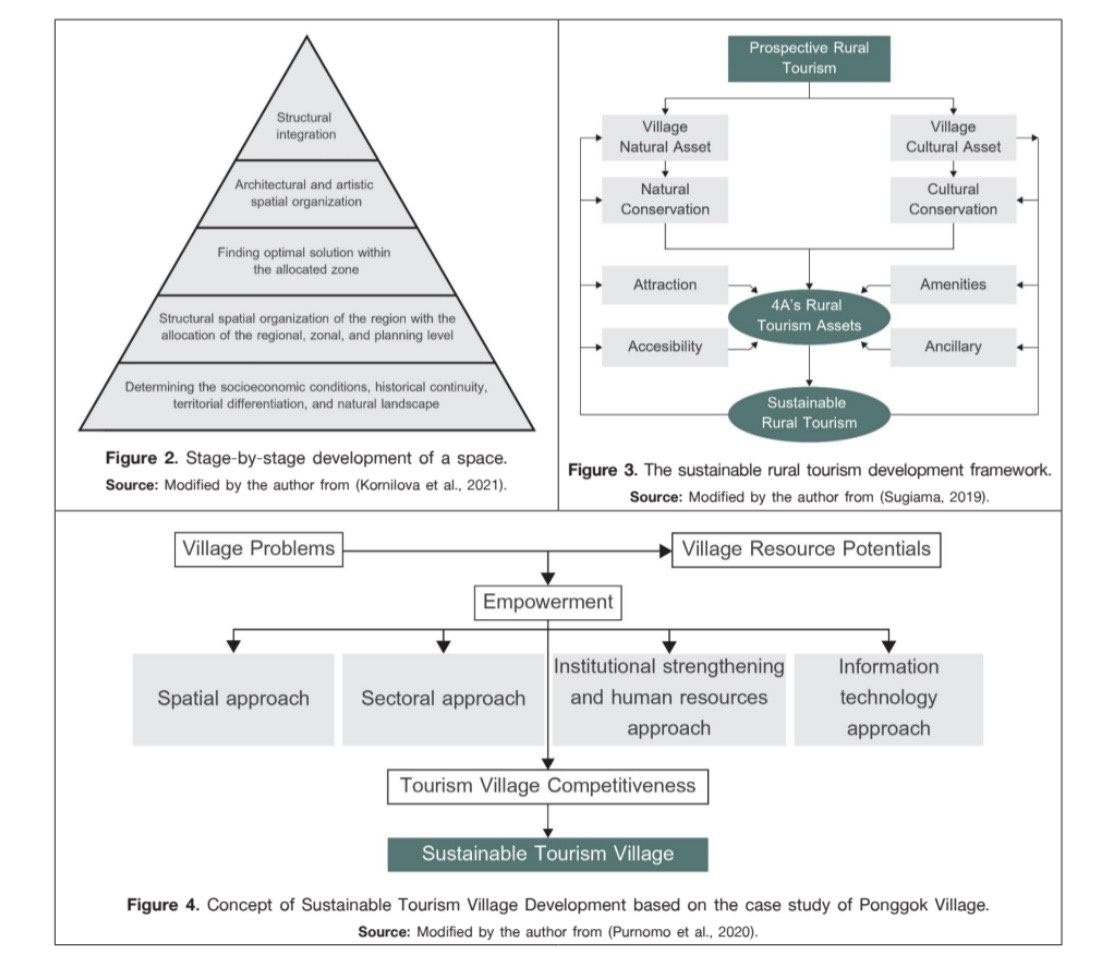
Kornilova, A. A., Khorovetskaya, Y. M., Abdrashitova, T. A., Smagulova, A. B., & Lapteva, I. V. (2021). Modern model of a rural settlement: Development of planning structure and reconstruction of villages. Civil Engineering and Architecture, 9(1), 214–224. https://doi.org/10.13189/cea.2021.090118
López-Sanz, J. M., Penelas-Leguía, A., Gutiérrez-Rodríguez, P., & Cuesta-Valiño, P. (2021). Rural tourism and the sustainable development goals. A study of the variables that most influence the behavior of the tourist. Frontiers in Psychology, 12, 722973. https://doi.org/10.3389/fpsyg.2021.722973
Luloff, A. E., Bridger, J. C., Graefe, A. R., Saylor, M., Martin, K., & Gitelson, R. (1994). Assessing rural tourism efforts in the United States. Annals of Tourism Research, 21(1), 46–64. https://doi.org/10.1016/0160-7383(94)90004-3
Mason, P., & Cheyne, J. (2000). Residents’ attitudes to proposed tourism development. Annals of Tourism Research, 27(2), 391–411. https://doi.org/10.1016/S0160-7383(99)00084-5
Mbaiwa, J. E. (2005). Enclave tourism and its socio-economic impacts in the Okavango Delta, Botswana. Tourism Management, 26(2), 157–172. https://doi.org/10.1016/j.tourman.2003.11.005
Mihai, F.-C., & Iatu, C. (2020). Sustainable rural development under agenda 2030. In M. J. Bastante-Ceca (Ed.), Sustainability assessment at the 21st century (pp. 9-18). IntechOpen. https://d-nb.info/1243083549/34
Ministry of Local Government, Rural Development and Co-Operatives. (2020). My village-my town: Extension of modern civic amenities in every village (Work plan). https://lged.portal.gov.bd/sites/default/files/files/lged.portal.gov.bd/page/184c146e_dde0_485c_9c05_930b771411bd/2023-06-17-09-31-2095884d23bd34b76e1290a7b628d886.pdf
Nastis, S. A., & Papanagiotou, E. (2009). Dimensions of sustainable rural development in mountainous and less favored areas: Evidence from Greece. Journal of the Geographical Institute Jovan Cvijic SASA, 59(2), 111–131. https://doi.org/10.2298/ijgi0902111n
Oppermann, M. (1996). Rural tourism in Southern Germany. Annals of Tourism Research, 23(1), 86–102. https://doi.org/10.1016/0160-7383(95)00021-6
Panyik, E., Costa, C., & Rátz, T. (2011). Implementing integrated rural tourism: An event-based approach. Tourism Management, 32(6), 1352–1363. https://doi.org/10.1016/j.tourman.2011.01.009
Purnomo, S., Rahayu, E. S., Riani, A. L., Suminah, S., & Udin, U. (2020). Empowerment model for sustainable tourism village in an emerging country. The Journal of Asian Finance, Economics and Business, 7(2), 261–270. https://doi.org/10.13106/jafeb.2020.vol7.no2.261
Reed, M. S. (2008). Stakeholder participation for environmental management: A literature review. Biological Conservation, 141(10), 2417–2431. https://doi.org/10.1016/j.biocon.2008.07.014
Rural Development and Cooperatives Division. (2001). National rural development policy 2001. FAO. https://faolex.fao.org/docs/pdf/bgd178050.pdf
Saarinen, J., & Lenao, M. (2014). Integrating tourism to rural development and planning in the developing world. Development Southern Africa, 31(3), 363–372. https://doi.org/10.1080/0376835X.2014.888334
Sharpley, R. (2002). Rural tourism and the challenge of tourism diversification: The case of Cyprus. Tourism Management, 23(3), 233–244. https://doi.org/10.1016/S0261-5177(01)00078-4
Sharpley, R., & Telfer, D. J. (Eds.). (2015). Tourism and development: Concepts and issues (2nd ed.). Channel View. https://doi.org/10.21832/9781845414740
Su, M. (2009). New rural development strategies. In M. Su, China’s rural development policy: exploring the new socialist countryside (pp. 119–144). FirstForumPress. https://doi.org/10.1515/9781626373037-008
Sugiama, A. G. (2019). The sustainable rural tourism asset development process based on natural and cultural conservation. Advances in Social Science, Education and Humanities Research, 354, 249-253. https://doi.org/10.2991/icastss-19.2019.52
The Economic Commission for Latin America and the Caribbean (ECLAC). (2018). The 2030 agenda and the sustainable development goals an opportunity for Latin America and the Caribbean. United Nations. https://repositorio.cepal.org/bitstream/handle/11362/40156/25/S1801140_en.pdf
Toufique, K. A. (2017). Bangladesh experience in rural development: The success and failure of the various models used. The Bangladesh Development Studies, 40A(1–2), 97–117. https://www.jstor.org/stable/26572746?seq=1
Travel Mate Bangladesh. (2020, February 10). Bisnakandi sylhet: Travel guideline (A-Z). https://www.travelmate.com.bd/bisnakandi-sylhet/
United Nations Development Programme. (2021). Sustainable Development Goals: The SDGS in action. UNDP. https://www.undp.org/sustainable-development-goals
World Tourism Organization (UNWTO). (2020). UNWTO recommendations on tourism and rural development – A guide to making tourism an effective tool for rural development. E-UNWTO. https://www.e-unwto.org/doi/book/10.18111/9789284422173
World Tourism Organization (UNWTO). (1967). Global code of ethics for tourism: For responsible tourism and related documents. https://webunwto.s3.eu-west-1.amazonaws.com/s3fs-public/2019-10/gcetpassportglobalcodeen.pdf
Wong, A. K. F., Wu, H., & Kim, S. (2022). Residents’ perceptions of tourism influence and intention to support tourism development: Application of the theory of planned behavior. Journal of China Tourism Research, 18(4), 710–734. https://doi.org/10.1080/19388160.2021.1964668
World Bank. (1975). Rural development: Sector policy paper (10272). https://documents.worldbank.org/en/publication/documents-reports/documentdetail/522641468766236215/rural-development
Zhao, Y. W., Xu, M. J., Xu, F., Wu, S. R., & Yin, X. A. (2014). Development of a zoning-based environmental-ecological coupled model for lakes: A case study of Baiyangdian Lake in northern China. Hydrology and Earth System Sciences, 18(6), 2113–2126. https://doi.org/10.5194/hess-18-2113-2014
