
An Empirical Study on Settlement Pattern and Architectural Features of Rural Housing in Haor-basin Region of Bangladesh
Article Sidebar
Main Article Content
Abstract
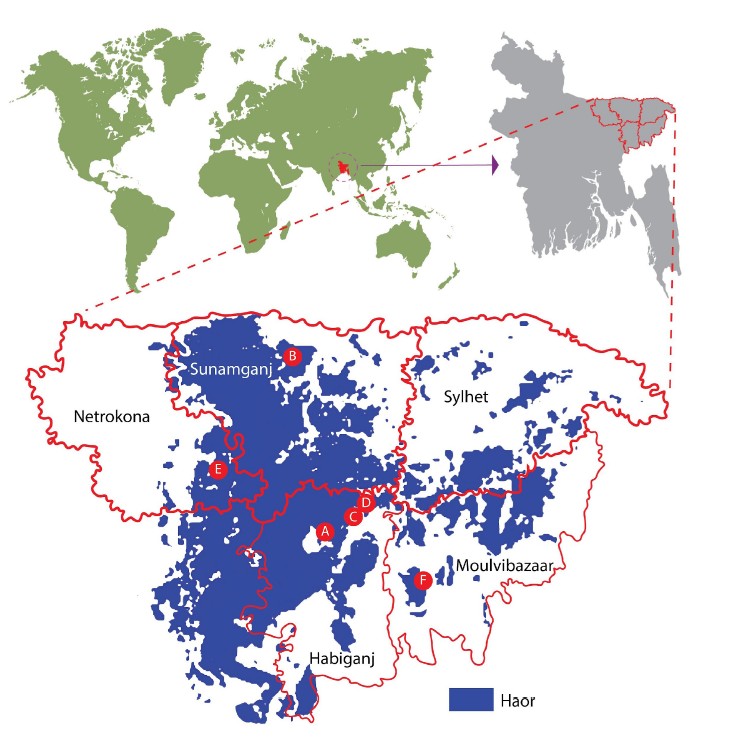
The Haor region is dominated by annual flooding, and over 90% of the land is submerged underwater for half of the year. The compact rural settlements are surrounded by a vast scale of seasonal wetlands needed to sustain the challenging environment. The indigenous architecture and settlement technique ensure the small island-like village can cope with the climatic challenge while ensuring community social coherence. The concept of shared spaces, a sense of ownership and privacy without creating physical barriers and strictly following the orientation of the houses created unique features of the rural settlements in the Haor Basin area. However, the recent developments using non-local materials, resisting the natural force instead of coping with it, and breaking social coherence by destroying the continuity of spaces are creating adverse effects. Since the rural settlements have gone through organic development yet maintained the pattern through respecting indigenous knowledge, there needs to be formal documentation of the planning concepts. This research attempts to identify the settlement pattern from empirical study, on-site observation and analysis of the pattern with an understanding of local norms and architectural knowledge. It is evident from the study that the rural houses are built aligned with the cardinal directions even when the site orientation is different. The settlement clusters are linearly aligned to the monsoon flood flow direction. Though the linear courtyards are subdivided in terms of ownership, practically, they are maintained as barrier-free connectivity among houses within the same housing cluster.
Downloads
Article Details

This work is licensed under a Creative Commons Attribution-NonCommercial-NoDerivatives 4.0 International License.
All material is licensed under the terms of the Creative Commons Attribution 4.0 International (CC-BY-NC-ND 4.0) License, unless otherwise stated. As such, authors are free to share, copy, and redistribute the material in any medium or format. The authors must give appropriate credit, provide a link to the license, and indicate if changes were made. The authors may do so in any reasonable manner, but not in any way that suggests the licensor endorses you or your use. The authors may not use the material for commercial purposes. If the authors remix, transform, or build upon the material, they may not distribute the modified material, unless permission is obtained from JARS. Final, accepted versions of the paper may be posted on third party repositories, provided appropriate acknowledgement to the original source is clearly noted.
References
Ahmed, I. (2012). The courtyard in rural homesteads of Bangladesh. Vernacular Architecture, 43(March), 47–57. https://doi.org/10.1179/0305547712Z.0000000005 DOI: https://doi.org/10.1179/0305547712Z.0000000005
Ahmed, K. I. (1991). UP TO THE WAIST IN MUD! The assessment and application of earth-derivative architecture in rural Bangladesh.
Alam, M. K., & Hasan, M. R. (2010). Protection Works Against Wave Attacks in the Haor Areas of Bangladesh: Analysis of Sustainability. Journal of Construction in Developing Countries, 15(2), 69–85.
Alam, S., & Choudhury, H. (2003). Wetland. Banglapedia: National Encyclopedia of Bangladesh, Banglapedia Trust, Asiatic Society of Bangladesh.
Bodach, S., Lang, W., & Hamhaber, J. (2014). Climate responsive building design strategies of vernacular architecture in Nepal. Energy & Buildings, 81, 227–242. https://doi.org/10.1016/j.enbuild.2014.06.022 DOI: https://doi.org/10.1016/j.enbuild.2014.06.022
Byomkesh, T., Nakagoshi, N., & Shahedur, R. M. (2009). State and management of wetlands in Bangladesh. Landscape and Ecological Engineering, 5(1), 81–90. https://doi.org/10.1007/s11355-008-0052-5 DOI: https://doi.org/10.1007/s11355-008-0052-5
Choudhury, S. A., Terao, T., Murata, F., & Hayashi, T. (2012). ISSN 1995-6983 Seasonal variations of temperature and rainfall characteristics in the northeastern part of Bangladesh around Sylhet. 6(2), 81–88.
Farid, S. (2017, November 10). In search of a development model for haor dwellers. The Daily Observer.
Hasan, M., Ullah, M., & Gomes, C. D. (2000). Rural Housing in Bangladesh : An Inquiry into Housing Typology , Construction Technology & Indigenous Practices. November 2000.
Islam, A. K. (2003). Patterns and Changes of Vernacular Architecture in Bangladesh: An Application of Amos Rapoport's Theory Defining Vernacular Design. Master's dissertation at The Royal Institutes of Technology: Stockholm, Sweden. Retrieved at: https://arc456.files.wordpress.com/2015/02/msc-thesis-kausarul.pdf [accessed 21.04.2023].
Kazal, M. M. H., Villinueve, C., Hossain, M. Z., & Das, T. K. (2010). Food Security Strategies of the people living in haor areas: status and prospects. Dhaka: NFPCSP.
Kumar, M., Mahapatra, S., & Atreya, S. K. (2009). Bioclimatism and vernacular architecture of north-east India. Building and Environment, 44(5), 878–888. https://doi.org/10.1016/j.buildenv.2008.06.008 DOI: https://doi.org/10.1016/j.buildenv.2008.06.008
Kumar, M., Mahapatra, S., & Atreya, S. K. (2022). Solar passive features in vernacular architecture of North-East India. Solar Energy, 85(9), 2011–2022. https://doi.org/10.1016/j.solener.2011.05.009 DOI: https://doi.org/10.1016/j.solener.2011.05.009
Murata, F. (2011). Daytime Thermodynamic and Airflow Structures over Northeast Bangladesh during the Pre-Monsoon Season : A Case Study on 25 April 2010. 89(April 2010), 2–5. https://doi.org/10.2151/jmsj.2011-A11 DOI: https://doi.org/10.2151/jmsj.2011-A11
NAPA. (2005). National Adaptation Programme of Action (NAPA). November, 2005.
Rashid, M. U. (2020). In Search of a Settlement Pattern for Bengal Delta Through Theoretical Re-Interpretations. 8(1), 21–34. https://doi.org/10.15415/cs.2020.81003 DOI: https://doi.org/10.15415/cs.2020.81003
Salauddin, M., & Saiful Islam, A. (2011). Identification of Land Cover Changes of the Haor Area of Bangladesh Using Modis Images. 3rd International Conference on Water & Flood Management.
Seraj, S.M, Ahmed, K. I. (2004). Building Safer Houses in Rural Bangladesh. Dhaka. Bangladesh University of Engineering and Technology, P. 250.
Yasmin, F. (2018). Assessment of spatio-temporal changes of haors in Sunamganj district by using Landsat images and hydrological data. Master’s Thesis Dissertation: Bangladesh University of Engineering and Technology, Dhaka. Retrieved at: http://lib.buet.ac.bd:8080/xmlui/handle/123456789/4985%0Ahttp://lib.buet.ac.bd:8080/xmlui/bitstream/handle/123456789/4985/Full Thesis.pdf?sequence=1 [accessed 21.04.2023]
