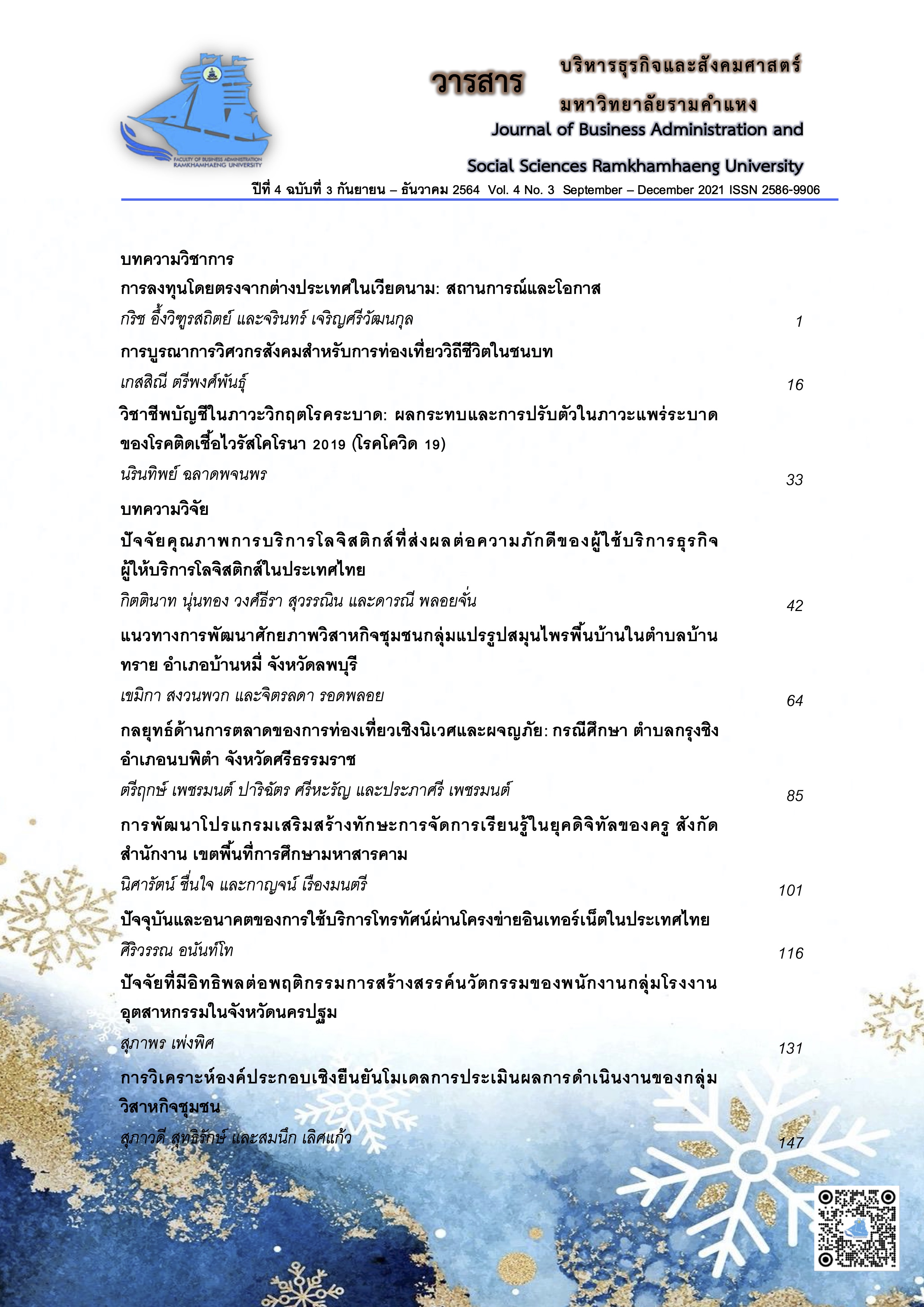
Marketing Strategies for Eco-Adventure Tourism: A Case Study of Krung Ching Subdistrict, Nopphitam District, Nakhon Si Thammarat Province
Article Sidebar
Main Article Content
Abstract
In this research investigation, the researchers examine marketing situations and develop a model of marketing strategies for eco-adventure tourism in Krung Ching subdistrict, Nopphitam district, Nakhon Si Thammarat province. In this qualitative research, key informants consisted of twenty members of the integrated agrotourism enterprise group using the techniques of purposive sampling and chain sampling. Data were collected from documents, in-depth interviews, and focus group discussions through the community participation process. Data were analyzed using the technique of content analysis.
Findings showed that the integrated agrotourism enterprise group commenced from the integration of agriculturalists. Later, they separated to form an enterprise group. In regard to the community potential, Khao Chang Lon Sea of Mist is a tourist attraction. Tie dye cloth from Yan Pho Uat, a local raw material from Krung Ching subdistrict, is a famous product. In addition, tourism activities have been included i.e. Khlong Klai rafting, bird watching, as well as visits to the Krung Ching Waterfall, and Hong Cave. The highest proportion of tourists came from such nearby provinces as Songkhla, Trang, Phatthalung, and Surat Thani. Next in descending order were tourists from Nakhon Si Thammarat, who came in groups or families. The model of marketing strategies for eco-adventure tourism in Nopphitam district, Nakhon Si Thammarat province consists of 1) branding strategy; 2) marketing communication strategy; and 3) product strategy.
Article Details
เนื้อหาและข้อมูลในบทความที่ลงตีพิมพ์ในวารสารบริหารธุรกิจและสังคมศาสตร์ มหาวิทยาลัยรามคำแหง ถือเป็นข้อคิดเห็นและความรับผิดชอบของผู้เขียนบทความโดยตรง ซึ่งกองบรรณาธิการไม่จำเป็นต้องเห็นด้วย หรือร่วมรับผิดชอบใดๆ
บทความ ข้อมูล เนื้อหา รูปภาพ ฯลฯ ที่ได้รับการตีพิมพ์ในวารสารบริหารธุรกิจและสังคมศาสตร์ มหาวิทยาลัยรามคำแหง ถือเป็นลิขสิทธิ์ของวารสารบริหารธุรกิจและสังคมศาสตร์ มหาวิทยาลัยรามคำแหง หากบุคคลหรือหน่วยงานใดต้องการนำบทความทั้งหมดหรือส่วนหนึ่งส่วนใดไปเผยแพร่ต่อ หรือเพื่อกระทำการใดๆ จะต้องได้รับอนุญาตเป็นลายลักษณ์อักษรจากวารสารบริหารธุรกิจและสังคมศาสตร์ มหาวิทยาลัยรามคำแหง ก่อนเท่านั้น
References
Arnould, E. J., & Price, L. L. (1993). River magic: Extraordinary experience and the extended service encounter. Journal of Consumer Research, 20(1993), 24–45.
Buckley, R. C. (2012). Sustainable tourism: Research & Reality. Annals of Tourism Research, 39(2), 528–546.
Chaiyasain, C. & Tirasattayapitak, A. (2020). Eco-Adventure Tourism: An Awareness of White Water Rafting Tour Operator Standardat Songpraek Village, Phang-nga Province. International Thai Tourism Journal, 15(1), 22-46.
Creswell, J. W. (1994). Research design: qualitative and quantitative approaches. Thousand Oaks, CA: Sage Publication.
Fluker, M. R., & Turner, L. W. (2000). Needs, motivations, and expectations of a commercial whitewater rafting experience. Journal of Travel Research, 38(2000), 380–389.
Fredman, P. & Sandell, K. (2009). Protect, Preserve, Present – The Role of Tourism in Swedish National Parks. (pp.197-207) In Tourism and National Parks: International Perspectives on Development. Warwick Frost and Michael Hall. (2009). Histories and Change London: Routledge.
Hirantat, W. (2013). Factors Affecting Thai Tourist Decision on Ecotourism of Nonthaburi Province. Retrieved from http://www.rpu.ac.th/Library_web/doc/RC_RR/2556_Hotel_Wuntika.pdf
Khanom, R. (2019). The Development of Eco Tourism of Lampratap Community, Khanom District, Nakhon Si Thammarat Province. Journal of Human Society, 9(2), 86-100.
Klaisang, T., Dockthaisong, B., and Kerdvichai, N. (2019). Development Sport Tourism by Integration of Buddhism Principle of Buriram Province. Journal of Graduate MCU KhonKaen Campus, 6(4), 823 – 840.
Nakaray, P., Rodyoo, C., and Kuenui, P. (2020). Assessment of the Tourism Potential of Nopphitam District Based on Community-Based Tourism Standard. University of Thai Chammerce Journal Humanities and Social Sciences, 40(2), 118-131.
Meebua, S., Uejitmet, W. & Subsin, W. (2017). Changes in The Way of Life and The Impact of Tourism on The Local Way of Kiriwong Life. Narkbhut Paritat Journal, 9(1), 128-139.
Mihalic, T. (2006). Sustainable-responsible tourism discourse - towards ‘responsustable’ tourism. Journal of Cleaner Production, 111(1), 461-470.
Office of Permanent Secretary Ministry of Tourism & Sport. (2016). 12 Mueang not to miss plus. Tourism Economic Review. Retrieved from https://www.mots.go.th/ewt_dl_link.php?nid=8265
Onwuegbuzie, A., Leech, N. L. & Collins, K. M. T. (2012). Qualitative Analysis Techniques for the Review of the Literature. The Qualitative Report, 17(28), 1-28.
Provincial Statistical Office Nakhon Si Thammarat. (2019). Tourism situation of Nakhon Si Thammarat Province 2019. Retrieved from http://nksitham.nso.go.th/index.php?option=com_content&view=article&id=954:2562&catid=85&Itemid=513
Rattanapong, T. (2015). Effects of engagement and satisfaction are more inclined to come back repeatedly, the attractions in the province of Nakhon Si Thammarat. (Master’s thesis, Prince of Songkla University).
Reimer, J. K., & Walter, P. (2013). How do you know it when you see it? Community-based ecotourism in the Cardamom Mountains of southwestern Cambodia. Tourism Management, 34(2013), 122-132.
Sharafuddin, M. A. (2015) Types of Tourism in Thailand. E-Review of Tourism Research, 12(3/4), 210-219. Retrieved from http://agrilife.org/ertr/files/2015/09/5.-eRTR_CMTRY_Vol.12-No3.4_Sharafuddin.pdf
Teepapan, P., & Teepapan, T. (2018). Strategic management. Bangkok: Amon Printing.
Tourism Authority of Thailand. (2012). Eco & adventure tourism. Bangkok: Tourism Authority of Thailand
Weaver, D. B. (2005). Comprehensive & minimalist dimensions of ecotourism. Annals of Tourism Research, 32(2), 439–455.
World Tourism Organization. (2014). Global report on adventure tourism. Madrid: World Tourism Organization.
Wu, C. H. J., & Liang, R. D. (2011). The relationship between white-water rafting experience formation and customer reaction: A flow theory perspective. Tourism Management, 32(2011), 317–325.
Yang, J. & Vingvorn, B. (2014). Effect of Marketing Communication Strategy toward the Buying Behavior for Private Car of Customers in Lampang Province. Journal of Management Science, Chiang Rai Rajabhat University, 9(2), 99-116.