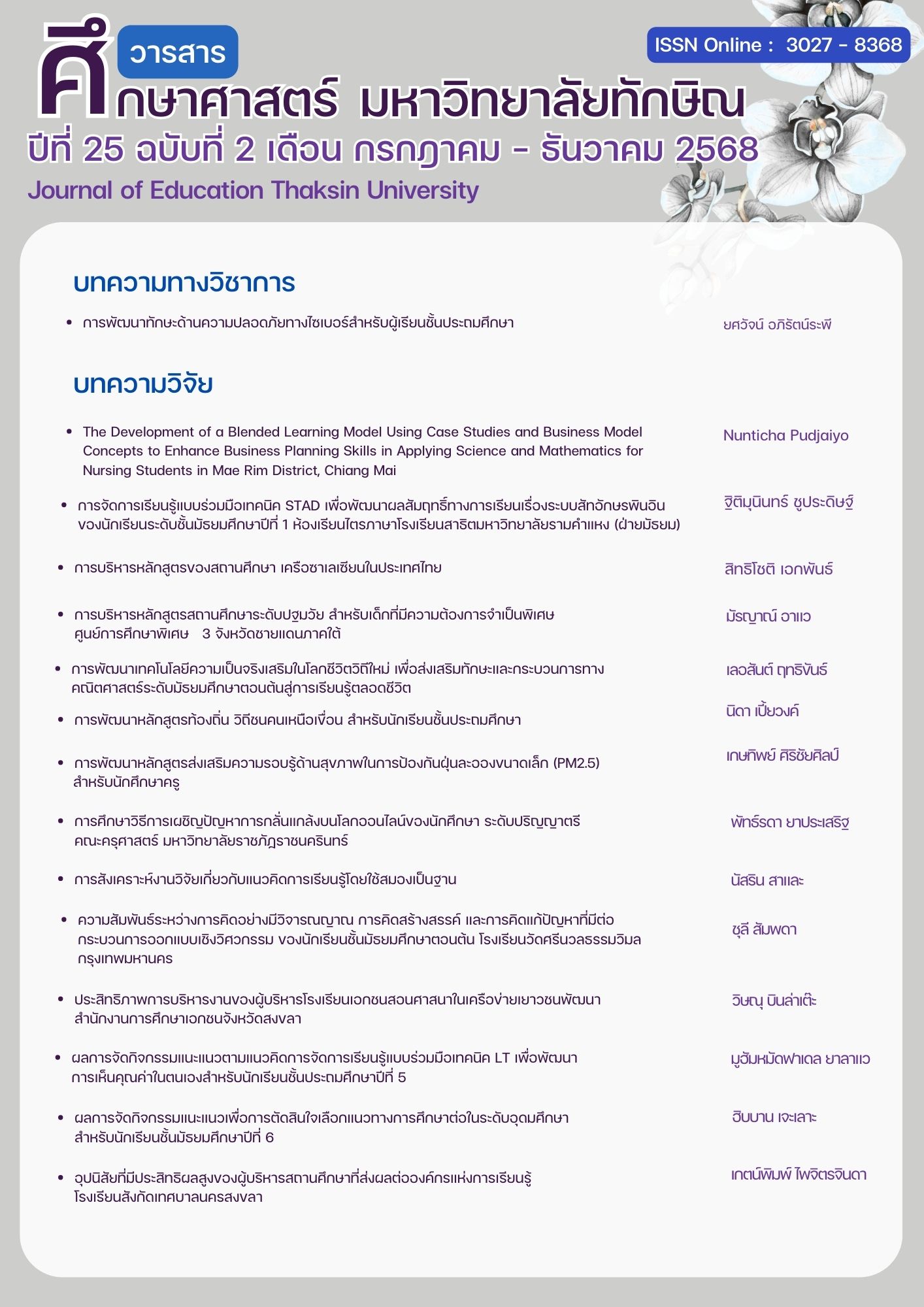
The Development of a Blended Learning Model Using Case Studies and Business Model Concepts to Enhance Business Planning Skills in Applying Science and Mathematics for Nursing Students in Mae Rim District, Chiang Mai
Article Sidebar
Main Article Content
บทคัดย่อ
Abstract
This study aimed to develop and evaluate a blended learning model integrating case studies and business model concepts to enhance business planning skills and the application of science and mathematics in everyday life among nursing students in Mae Rim District, Chiang Mai Province. The research employed a mixed-methods approach with 150 nursing students as the sample. Data collection instruments included surveys, semi-structured interviews, lesson plans, and assessments of learning outcomes. The model consisted of three core components: instructional elements (teachers, students, case studies, digital technology, and learning environment), a structured learning process (preparation, case analysis, learning activities, presentation, and evaluation), and dual platforms (online and classroom-based). The findings revealed a statistically significant improvement in business planning skills, as evidenced by post-test scores (p < 0.05), alongside high levels of student satisfaction and expert validation of the model's appropriateness. The study underscores the model's effectiveness in fostering critical thinking, problem-solving, and the integration of theoretical knowledge into practical applications. The results suggest that the blended learning approach is a robust framework for enhancing educational outcomes, particularly in nursing education. Recommendations include further refinement of the model for diverse educational contexts and ongoing support for digital competency development.
Article Details

อนุญาตภายใต้เงื่อนไข Creative Commons Attribution-NonCommercial-NoDerivatives 4.0 International License.
ในกรณีที่กองบรรณาธิการ หรือผู้เชี่ยวชาญ ซึ่งได้รับเชิญให้เป็นผู้ตรวจบทความวิจัย หรือ บทความทางวิชาการมีความเห็นว่าควรแก้ไขความบกพร่อง ทางกองบรรณาธิการจะส่งต้นฉบับให้ ผู้เขียนพิจารณาจัดการแก้ไขให้เหมาะสมก่อนที่จะลงพิมพ์ ทั้งนี้ กองบรรณาธิการจะยึดถือความคิด เห็นของผู้เชี่ยวชาญเป็นเกณฑ์
เอกสารอ้างอิง
American Psychological Association. (2020). Publication manual of the American Psychological Association (7th ed.). Washington, DC: APA.
Bank of Thailand. (2018). Application of Business Models in Business Planning. Retrieved April 17, 2024. from: https://www.bot.or.th.
Cohen, J. (1988). Statistical power analysis for the behavioral sciences (2nd ed.). Hillsdale, NJ: Lawrence Erlbaum Associates.
Creswell, J. W., & Creswell, J. D. (2018). Research design: Qualitative, quantitative, and mixed methods approaches (5th ed.). Thousand Oaks, CA: Sage.
Creswell, J. W., & Creswell, J. D. (2018). Research design: Qualitative, quantitative, and mixed methods approaches (5th ed.). Thousand Oaks, CA: Sage.
Department of Industrial Promotion. (2022). SME Promotion Policy. Retrieved April 17, 2024. from: https://www.dip.go.th.
Fraenkel, J. R., Wallen, N. E., & Hyun, H. H. (2012). How to design and evaluate research in education (8th ed.). New York, NY: McGraw-Hill.
Gagné, R. M., Wager, W. W., Golas, K. C., & Keller, J. M. (2005). Principles of instructional design (5th ed.). Belmont, CA: Wadsworth.
Garrison, D. R., & Vaughan, N. D. (2008). Blended learning in higher education: Framework, principles, and guidelines. San Francisco, CA: Jossey-Bass.
Garrison, D. R., & Vaughan, N. D. (2008). Blended learning in higher education: Framework, principles, and guidelines. San Francisco, CA: Jossey-Bass.
Johnson, K., McHugo, C., & Hall, T. (2006). Analyzing the efficacy of blended learning using Technology Enhanced Learning (TEL) and m-learning delivery technologies. Online. Retrieved April 17, 2024. from: http://www.ascilite.org.au/conferences/sydney06/proceeding/pdf_ papers/p73.pdf.
Kolb, D. A. (1984). Experiential learning: Experience as the source of learning and development. Englewood Cliffs, NJ: Prentice Hall.
Kolb, D. A. (1984). Experiential learning: Experience as the source of learning and development. Englewood Cliffs, NJ: Prentice Hall.
Kvale, S., & Brinkmann, S. (2015). Interviews: Learning the craft of qualitative research interviewing (3rd ed.). Thousand Oaks, CA: Sage.
Martin, F., & Lavolette, A. (2021). Exploring the impact of blended learning on student engagement and academic performance. Journal of Educational Technology, 45(2), 123-138. https://doi.org/10.1016/j.edtech.2021.01.004.
Office of the Higher Education Commission. (2022). Thailand’s Educational Strategic Plan. Retrieved April 17, 2024. from: https://www.mua.go.th.
Osterwalder, A., & Pigneur, Y. (2010). Business model generation: A handbook for visionaries, game changers, and challengers. Hoboken, NJ: Wiley.
Osterwalder, A., & Pigneur, Y. (2010). Business model generation: A handbook for visionaries, game changers, and challengers. Hoboken, NJ: Wiley.
Richardson, J. C., & Swan, K. (2003). Examining social presence in online courses in relation to students' perceived learning and satisfaction. Journal of Asynchronous Learning Networks, 7(1), 68–88.
Sopita Suwuttho. (2012). Development of blended learning management to enhance professional competencies for medical educational technology. Doctor of Philosophy, Department of Educational Technology, Faculty of Industrial Education, Graduate School, King Mongkut's University of Technology North Bangkok.
Suthida Prechanont. (2021). Development of a blended learning model using cloud- based and synectics processes with out-of-the-box thinking techniques to enhance creative problem-solving abilities in photography among Rajabhat University students. Doctoral dissertation, Graduate School, Silpakorn University.
