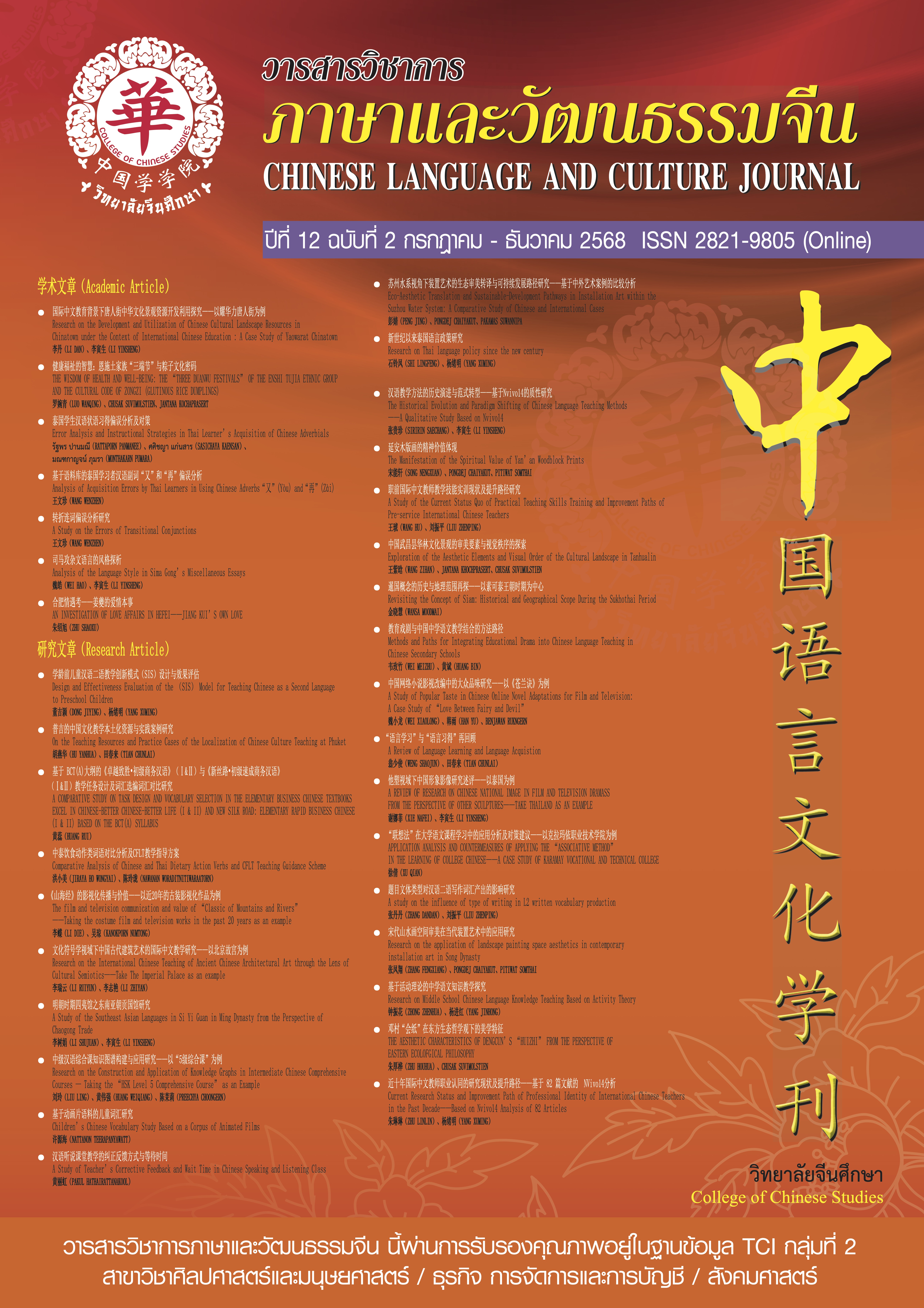
Comparative Analysis of Chinese and Thai Dietary Action Verbs and CFLT Teaching Guidance Scheme
Keywords:
Dietary action verbs, Chinese–Thai Food Culture, CFLT teachingAbstract
Eating and drinking are essential human activities, and linguistic expressions derived from eating-related actions have long permeated everyday communication. Both Chinese and Thai exhibit similarities as well as distinctive features in their lexical expressions of eating-related actions. From the perspective of Chinese as a Foreign Language Teaching (CFLT), this study employs a sentence-completion task to systematically examine the similarities and differences in the selection of eating-action verbs among 50 native speakers of Chinese and Thai. Prior to analysis, the study draws on sociocultural linguistics and pragmatics to categorize the factors influencing verb choice into two dimensions: physiological needs and sociocultural factors. Based on this framework, the collected data were analyzed. The results reveal significant cross-linguistic differences in basic verb selection strategies, the expression of subtle eating actions, and culturally specific usages involving politeness and social relations. In response to these findings, the study proposes pedagogical suggestions for CFLT vocabulary instruction and further develops a four-stage teaching practice model specifically designed for local Thai Chinese-language teachers. This model provides readily applicable classroom procedures that guide learners to understand and acquire the multiple functions of Chinese eating-action verbs by drawing on their existing life experiences. The proposed instructional approach facilitates learners’ effective transfer of linguistic knowledge, enhances their intercultural pragmatic competence, and better equips them to meet authentic communicative needs.
References
昌帅. 跨文化交际视角下对外汉语节日词汇教学研究.[J]. 汉字文化, 2023, (15): 90-92
董为光. 汉语“吃~”类说法文化探源.[J]. 语言研究,1995,(2): 170-176
樊国萍. 现代汉语“饮食”动词分析.[J]. 科教文汇(下旬刊),2008,(10):248
郭转转.对泰汉语中的词语文化含义教学研究:[硕士学位论文].[D].兰州:兰州大学,2017
黄心怡,缪军荣. “吃”的动词语义扩展与文化的关系.[J]. 文学教育(下),2018,(10): 58-60
何国锦, 张萌. 文化类似性研究与汉语文化类词汇教学策略.[J]. 语文学刊, 2013, (12): 150-151
何自然. 人际语用学:使用语言处理人际关系的学问.[J]. 外语教学,2018,39(6): 1-6
姜晖,吴天怡. 元语用理论下的二语语用能力及其培养.[J]. 浙江外国语学院学报,2023,(4): 7-15
刘淑娟.汉泰语动词“吃”带宾语情况的对比研究:[硕士学位论文].[D].武汉:华中师范大学,2021
刘月.泰国Dontanwittaya学校汉语教师词汇教学设计研究:[硕士学位论文].[D].昆明:云南大学,2021
穆永岩. 现代汉语“吃”类动词隐喻形成的动因.[J]. 才智,2013,(23):219-220
牛永华. 跨文化交流下对外汉语教学模式的创新与实践研究.[N]. 精神文明报, 2024-11-21(B02)
聂亚宁. 从体验论看汉语“吃”的转喻和隐喻认知模式及其特点.[J]. 湖南大学学报(社会科学版),2008,(02):113-117
寇晓汇. 浅谈概念隐喻——以“嚼”、“吞”、“消化”为例.[J]. 海外英语,2012,(01):243-244
唐秀萍. 对外汉语词汇教学方法初探——以配价理论为依据.[J]. 教育, 2019, (28): 76-77
王晓庆. 社会文化理论在对外汉语词汇教学中的应用研究.[J]. 长春师范大学学报,2021,40(7): 167-170
向大军. 现代汉语“吃”的经验语法探微[J]. 北京科技大学学报(社会科学版),2016,32(4): 23-29+58
谢晓明,左双菊. 饮食义动词“吃”带宾情况的历史考察.[J]. 古汉语研究,2007,(4): 91-96
熊金星,谢晓明. “吃”“喝”带宾现象的文化表征.[J]. 湘潭师范学院学报(社会科学版),2006,(04):167-169
徐武林. “表扬”与“称赞”对比初探.[J]. 中国学研究期刊,2010,3(3): 128-153
严欢, 郭坦, 陈万瑜. 泰国高中汉语教学“三教”问题分析及对策.[J]. 教育观察, 2020, 9 (03): 98-100+130
杨丽忠,段莉. 对汉语“吃+宾语”的认识.[J]. 长治学院学报,2010,27(1): 47-49
周红辉,朱卓卉. 社会认知语用学中情境化话语的理论建构功能剖析.[J]. 外国语文,2023,39(4): 102-111
Jing Shen, Methawee Yuttapongtada, Rujira Sengnetr. A Comparative Study of the Extended Meanings of “to Eat” in the Verb-Object Compounds in Thai and Mandarin.[J]. Journal of Humanities & Social Sciences (JHUSOC),2019,17(1):68-84
Lantolf, J. P., & Thorne, S. L. Sociocultural theory and the genesis of second language development.[M].Oxford : Oxford University Press,2006
Pinanong Ampala. A Semantics Change of [kin] from the Concept of ‘EATING IS LIFE’ in Thai Language.[J]. Payap University Journal,2022,32(1):20-35
Suchanan Wisetsut, Warissara Naikun,Thitiwan Cheewawiphas. A comparative study of the structure and meaning of compound words containing the word “Chi” in Chinese and “Eat” in Thai.[J]. Journal of Humanities and Social sciences Songkhla Rajabhat University,2022,4(1), 1–27
Vygotsky, L.S.Mind in society: The development of higher psychological processes.[M].Cambridge, MA: Harvard University Press,1978.
Xinyan Liang, Jarunee Dibyamandala, Charin Mangkhang. Intercultural Communication Competence Enrichment Through Chinese Food Culture in Chinese as a Foreign Language Teaching.[J]. Journal of Multidisciplinary in Social Sciences,2023,18(2):62–71
Downloads
Published
How to Cite
Issue
Section
License
Copyright (c) 2026 Chinese Language and Culture Journal

This work is licensed under a Creative Commons Attribution-NonCommercial-NoDerivatives 4.0 International License.
บทความที่ได้รับการตีพิมพ์เป็นลิขสิทธิ์ของวารสารภาษาและวัฒนธรรมจีน มหาวิทยาลัยหัวเฉียวเฉลิมพระเกียรติ
บทความใน “วารสารวิชาการภาษาและวัฒนธรรมจีน” เป็นทรรศนะของผู้เขียนโดยเฉพาะ กองบรรณาธิการไม่มีส่วนในความคิดเห็นในข้อเขียนเหล่านั้น


