
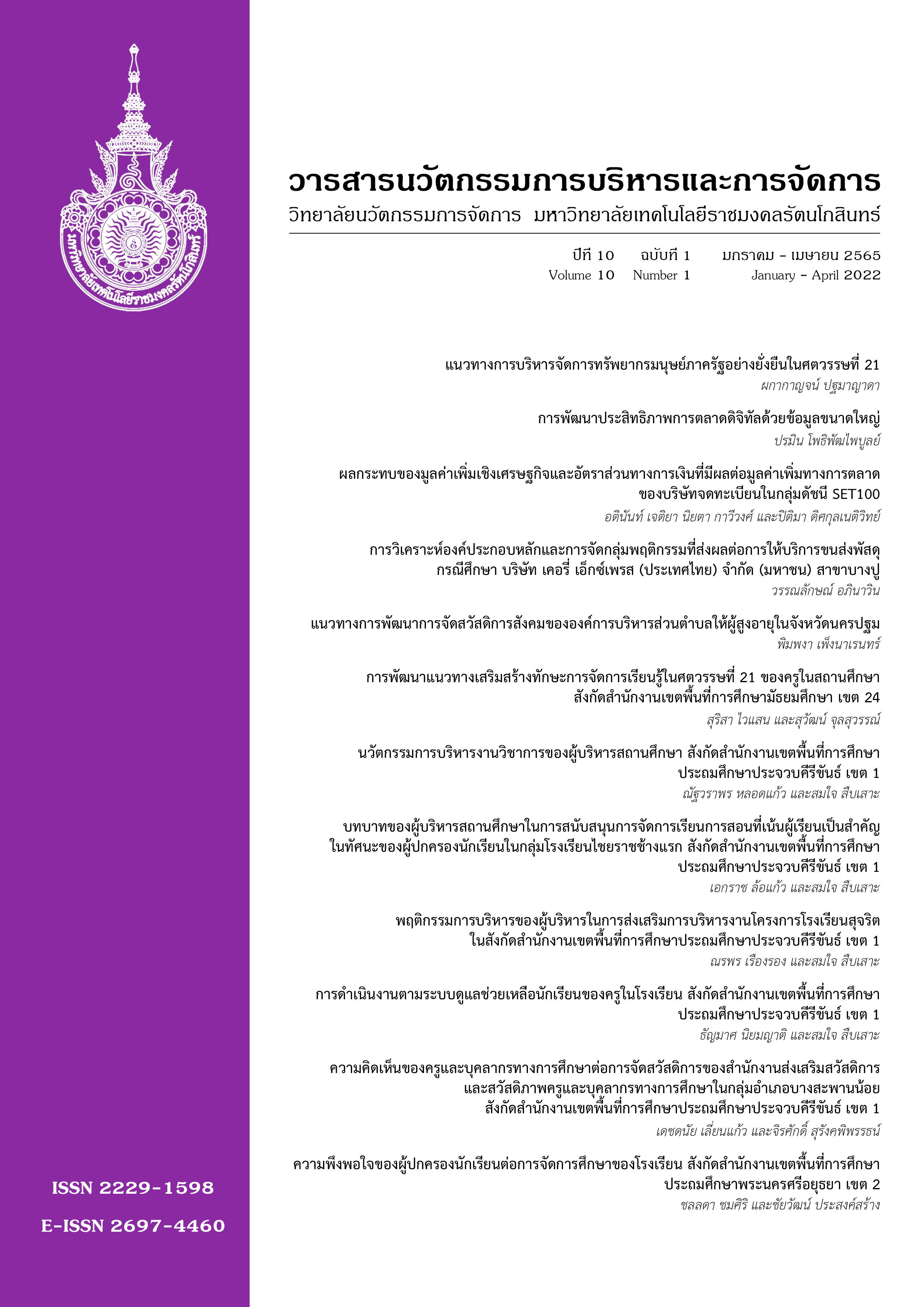
Impact of Economic Value Added and Financial Ratios Towards Market Value Added of Listed Companies in SET100 Index
Article Sidebar
Main Article Content
Abstract
The purpose of this study is to find the relationship between economic value added, financial ratios and market value added of listed companies in SET100 Index. Financial ratios used in this study are Profitability ratios which comprises of (1) return on assets (ROA), (2) return on equity (ROE) and (3) earnings per share (EPS). The samples were companies in the SET100 Index, all annual financial reports for 5 years (from 2014 to 2018) were collected. This research excludes companies in financial industry.
Multiple linear regression was employed to analyze the information. The independent variable were profitability ratios and economic value added, the dependent variable was market value added, and the controlled variables were size of firms and financial risks. The results show that economic value added, ROA, and ROE have a significant impact on the market value added.
Article Details

This work is licensed under a Creative Commons Attribution-NonCommercial-NoDerivatives 4.0 International License.
ข้อความและบทความในวารสารนวัตกรรมการบริหารและการจัดการ เป็นแนวคิดของผู้เขียน ไม่ใช่ความคิดเห็นและความรับผิดชอบของคณะผู้จัดทำ บรรณาธิการ กองบรรณาธิการ วิทยาลัยนวัตกรรมการจัดการ และมหาวิทยาลัยเทคโนโลยีราชมงคลรัตนโกสินทร์
ข้อความ ข้อมูล เนื้อหา รูปภาพ ฯลฯ ที่ได้รับการีพิมพ์ในวารสารนวัตกรรมการบริหารและการจัดการ ถือเป็นลิขสิทธิ์ของวารสารนวัตกรรมการบริหารและการจัดการ หากบุคคลใดหรือหน่วยงานใดต้องการนำทั้งหมดหรือส่วนหนึ่งส่วนใดไปเผยแพร่ต่อหรือกระทำการใดๆ จะต้องได้รับอนุญาติเป็นลายลักษณ์อักษรจากวารสารนวัตกรรมการบริหารและการจัดการก่อนเท่านั้น
References
โกศล ดีศีลธรรม. (2552). การบริหารเพื่อสร้างผลตอบแทนทางเศรษฐศาสตร์. Technology Promotion Magazine, 36(205), 16-20.
ณิชานันท์ แอดสกุล. (2558). ตัววัดผลการดำเนินงานที่มีอิทธิพลต่อมูลค่าเพิ่มเชิงเศรษฐกิจและมูลค่าทางการตลาดของบริษัทจดทะเบียนในตลาดหลักทรัพย์แห่งประเทศไทย กลุ่มอุตสาหกรรมบริการ. วิทยานิพนธ์บัญชีมหาบัณฑิต มหาวิทยาลัยศรีปทุม.
ตลาดหลักทรัพย์แห่งประเทศไทย. (2561). รายชื่อหลักทรัพย์ที่ใช้คำนวณดัชนี SET50 Index และ SET100 Index. สืบค้น 10 ตุลาคม 2562, จาก https://www.set.or.th/th/market/files/constituents/SET50_100_H2_2018.pdf
วีระชาติ ชุตินันท์วโรดม. (2556). เทคนิคการประเมินมูลค่าหุ้น. สืบค้น 10 ตุลาคม 2562, จาก https://www.set.or.th/dat/vdoArticle/attachFile/AttachFile_1429790208378.pdf
สถาบันพัฒนาความรู้ตลาดทุน ตลาดหลักทรัพย์แห่งประเทศไทย. (2548). การเงินธุรกิจ. กรุงเทพฯ:อมรินทร์พริ้นติ้งแอนด์พับลิชชิ่ง.
Alsoboa, S. S. (2017). The influence of economic value added and return on assets on created shareholders value: A comparative study in Jordanian public industrial firms. International Journal of Economics and Finance, 9(4), 63-78.
Bognárová, K. J. (2018). The Effect of Leverage and Economic value added on Market value added. Challenges of the Knowledge Society, 812-816.
Brigham, E. F., & Houston, J. F. (2019). Fundamentals of financial management. Cengage Learning.
Grant, J. L. (2003). Foundations of economic value added. Vol. 99. NJ: John Wiley & Sons.
Kadar, K., & Rikumahu, B. (2017). Relationship Analysis Between EVA, EPS, ROA, ROE to MVA for Measuring Financial Performance (Case Study on Telecommunication Companies Listed in IDX 2011-2016). eProceedings of Management, 4(3).
Prasad, H., & Shrimal, K. (2015). An Empirical Study on Relationship between Selected Financial Measures and Market Value Added of Infrastructural Companies in India. Pacific Business Review International, 8(1), 19-23.
Quintiliani, A. (2018). The Relationship between the Market Value Added of SMEs Listed on AIM Italia and Internal Measures of Value Creation The Role of Corporate Strategic Planning. International Journal of Financial Research, 9(1).
Riahi-Belkaoui, A. (1999). Capital structure: determination, evaluation, and accounting. CT: Quorum Books Publisher.
Stewart, G.B. (1991). The Quest for Value. New York: Harper Business.
Stewart, B. (2013). Best-practice EVA: the definitive guide to measuring and maximizing shareholder value. NJ: John Wiley & Sons.
Yan, Q., & Wang, Y. (2016, December). REVA-based Value Analysis on Listed Companies of Power Industry. In 2016 International Conference on Modeling, Simulation and Optimization Technologies and Applications (MSOTA2016). Atlantis Press.
Young, S. D., & O'Byrne, S. F. (2001). EVA and value based management. New York: McGraw Hill.
