
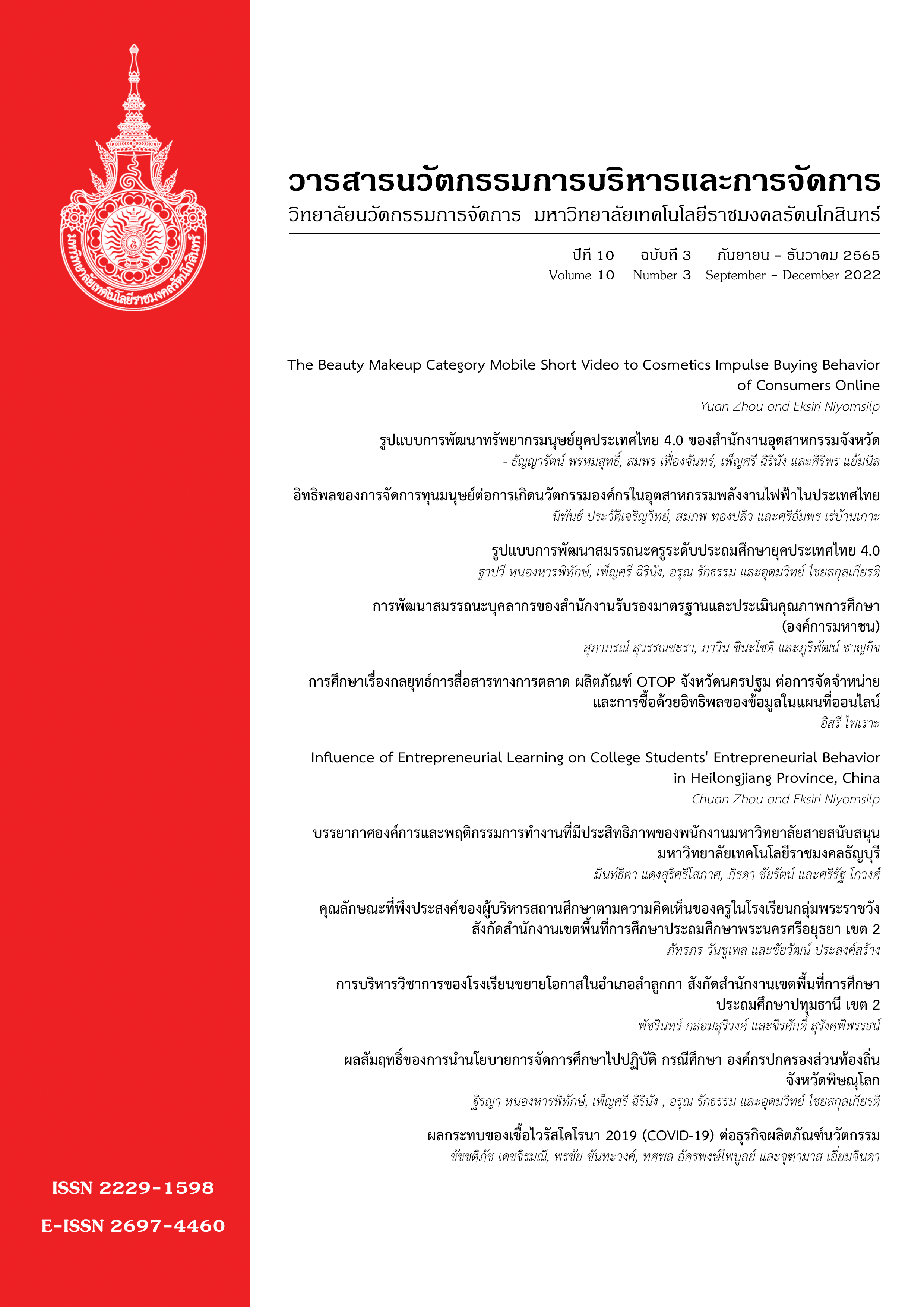
บรรยากาศองค์การและพฤติกรรมการทำงานที่มีประสิทธิภาพของพนักงานมหาวิทยาลัย สายสนับสนุน มหาวิทยาลัยเทคโนโลยีราชมงคลธัญบุรี
Article Sidebar
Main Article Content
บทคัดย่อ
การวิจัยนี้มีวัตถุประสงค์การวิจัยเพื่อ 1) เพื่อศึกษาระดับบรรยากาศองค์การ 2) เพื่อศึกษาระดับพฤติกรรมการทำงานที่มีประสิทธิภาพ 3) เพื่อเปรียบเทียบพฤติกรรมการทำงานที่มีประสิทธิภาพ จำแนกตามข้อมูลส่วนบุคคล 4) เพื่อศึกษาความสัมพันธ์ระหว่างบรรยากาศองค์การกับพฤติกรรมการทำงานที่มีประสิทธิภาพของพนักงานมหาวิทยาลัย สายสนับสนุน มหาวิทยาลัยเทคโนโลยีราชมงคลธัญบุรี การวิจัยเชิงสำรวจด้วยวิธีการสุ่มแบบชั้นภูมิ เก็บข้อมูลกับพนักงานมหาวิทยาลัยสายสนับสนุน จำนวน 297 คน วิเคราะห์ข้อมูลด้วยค่าเฉลี่ย ค่าเบี่ยงเบนมาตรฐาน สถิติทดสอบ t-test, One-Way ANOVA และการหาค่าสัมประสิทธิ์สหสัมพันธ์ของเพียร์สัน พบว่า กลุ่มตัวอย่างส่วนใหญ่ เป็นเพศชาย มีอายุอยู่ระหว่าง 20 - 29 ปี มีการศึกษาระดับปริญญาตรี และมีระยะเวลาการปฏิบัติงานน้อยกว่า 5 ปี มีความเห็นเกี่ยวกับบรรยากาศองค์การและพฤติกรรมการทำงานอยู่ในระดับปานกลาง ผลการทดสอบสมมติฐาน พบว่าพนักงานมหาวิทยาลัยสายสนับสนุนที่มีปัจจัยส่วนบุคคลต่างกันมีพฤติกรรมการทำงานไม่แตกต่างกัน นอกจากนี้บรรยากาศองค์การ ในด้านโครงสร้าง ด้านมาตรฐานงาน ด้านการชื่นชมและให้รางวัล ด้านการสนับสนุน และด้านความผูกพันต่อองค์การ มีความสัมพันธ์กับพฤติกรรมการทำงานที่มีประสิทธิ ภาพของพนักงานมหาวิทยาลัยสายสนับสนุน สำหรับบรรยากาศองค์การในด้านความรับผิดชอบนั้น ไม่มีความสัมพันธ์กับพฤติกรรมการทำงานที่มีประสิทธิภาพของพนักงานมหาวิทยาลัยสายสนับสนุน มหาวิทยาลัยเทคโนโลยีราชมงคลธัญบุรี
Article Details

อนุญาตภายใต้เงื่อนไข Creative Commons Attribution-NonCommercial-NoDerivatives 4.0 International License.
ข้อความและบทความในวารสารนวัตกรรมการบริหารและการจัดการ เป็นแนวคิดของผู้เขียน ไม่ใช่ความคิดเห็นและความรับผิดชอบของคณะผู้จัดทำ บรรณาธิการ กองบรรณาธิการ วิทยาลัยนวัตกรรมการจัดการ และมหาวิทยาลัยเทคโนโลยีราชมงคลรัตนโกสินทร์
ข้อความ ข้อมูล เนื้อหา รูปภาพ ฯลฯ ที่ได้รับการีพิมพ์ในวารสารนวัตกรรมการบริหารและการจัดการ ถือเป็นลิขสิทธิ์ของวารสารนวัตกรรมการบริหารและการจัดการ หากบุคคลใดหรือหน่วยงานใดต้องการนำทั้งหมดหรือส่วนหนึ่งส่วนใดไปเผยแพร่ต่อหรือกระทำการใดๆ จะต้องได้รับอนุญาติเป็นลายลักษณ์อักษรจากวารสารนวัตกรรมการบริหารและการจัดการก่อนเท่านั้น
เอกสารอ้างอิง
กิติยา วงษ์ภักดี, เมทินี รัษฎารักษ์ และบุบผา ฐานุตตมานนท์. (2563). บรรยากาศการทำงานที่ส่งผลต่อพฤติกรรมการปฏิบัติงาน
ของเจ้าหน้าที่และข้าราชการกรมศุลกากร. วารสารวิชาการสังคมศาสตร์เครือข่ายวิจัยประชาชื่น, 1,(3), 23-73.
จารุวัฒน์ ต่ายเทศ. (2555). บรรยากาศองค์กรที่มีผลต่อประสิทธิผลขององค์กร. (ปริญญานิพนธ์มหาบัณฑิต).
สาขาการจัดการ มหาวิทยาลัยศรีนครินทรวิโรฒ, กรุงเทพฯ.
จุฬารัตน์ เสกนำโชค. (2548). ความสัมพันธ์ระหว่างบรรยากาศองค์กรและความพึงพอใจในการปฏิบัติงานของพนักงาน
ในสายงานบัญชี บริษัทเอกชนในกรุงเทพมหานคร. (สารนิพนธ์). มหาวิทยาลัยสารคาม, มหาสารคาม.
บุญสัน อนารัตน์. (2554). ความสัมพันธ์ระหว่างบรรยากาศองค์การกับคุณภาพชีวิตการทางานของ. นักวิชาการสาธารณะสุข
ที่ปฏิบัติงานในศูนย์สุขภาพชุมชน จังหวัดหนองคาย. (การศึกษาอิสระ ปริญญาสาธารณสุขศาสตรมหาบัณฑิต).
มหาวิทยาลัยขอนแก่น, ขอนแก่น.
พัชรนันท์ จุมพลพิทักษ์ และณักษ์ กุลิสร. (2555). ปัจจัยที่มีความสัมพันธ์กับพฤติกรรมการทำงานของพนักงาน
ประจำสำนักงานโรงงานประกอบแผงวงจรอิเล็กทรอนิกส์แห่งหนึ่งในจังหวัดปทุมธานี.
วารสารบริหารธุรกิจศรีนครินทรวิโรฒ, 3(1), 61 - 77.
ทิพาพร อยู่ศรี และธนาวุฒิ ประกอบผล. (2562). ความสัมพันธ์ระหว่างบรรยากาศองค์กรกับแรงจูงใจในการปฏิบัติงานของ พนักงานในสวนอุตสาหกรรมโรจนะจังหวัดพระนครศรีอยุธยา. วารสารครุศาสตร์อุตสาหกรรม, 16(2), 128 -136.
วิทยา จูงหัตถการสาธิต. (2552). ความพึงพอใจและประสิทธิภาพในการทำงาน บริษัทแอดวานซ์ ดาต้า เน็ตเวิร์คคอมมูนิเคชัน
จำกัด (สารนิพนธ์มหาบัณฑิต การจัดการ). มหาวิทยาลัยศรีนครินทรวิโรฒ, กรุงเทพฯ.
ภานุ ชินะโชติ. (2547). การรับรู้บรรยากาศองค์กรการมีส่วนร่วมและทัศนคติในงานที่มีผลต่อการปฏิบัติงานของพนักงาน
อุตสาหกรรมผลิตผ้าแห่งหนึ่ง (วิทยานิพนธ์ วิทยาศาสตร์มหาบัณฑิต). สาขาจิตวิทยาอุตสาหกรรม
มหาวิทยาลัยเกษตรศาสตร์, กรุงเทพฯ.
ยุวดี นิตุธร. (2559). การศึกษาความสัมพันธ์ระหว่างบรรยากาศเชิงสร้างสรรค์กับประสิทธิภาพการทำงานของบุคลากร
ด้านซอฟต์แวร์ (วิทยานิพนธ์ คณะพัฒนาธุรกิจและอุตสาหกรรม). มหาวิทยาลัยเทคโนโลยีพระจอมเกล้าพระนครเหนือ,
กรุงเทพฯ.
Hay Group Research. (2005). Climate Improvement Accreditation. Retrieved January 10, 2022.,
from htpp://www.hayresourcesdirect.Haygroup.com.
Hemakumara, G., & Rainis, R. (2018). Spatial Behavior Modelling of Unauthorized Housing in Colombo,
Sri Lanka. KEMANUSIAAN: The Asian Journal of Humanities, 25(2), 91-107.
Hastings, J. W., Garg, M., Lynn, E. T., & Divino, C. M. (2014). Surgical repair of ileovesical fistulas: long-term
complications, quality of life, and patient satisfaction. The American Surgeon, 80(12), 1207-1211.
Raziq, A., & Maulabakhsh, R. (2015). Impact of working environment on job satisfaction.
Procedia Economics and Finance, 23, 717-725.
Sarode, A. P., & Shirsath, M. (2012). The factors affecting employee work environment & it’s relation with
employee productivity. International Journal of Science and Research (IJSR). 3(11), 2735-2737.
Stubbart, C. I., & Knight, M. B. (2006). The case of the disappearing firms: empirical evidence and implications.
Journal of Organizational Behavior: The International Journal of Industrial, Occupational and
Organizational Psychology and Behavior, 27(1), 79-100.
Tremblay, M., Cloutier, J., Simard, G., Chênevert, D., & Vandenberghe, C. (2010). The role of HRM practices,
procedural justice, organizational support and trust in organizational commitment and in-role and
extra-role performance. The international journal of human resource management, 21(3), 405-433.
Williams, L. J., & Anderson, S. E. (1991). Job satisfaction and organizational commitment as predictors of
organizational citizenship and in-role behaviors. Journal of management, 17(3), 601-617.
