
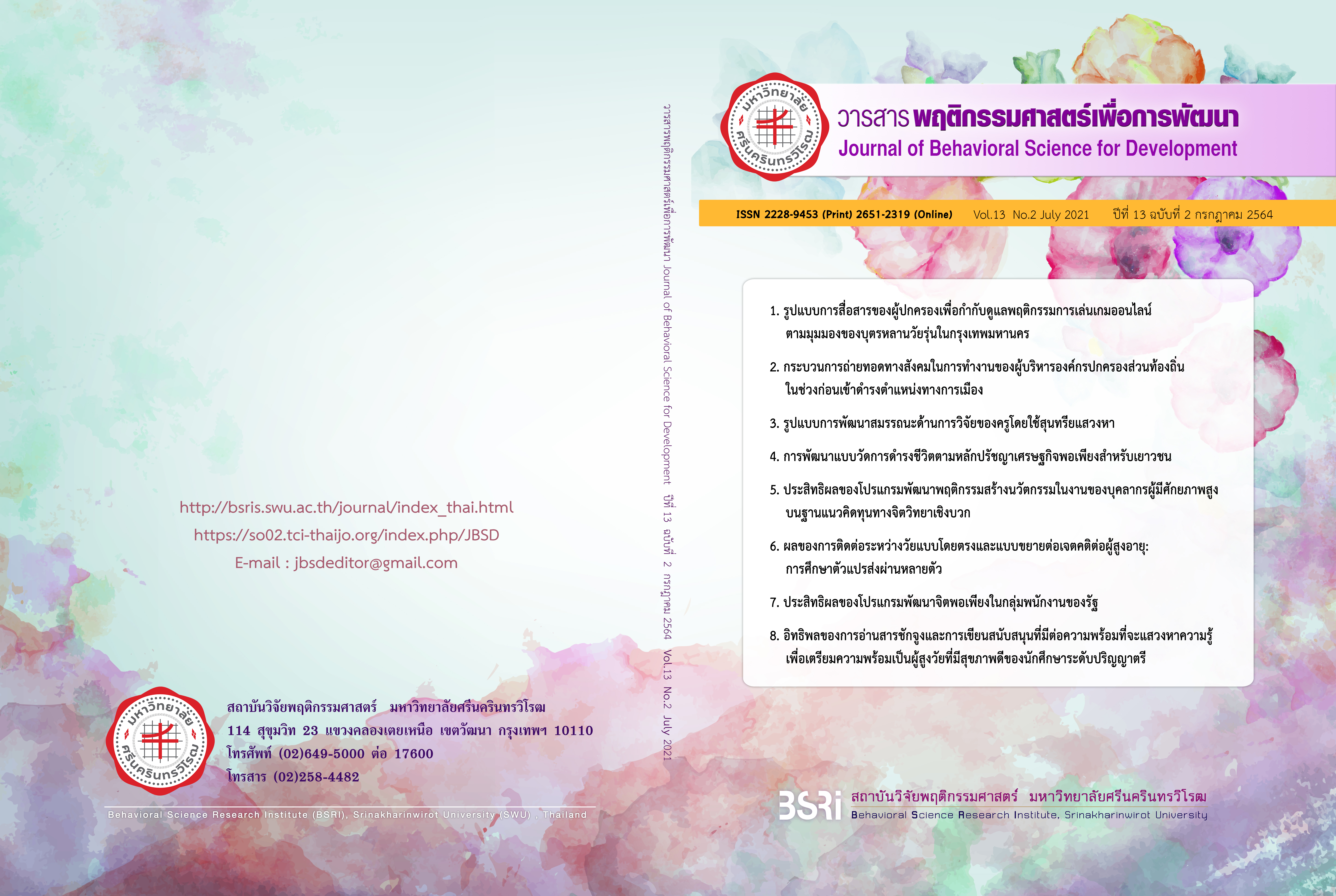
รูปแบบการสื่อสารของผู้ปกครองเพื่อกำกับดูแลพฤติกรรมการเล่นเกมออนไลน์ตามมุมมองของบุตรหลานวัยรุ่นในกรุงเทพมหานคร
คำสำคัญ:
รูปแบบการสื่อสารของผู้ปกครอง, บุตรหลานวัยรุ่น, พฤติกรรมการเล่นเกมออนไลน์, คะแนนการติดเกม, ระดับการติดเกมบทคัดย่อ
การวิจัยครั้งนี้ ศึกษาถึงรูปแบบการสื่อสารของผู้ปกครองเพื่อกำกับดูแลพฤติกรรมการเล่นเกมออนไลน์ตามมุมมองของบุตรหลานวัยรุ่น รวมถึงความสัมพันธ์ระหว่างรูปแบบการสื่อสารของผู้ปกครองกับระดับการติดเกมออนไลน์ของวัยรุ่นในกรุงเทพมหานคร รูปแบบการวิจัยเป็นแบบผสมผสานเชิงคุณภาพและเชิงปริมาณ เก็บข้อมูลด้วยวิธีการสนทนากลุ่ม และแจกแบบสอบถาม ผลการวิจัยพบว่า รูปแบบการสื่อสารของผู้ปกครองในมุมมองของบุตรหลานวัยรุ่นเป็นแบบ “กำกับชี้แนะ” มากที่สุด แต่บุตรหลานวัยรุ่นพึงพอใจและคาดหวังมากที่สุดต่อการสื่อสารแบบ “ตามใจ” ขณะที่แบบ“บังคับควบคุม” ได้รับความพึงพอใจและคาดหวังต่ำที่สุด ลักษณะการสื่อสารของผู้ปกครองที่บุตรหลานวัยรุ่นไม่พึงพอใจ มี 5 ลักษณะ ได้แก่ 1) ใช้อารมณ์ออกคำสั่งให้หยุดเล่นทันที 2) ต่อว่าแบบน้อยใจ 3) จับผิดว่าเล่นแต่เกม 4) ไม่เชื่อมั่นในตัวบุตรหลานวัยรุ่น 5) โทษแต่เกม และยังพบว่า ความพึงพอใจของบุตรหลานวัยรุ่นต่อรูปแบบการสื่อสารของผู้ปกครองในการกำกับดูแลพฤติกรรมการเล่นเกมออนไลน์ มีความสัมพันธ์กับคะแนนการติดเกมออนไลน์ของวัยรุ่นในทิศทางที่ตรงกันข้าม และวัยรุ่นที่ผู้ปกครองมีรูปแบบการสื่อสารที่ต่างกัน จะมีความถี่ในการเล่นเกมออนไลน์ต่อสัปดาห์ต่างกัน ข้อเสนอแนะเชิงนโยบายจากผลการวิจัยนี้ คือ โรงเรียน ผู้ปกครอง และหน่วยงานทางการแพทย์ ควรร่วมกัน สร้างกลไกการประเมินตนเองให้กับผู้ปกครอง ถึงวิธีการสื่อสารเพื่อการกำกับดูแลพฤติกรรมการเล่นเกมออนไลน์ของบุตรหลานวัยรุ่น และประสิทธิผลที่เกิดขึ้นเป็นประจำและต่อเนื่อง
เอกสารอ้างอิง
Baumrind, D. (1967). Child care practices anteceding three patterns of preschool behavior. Genetic Psychology Monographs, 75, 43-88.
Chantavanich, S. (2010). Kān wikhro̜ khō̜mūn chœ̄ng khunnaphāp [Qualitative data analysis]. Chulalongkorn University Press.
Charoenwanit, S. (2014). Phrưttikam kān tit kēm : Phonkrathop læ kān pō̜ngkan [Game addiction behavior: Effects and Prevention]. Thai Journal of Science and Technology, 22(6), 871-879.
Cheyjunya, P., Anawushsiriwongse, T., & Vivatananukul, M. (1998). Nǣokhit lak nithētsāt [The Core Concept of Communication]. Khāofāng.
Child and Adolescent Mental Health Rajanagarindra Institute. (2017). Khūmư̄ kānchai bǣp thotsō̜p kān tit kēm chabap dek læ wairun [The Manual of Game Addiction Screening Test]. Bangkok.
Creswell, J. W. (2013). Research Design: Qualitative, Quantitative, and Mixed Methods Approaches (2nd edition). Sage publications.
Department of Mental Health. (2019, December 11). Re: Phō̜ mǣ rangsan wichā chīwit kro̜ khum phai lūk [Parents create a life course, protective armor for children]. [Web article]. https://www.dmh.go.th/news-dmh/view.asp?id=28394
Department of Mental Health. (2019, February 12). Re: Yō̜t dek tit kēm phung hok thao [6 times the number of children addicted to the game]. (Web article). https://www.thaihealth.or.th/Content/40775
Electronic Transactions Development Agency. (2018). Rāingān phonlakā rasamrūat phrưttikam phūchai ʻinthœ̄net nai prathēt Thai pī sō̜ngphanhārō̜ihoksipʻet [The report of Thailand internet user profile 2018]. http://digital.library.tu.ac.th/tu_dc/frontend/Info/item/dc:145655
Intarathat, K., & Yenjabok, P. (2004). Kānsư̄sān rawāng bukkhon [Interpersonal Communication]. Pirun. https://pirun.ku.ac.th/~agrpct/lesson3/lesson3.html
National Statistical Office. (2018, October). Phonlakā rasamrawa čhō̜kā ramī kānchai theknōlōyī sārasonthēt læ kānsư̄sān nai khrūarư̄an Phō̜.Sō̜. sō̜ngphanhārō̜ihoksipʻet [Survey results on the use of information and communication technology in the household in 2019]. Thailand Ministry of Digital Economy and Society. http://www.nso.go.th/sites/2014/DocLib14/News/2561/10-61/N26-10-61.pdf
Pinto, N. (2020). Kānsư̄sān khō̜ng phūpokkhrō̜ng phư̄a kamkap dūlǣ phrưttikam kān len kēm ʻō̜nlai tām mummō̜ng khō̜ng but lān wairun kap phrưttikam kān len kēm ʻō̜nlai khō̜ng wairun nai Krung Thēp Mahā Nakhō̜n [Parental communication to monitor online gaming behavior in teenaged children’s view and their online gaming behavior in Bangkok] [Research Report]. Faculty of Journalism and Mass Communication, Thammasat University.
Rittakananon, P. (2006). Phatthanākān manut [Human Development]. Thammadā phlēt.
Schneider, L. A., King, D. L., & Delfabbro, P. H. (2017). Family factors in adolescent problematic Internet gaming: A systematic review. Journal of Behavioral Addiction, 6(3), 321–333. https://doi.org/10.1556/2006.6.2017.035
Tantipiwatanaskul, P. (2020, October 25). Phō̜mǣ ying khēmngūat lūk ying tō̜tān [The More Strict Parents, The more children resist] [Video]. Youtube. https://www.youtube.com/watch?v=XJQCxKtoG3Q
Thitimanakul, N. (2002). rīanrū rư̄ang kēm čhāk kēm mœ̄ tūa yong [Leaning Games from the Expert Gamer]. sœ̄mwit ʻinfō̜ mēchan.
Voice Online. (2017, February 11). Re: Phœ̄i pī hoksip phop dek - wairun pūai pen rōk tit kēm phœ̄m khưn hok thaotūa [Revealing the year 60 met children - teenagers Sickness with game addiction increased 6 times]. https://voicetv.co.th/read/r1voDNTIf
Wongrajit, K. (2018, November 1). Re: Nưng - čhet Phrưtsačhikāyon sapdā sukkhaphāp čhit hǣng chāt (November 1-7; The National Mental Health Week). https://www.dmh.go.th/sty_lib/news/articles/view.asp?id=1239
Yamane, T. (1967). Statistics; An Introductory Analysis. Harper and Row.
ดาวน์โหลด
เผยแพร่แล้ว
รูปแบบการอ้างอิง
ฉบับ
ประเภทบทความ
สัญญาอนุญาต
ลิขสิทธิ์ (c) 2021 วารสารพฤติกรรมศาสตร์เพื่อการพัฒนา

อนุญาตภายใต้เงื่อนไข Creative Commons Attribution-NonCommercial-NoDerivatives 4.0 International License.


