STORYTELLING SKILL DEVELOPMENT FOR COMMUNITIES TO CONSERVE AND PROMOTE SUSTAINABLE TOURISM IN CHANTHABURI PROVINCE
Article Sidebar
Main Article Content
Abstract
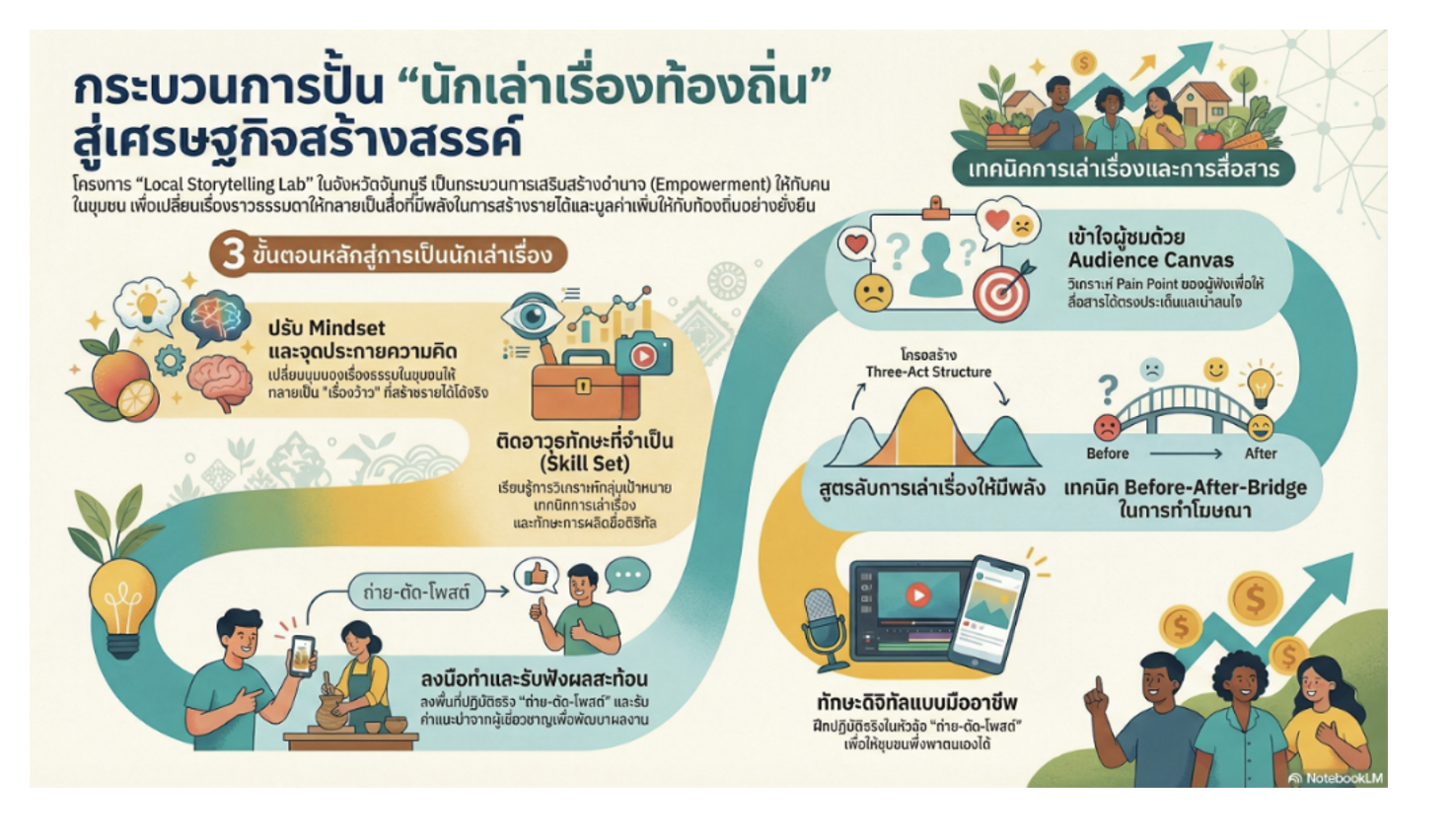
Introduction: Local storytelling as a means of driving the creative economy has gained increasing attention in recent years. Thailand possesses a rich diversity of cultural identities and environmental resources, which constitute valuable local assets. However, many communities still lack effective communication skills, which are essential for conveying local stories and values. Objectives: This study aimed to develop community members’ capacities in creative local storytelling and to derive lessons learned regarding content design approaches that create economic value while promoting sustainable tourism. Method: This study employed participatory action research integrated with a mixed-methods approach. Quantitative data were collected through knowledge tests and skill assessments, while qualitative data were gathered through observations and reflective lesson extraction. The participants consisted of 32 volunteer community members from Ban Samet Ngam Community, Chanthaburi Province. Results: The findings revealed that the training program successfully transformed participants’ engagement from initial interest to sustained action and proactive involvement. Through the development of knowledge, attitudes, and practical skills, participants were able to generate meaningful positive impacts within their community. They demonstrated the ability to design content and storytelling strategies that reflected their unique identities and local assets while selecting communication tools appropriate to their context. The program also fostered collaboration among different generations within the community, enabling mutual empowerment and knowledge exchange. As a result, community communication became clearer, more engaging, and more capable of generating tangible economic value. Conclusion: The findings are consistent with the Nation Brand Hexagon framework, which emphasizes that local storytelling conducted by community members through the presentation of local assets and unique strengths not only contributes to cultural preservation and sustainable tourism promotion but also communicates local values and identities to external audiences. Such processes can create more equitable social and economic opportunities for communities in the future.
Downloads
Article Details

This work is licensed under a Creative Commons Attribution-NonCommercial-NoDerivatives 4.0 International License.
The author(s) is only responsible for data appearing in the submitted manuscript of Interdisciplinary social sciences and communication journal.Besides, this journal encourages and enables you to share data such as statements, contents, figures, etc. that support your research publication where appropriate, and enables you to interlink the data with proper citation.
References
Anholt, S. (2007). The theory of competitive identity. In Competitive identity: The new brand management for nations, cities and regions (pp. 25-42). Palgrave Macmillan UK.
Chronis, A. (2005). Constructing heritage at the Gettysburg storyscape. Annals of tourism research, 32(2), 386-406.
Creative Economy Agency (Public Organization). (2024). Creative economy x innovation:Driving Thai soft power to be marketable and successful.https://www.cea.or.th/en/single-softpower/creative-economy-thailand-2022
Murphy, P. (1985). Tourism: A community approach (RLE Tourism). Routledge.
Roam, D. (2016). Show and tell: how everybody can make extraordinary presentations. Portfolio.
UN World Tourism Organization. (2017). Sustainable Tourism Development.https://www.unwto.org/sustainable-development
Howkins, J. (2001). The Creative Economy: How People Make Money from Ideas. Penguin.
