A COMUNICATION MODEL FOR PROMOTING THE PRODUCTION AND CONSUMPTION OF SAFE AGREECULTURAL PRODUCTS : A CASE STUDY OF ORGANIC FARMING IN CHACHOENGSAO PROVINCE
Article Sidebar
Main Article Content
Abstract
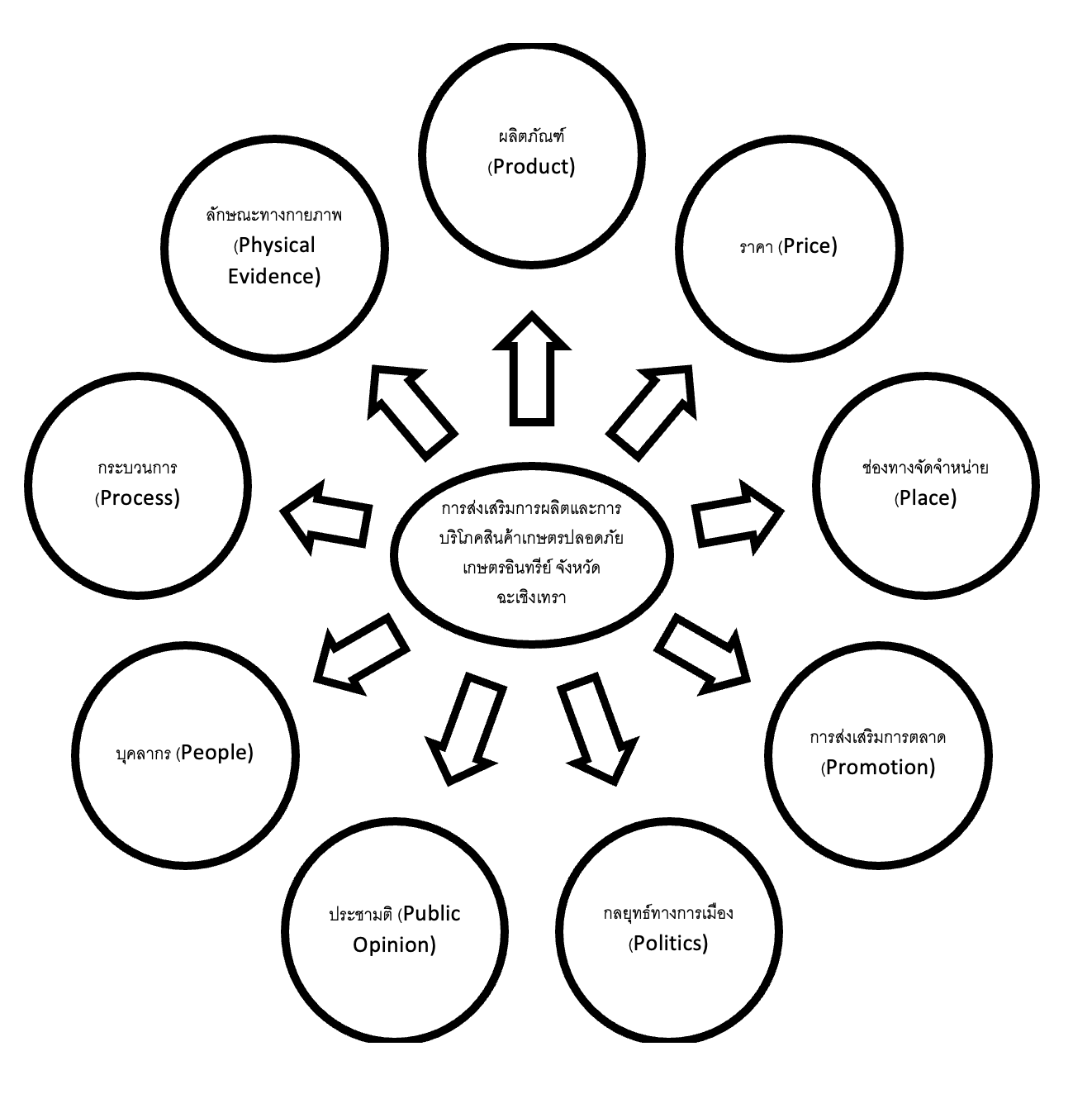
Introduction: Communicating a new paradigm to promote the production and consumption of safe agricultural products: A case study of organic farming in Chachoengsao Province. Objectives: 1) to study the in-depth contextual information and traditional knowledge regarding the promotion of safe and organic agricultural production and consumption in Chachoengsao Province. 2) to study the factors influencing the communication of a new paradigm to promote the production and consumption of safe and organic agricultural products in Chachoengsao Province. 3) to propose a model for communicating a new paradigm to promote the production and consumption of safe and organic agricultural products in Chachoengsao Province. Method: This research employed a mixed-methods approach, combining quantitative and qualitative research. A purposive sampling method was used to select 200 participants. Data were analyzed using frequency, percentage, mean, standard deviation, multiple regression analysis, and in-depth interviews with 14 stakeholders. Content analysis was also conducted on these interviews. Results: 1) Promoting the production and consumption of safe agricultural products (organic agriculture) under a new paradigm emphasizes the value of products in terms of safety, health, environment, and certification standards, rather than just economic dimensions. Consumers accept higher prices if they receive value for their money. Distribution channels focus on directly connecting producers and consumers to reduce intermediaries and increase transparency. Marketing communication shifts from a sales-oriented approach to education and raising awareness of health and the environment. Public policy and societal opinion play a crucial role in supporting and driving the sustainable growth of organic agriculture. Simultaneously, relevant personnel must possess knowledge and attitudes aligned with organic farming principles, and production processes must be transparent, verifiable, and build consumer trust. 2) Factors influencing the promotion of the production and consumption of safe organic agricultural products were found to have a positive influence on all variables. The standard coefficient showed that marketing promotion had the greatest influence, followed by physical evidence, product, political strategy, price, process, distribution channels, public opinion, and personnel, in that order. Multiple regression analysis revealed that Model 1 explained 48% of the variance (R² = 0.48), increasing to 57% in Model 2 (R² = 0.57) and 62% in Model 3 (R² = 0.62), which was the best model. All models were statistically significant at the 0.05 level (Sig. = 0.000). 3) The new communication paradigm for promoting the production and consumption of safe organic agricultural products in Chachoengsao Province. Promoting the production and marketing of safe organic agricultural products in the future must be driven by the participation of all sectors government, private sector, and community. In particular, it requires marketing strategies that integrate economic, social, and consumer psychology knowledge. The most important aspect is building trust and a positive image in the minds of consumers, so that organic agriculture is not just a consumption option, but a sustainable consumption culture for Thai society in the future. Conclusion: Organic agriculture promotion must prioritize building trust through health and environmental values rather than price alone. This is achieved through integrated marketing and multi-sectoral collaboration to foster a sustainable consumption culture.
Downloads
Article Details

This work is licensed under a Creative Commons Attribution-NonCommercial-NoDerivatives 4.0 International License.
The author(s) is only responsible for data appearing in the submitted manuscript of Interdisciplinary social sciences and communication journal.Besides, this journal encourages and enables you to share data such as statements, contents, figures, etc. that support your research publication where appropriate, and enables you to interlink the data with proper citation.
References
Cannon, G., & Leitzmann, C. (2022). Food and nutrition science: the new paradigm. Asia Pacific journal of clinical nutrition, 31(1), 1-15.
Chaudhry, S. R. (2024). Psychobiotics and gut–Brain axis - A new paradigm for improving mental health. Probiotics (pp. 146-158). CRC Press.
D'Hollander, C. J., Keown-Stoneman, C. D., Birken, C. S., O'Connor, D. L., Maguire, J. L., Cohn, R., & Vandenberghe, H. (2022). Timing of introduction to solid food, growth, and nutrition risk in later childhood. The Journal of pediatrics, 240(3), 102-109.
Hair Jr, J. F., da Silva Gabriel, M. L. D., & Patel, V. K. (2014). Modelagem de Equações Estruturais Baseadaem Covariância (CB-SEM) com o AMOS: Orientações sobre a sua aplicação como uma Ferramenta de Pesquisa de Marketing. REMark-Revista Brasileira de Marketing, 13(2),44-55.
Ihsaniyati, H., Sarwoprasodjo, S., Muljono, P., & Gandasari, D. (2023). The use of social media for development communication and social change: A review. Sustainability, 15(3), 2283.
Kotler, P., & Keller, K. L. (2016). A framework for marketing management (6th ed.). Pearson Education Limited.
Kuchta, E. C. (2024). The epistemological possibilities of love: Towards relational and ecological healing. Routledge.
Kumar, A., Singh, S. K., Kant, C., Verma, H., Kumar, D., Singh, P. P., & Kumar, M. (2021). Microbial biosurfactant: a new frontier for sustainable agriculture and pharmaceutical industries. Antioxidants, 10(9), 1472.
Kumar, P., & Kumar Singh, R. (2022). Strategic framework for developing resilience in Agri-Food Supply Chains during COVID - 19 pandemic. International Journal of Logistics Research and Applications, 25(11), 1401-1424.
Lee, S., Shin, S., Lee, H., & Park, M. S. (2023). Which urban agriculture conditions enable or constrain sustainable food production?. International Journal of Agricultural Sustainability, 21(1), 2227799.
Li, W., Long, R., & Chen, H. (2016). Consumers’ evaluation of national new energy vehicle policy in China: An analysis based on a four-paradigm model. Energy Policy, 99, 33-41.
Ma, W., Sonobe, T., & Gong, B. (2024). Linking farmers to markets: Barriers, solutions, and policy options. Economic Analysis and Policy, 82, 1102-1112.
Marvin, H. J., Bouzembrak, Y., Van der Fels-Klerx, H. J., Kempenaar, C., Veerkamp, R., Chauhan, A.,& Tekinerdogan, B. (2022). Digitalisation and artificial intelligence for sustainable food systems. Trends in Food Science & Technology, 120, 344-348.
Ministry of Agriculture and Cooperatives. (2020). 20-Year Agriculture and Cooperative Strategy (2017–2036).
Nguyen-Minh, Q., Vignola, R., Brouwer, I. D., & Oosterveer, P. (2025). Transitioning practices of vegetable small-scale actors in Vietnam: an interplay of food safety, labor demand, and soil environment. Agriculture and Human Values, 42(2), 825-843.
Office of Agricultural Economics. (2021). Directions for Thai agricultural development in the Thailand 4.0 era.
Office of the National Economic and Social Development Council. (2018). The Twelfth National Economic and Social Development Plan (2017–2021).
Patel, S. K., Sharma, A., & Singh, G. S. (2020). Traditional agricultural practices in India: an approach for environmental sustainability and food security. Energy, Ecology and Environment, 5(4), 253-271.
Servaes, J. (2022). Communication for development and social change: handbook of nonprofit communication (pp. 23-31). Routledge.
Shen, B., Liu, J., Zhou, Y., & Zhu, H. (2025). Effectiveness of meaning-centered interventions on anxiety and depressive symptoms, sense of meaning, and quality of life in patients with advanced cancer: a meta-analysis of randomized controlled trials. Supportive Care in Cancer, 33(1), 67.
Srisa-ard, B. (2011). Introduction to research (9th ed.). Suwiriyasan.
Tauchid, A., Muhid, A., Khudlori, A., Ayunda, N. A., Lee, A., & Jisoo, C. (2025). Investigating communicative language teaching through meaning-based tasks and processing strategies to strengthen learners’ oral performance. Journal of Research in English Language Teaching and Linguistics, 1(2), 153-169.
Verma, A., Shameem, N., Jatav, H. S., Sathyanarayana, E., Parray, J. A., Poczai, P., & Sayyed, R. Z.(2022). Fungal endophytes to combat biotic and abiotic stresses for climate-smart and sustainable agriculture. Frontiers in plant science, 13, 953836.
Wismashanti, R. A., & Azizah, K. (2023). A Systematic Literature Review on Communication In Health Using Narrative Theory. Komunikasi: Jurnal Komunikasi, 14(1), 82-91.
Yu, P. (2022). Diffusion of Innovation theory. In Implementation science (pp. 59-61). Routledge.
