FACTORS INFLUENCING THE DECISION TO PURCHASE TOUR PACKAGES AMONG THAI TOURISTS
Article Sidebar
Main Article Content
Abstract
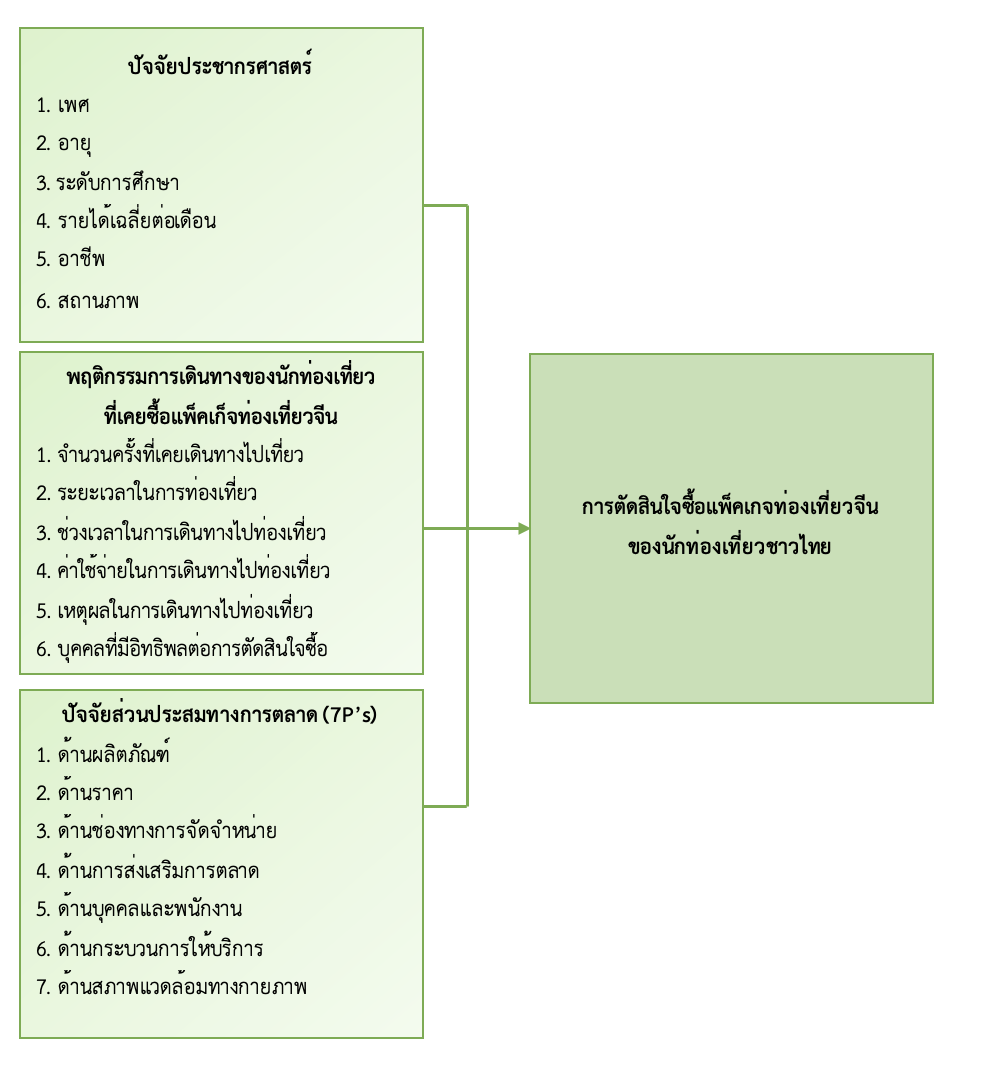
Introduction: Tourism serves as a vital mechanism for driving economic growth across numerous countries worldwide and represents the fastest-growing sector in the global economy in the post-COVID-19 era. Objectives: 1) examine the personal characteristics, travel behavior, marketing mix perceptions, and package tour purchasing decisions of Thai tourists traveling to China. 2) identify the marketing mix factors that significantly influence Thai tourists' decisions to purchase Chinese travel packages. Method: A quantitative research design was employed. The sample comprised 422 Thai tourists who had previously purchased guided tour programs to China, selected through purposive sampling. Data were collected via a structured questionnaire and analyzed using frequency, percentage, mean, standard deviation, and multiple regression analysis. Results: The majority of respondents were female, aged 21–30 years, holding a bachelor's degree, earning a monthly income below 20,000 Thai baht, and employed in state-owned enterprises or government agencies. With respect to travel behavior, most respondents had visited China one to two times, with trip durations of three to five days, predominantly during weekends. Package expenditure was typically below 10,000 baht, with leisure and relaxation as the primary travel motivation, and family members or relatives as the principal sources of travel influence. Overall perceptions of marketing mix factors were rated at a high level (M = 4.07, SD = 0.76), as were purchasing decision scores (M = 4.04, SD = 0.81). Multiple regression analysis revealed that at least one predictor variable significantly influenced purchasing decisions at the p < .01 level. Specifically, product, price, and distribution channels each exerted a statistically significant influence (p < .01). The overall predictive model accounted for 73.1% of the variance in purchasing decisions (R² = .731), expressed as: Y = .415 + .162(Product) + .231(Price) + .222(Distribution Channels). Conclusion: Marketing mix factors - particularly price, distribution channels, and product - are key variables influencing Thai tourists' decisions to purchase Chinese travel packages. Tourism operators should prioritize competitive and appropriate pricing strategies, develop easily accessible sales channels, and design travel programs that precisely meet the needs and expectations of their target market.
Downloads
Article Details

This work is licensed under a Creative Commons Attribution-NonCommercial-NoDerivatives 4.0 International License.
The author(s) is only responsible for data appearing in the submitted manuscript of Interdisciplinary social sciences and communication journal.Besides, this journal encourages and enables you to share data such as statements, contents, figures, etc. that support your research publication where appropriate, and enables you to interlink the data with proper citation.
References
Boonchu, S. (2017). Factors affecting detached house purchase decisions in housing projects in Mueang District, Ratchaburi Province [In Thai] [Unpublished master's thesis]. Silpakorn University].
Junnieng, W., & Sawang, S. (2021). Service marketing mix and reference groups affecting the selection of resort accommodations in Kanchanaburi Province during COVID-19. In Proceedings of the 16th National Graduate Research Conference (pp. 932–944).Rangsit University.
Kanjanawasee, S. (2001). Classical test theory (5th ed.). Chulalongkorn University.
Kotler, P., & Keller, K. L. (2014). Marketing management (14th ed.). Pearson.
Matkaew, S. (2016). Marketing mix related to the decision to purchase Japan tour package services among consumers in Bangkok [In Thai] [Unpublished master's thesis]. Kasetsart University.
Muangneay, B., Pradabtanakij, D., & Wattanakomon, S. (2016). Marketing mix factors influencing behavior in selecting tour program services among Thai tourists [Article in Thai]. Journal of Technical Education Development, 28(99), 86 - 93.
Ngam-imsub, B. (2017). A study of personal factors, sales skills of insurance agents, and integrated marketing communication affecting life insurance purchase decisions of private company employees in Bangkok [In Thai] [Unpublished master's thesis]. Bangkok University.
Pichpantdecha, P. (2018). Religious tourism management in Hong Kong and its influence on Thai tourists [In Thai] [Unpublished master's thesis]. Thammasat University.
Pimpaporn, T., & Pimpaporn, W. (2022). Internet-using behavior and perception of tourism information through digital media on travel intention: The role of internet data trust [Article in Thai]. Interdisciplinary Social Sciences and Communication Journal, 5(1),
–60. https://so02.tci-thaijo.org/index.php/ISSC/article/view/246006/171379
Sari, D. M. F. P., & Pidada, I. A. (2020). Hedonic shopping motivation, shopping lifestyle, price reduction toward impulse buying behavior in shopping center. International Journal of Business, Economics and Management, 1(3), 48 - 54.
Srisaad, B. (2017). Basic research (10th ed., rev.) [In Thai]. Suviriyas.
Wanichbuncha, K. (2002). Using SPSS for Windows in data analysis (5th ed.) [In Thai].Chulalongkorn University Press.
Wanichbuncha, K. (2011). Statistics for research (6th ed.) [In Thai]. Thammasat University.
Wongdee, P. (2019). Factors influencing travel decisions to agricultural tourism destinations among Thai tourists: A case study of the Sufficiency Economy Learning Center at Ban Khong Pho, Phra Nakhon Si Ayutthaya District [In Thai] [Unpublished master's thesis]. Bangkok University].
