EXPECTATIONS OF STAKEHOLDERS IN THE DEVELOPMENT OF SME BUSINESSES IN THE DIGITAL ERA IN CHANTHABURI PROVINCE REGARDING THE LEARNING OUTCOMES OF THE GRADUATE-LEVEL COMMUNICATION ARTS PROGRAM
Article Sidebar
Main Article Content
Abstract
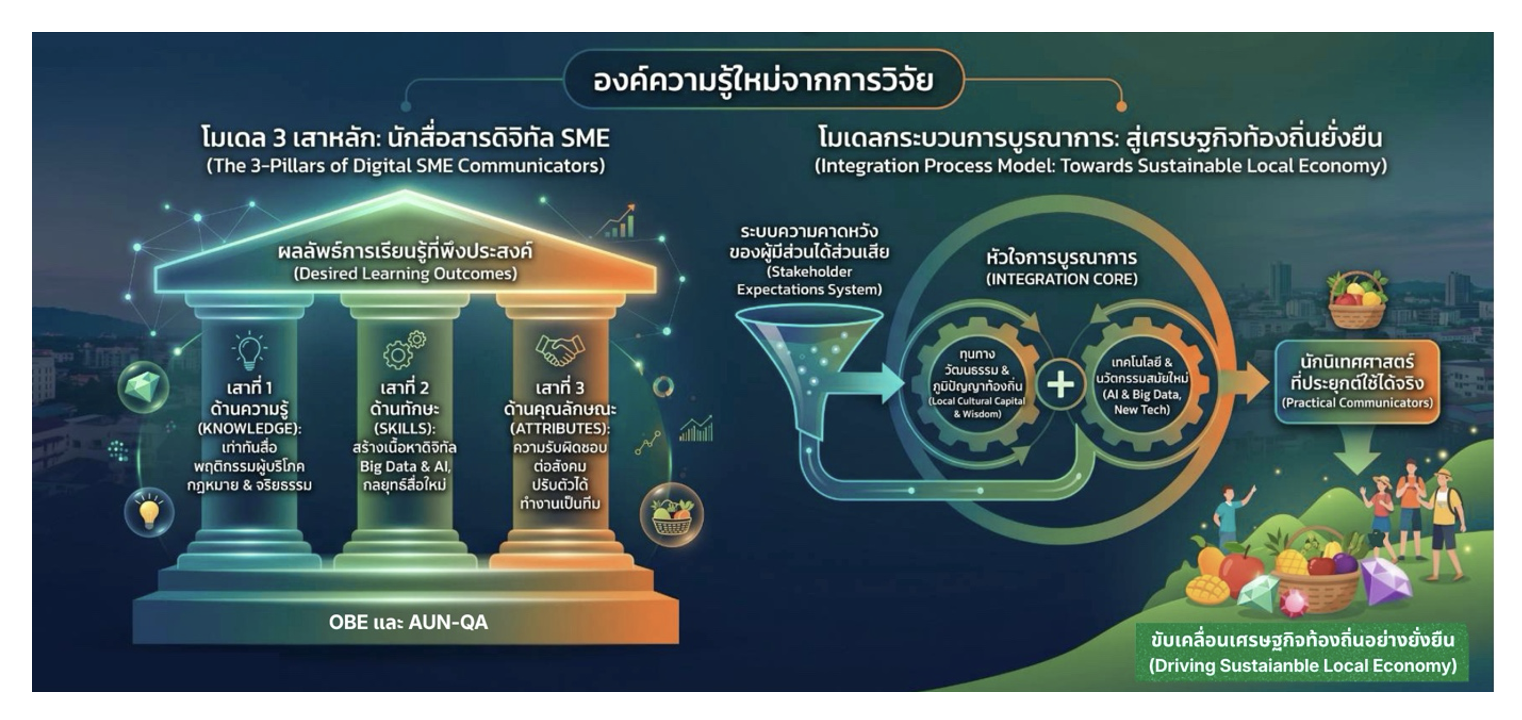
Introduction: The Faculty of Communication Arts, Rambhai Barni Rajabhat University, recognizes the necessity of gaining an in-depth understanding of the needs of stakeholders across all sectors and levels, in order to use this information as a foundation for the development and improvement of graduate programs. The aim is to produce communication professionals who effectively respond to the development of local businesses in Chanthaburi Province in the digital era. Objective: To explore the expectations for the learning outcomes of the graduate-level Communication Arts program in relation to the development of SMEs in Chanthaburi Province in the digital era. Methods: A qualitative research approach was utilized, collecting data through documentary research, as well as through semi-structured in-depth interviews with 70 key informants across four sectors: 15 from the government sector, 25 from the private sector, 15 from the academic sector, and 15 from the workforce. Results: Stakeholders expect graduates to integrate knowledge of digital communication such as marketing, artificial intelligence, and big data—with local contexts to enhance SME development in Chanthaburi Province sustainably. The desired learning outcomes encompass three core areas: (1) knowledge, including media literacy, consumer understanding, laws, and professional ethics; (2) skills, such as content creation, data utilization, and strategic design; and
(3) attributes/characteristics, including responsibility, adaptability, and teamwork. Therefore, the curriculum should emphasize integrative learning, data analysis, practical experience, the application of digital technology, and ethical cultivation to produce communication professionals capable of driving local business growth. Conclusion: The development of the graduate-level Communication Arts program should systematically integrate digital communication skills and modern technology with local cultural capital and wisdom, guided by the Outcome-Based Education framework and AUN-QA standards. This approach ensures the production of highly capable communicators who can practically apply their skills to sustainably drive the local economy of Chanthaburi Province.
Downloads
Article Details

This work is licensed under a Creative Commons Attribution-NonCommercial-NoDerivatives 4.0 International License.
The author(s) is only responsible for data appearing in the submitted manuscript of Interdisciplinary social sciences and communication journal.Besides, this journal encourages and enables you to share data such as statements, contents, figures, etc. that support your research publication where appropriate, and enables you to interlink the data with proper citation.
References
ASEAN University Network. (2020). The Guide to AUN-QA Assessment at Programme Level. ASEAN University Network.
Dhirapongse, S., Suwannasri, N, Khumyoo, T., Rodpuang, J, and Nuchanart, N. (2021). Expectations and Needs of Stakeholders towards Master of Education in Early Childhood and Primary Education Management. Journal of Early Childhood Education Management, 3(2), 1-10. so02.tci-thaijo.org/index.php/ECEM/article/view/254814/171435
Ruangying, J., and Chavisschindha, T. (2022). A Development of a Regulatory Framework for Monitoring External Quality Assurance of Cross-Border Higher Education Institutions in Thailand. Hatyai Academic Journal, 20(2), 443-465. so01.tci- thaijo.org/index.php/HatyaiAcademicJournal/article/view/242911/171960
Thepsaeng, S., Naruekhoskittikirati, K., and Thepsaeng, U. (2023). Outcome-Based Education (OBE):
Important Key in Student-Centered Learning Management. Journal of Interdisciplinary Research and Educational Innovation, 2(1), 39-52.
so08.tcithaijo.org/index.php/JIREI/article/view/1928/1488
Woraphan, P., and Srikolchan, A. (2024). Instructional Guidelines for the Operation of AUN-QA Criteria Development of Bachelor of Education Program in Social Studies. Journal of Education Rajabhat Maha Sarakham University, 21(1), 169-182. so06.tci- thaijo.org/index.php/edu-rmu/article/view/270470/182522
Yanawongsa, T., Intasingh, S., Nguenyuang, S., and Intanet, N. (2021). Outcome-Based Curriculum:
New approach for Higher Education Curriculum. Humanities and Social Sciences Journal of Pibulsongkram Rajabhat University, 15(2), 279-291.so01.tcithaijo.org/index.php/GraduatePSRU/article/view/242250
